
 Marshall Rare Books
A Collection and Abridgement of Celebrated Criminal Trials in Scotland, from A.D. 1536 to 1784. With Historical and Critical Remarks
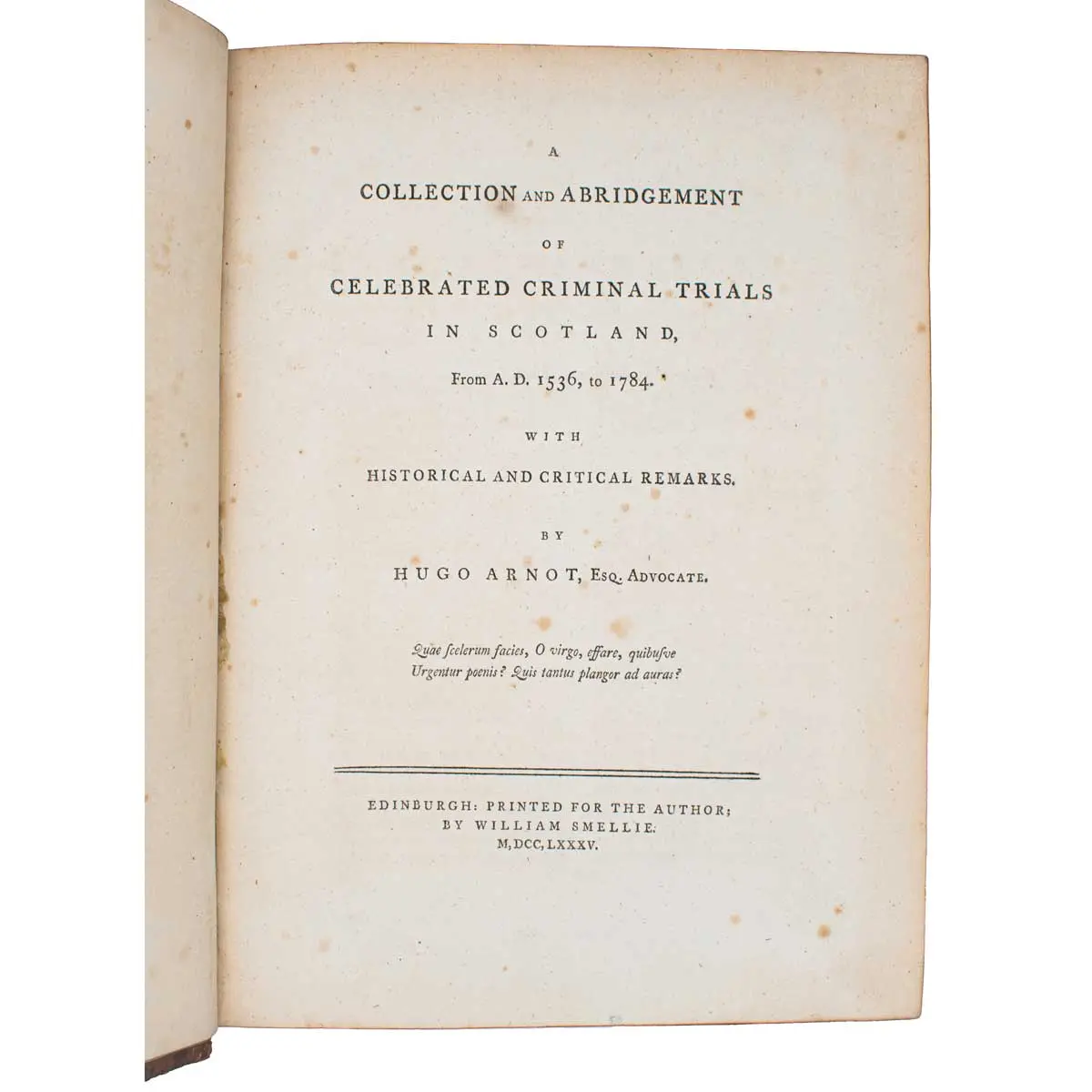
A fine copy of Arnot’s famous work. The book is separated by genre, including sections on treason, murder, piracy, forgery, incest, adultery, blasphemy and witchcraft.
FIRST EDITION, list of subscribers, with additional subscribers omitted leaf, contemporary polished calf, rebacked, original spine relaid, red morocco label, bookplate of Henry George Watson to pastedown, 4to, Edinburgh, for the Author by William Smellie, 1785.
A fine copy of Arnot’s famous work. The book is separated by genre, including sections on treason, murder, piracy, forgery, incest, adultery, blasphemy and witchcraft.
In a foreword in the chapter on witchcraft, Arnot explains that the law passed, which made the “practising of sorcery, or consulting with witches” a capital punishment, did not come from a belief in witchcraft, but to punish those who believed in supernatural powers for impiety and blasphemy. He goes on to describe a number of witch trials, including Alison Pearson, who was convicted of practising sorcery, and of invoking the Devil.
Others include; Euphan McCalzeane, who was accused of treason for conspiring the King’s death, particularly by raising storms to obstruct his return from Denmark; Margaret Wallace, accused of inflicting and curing diseases by “inchantment”; Alexander Hamilton, who confessed to meeting the Devil, became the Devil’s servant and was given instructions on how to get revenge on his enemies; Isobel Elliot and nine other women, who were executed “for having had carnal copulation with the Devil.”
In his texts, Arnot was sharp and outspoken, which was met with mixed feelings. This work was so popular it was reprinted several times as well as being pirated in Ireland.