Marshall Rare Books
A Cruising Voyage Round the World: First to the South Seas, thence to the East-Indies, and Homewards by the Cape of Good Hope. Begun in 1708, and Finish'd in 1711..Containing a Journal of all the Remarkable Transactions.. An Account of Alexander Selkirk's living alone four years and four months on an island…
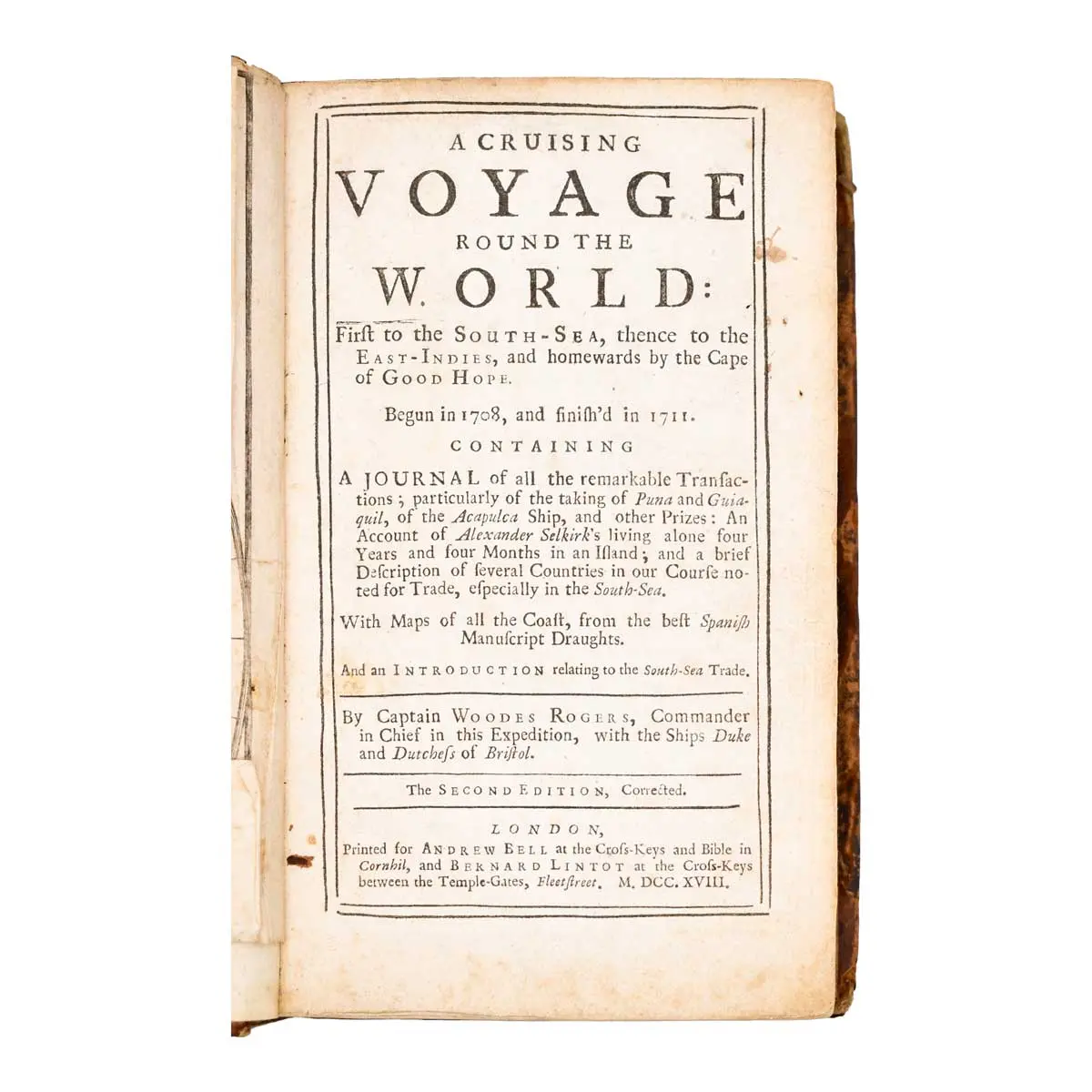
This work is an account of one of the most colourful and swashbuckling voyages written about the buccaneers.
Second Edition
London: Printed for A. Bell and B. Lintot, 1718, 8vo, five folding maps, including a folding map of the world, contemporary panelled calf gilt, rebacked, original spine laid on.
This work is an account of one of the most colourful and swashbuckling voyages written about the buccaneers.
Bristol was England’s second largest port, thriving on the growing trade with the American colonies. William Dampier persuaded the merchant and sea captain Woodes Rogers to join him in a circumnavigation (Dampier’s third) and to pursue the Spanish Treasure Galleons. The war of the Spanish Succession was still under way so Rogers and a prominent Bristol consortium of respected citizens were receptive to Dampier’s plans to plunder from privateering in the Pacific against England’s enemies, the French and the Spanish.
The consortium purchased two ships: the 320 tons, 30 guns Duke and the 260 tons, 26 guns Duchess. Dampier was to be the ‘pilot for the South Seas’. They left Bristol on 2 August 1708 and struck out for the long haul to Brazil via Cape Horn, sighting the coast on 14 November. Re-provisioned they arrived in the Pacific and set course for the Juan Fernandez Islands where they found and rescued Alexander Selkirk, the source for Defoe’s Robinson Crusoe.
After illness, near mutiny and unrest from unruly crews, the privateers captured the large ship Havre de Grace, attacked and plundered the Spanish stronghold of Guayaquil in Ecuador. There was bitter arguments over the distribution of plunder but Rogers dealt severely with the ringleaders and kept the rest of the crew in check. Their greatest prize was the capture of the Manila Treasure Ship – the galleon Nuestra Senora de la Encarnacion Disengano. During this engagement Rogers was hit on the jaw by musket shot, and had to wait until they made the long voyage to Batavia to have it properly attended by a doctor.
On October 1711, the battered little squadron sailed up the Thames to an enthusiastic reception. They brought back nearly £150,000 from the Manila galleon, and even after legal fees, customs dues and payment to the East India Company there was still a fortune left.
Dampier had fulfilled his ambition of seizing a Spanish treasure ship, although he had difficulty acquiring his share of the spoils. Rogers went on to become Governor of the Bahamas and was instrumental in controlling piracy on the islands. He was also involved in the engagement and death of Edward Teach (Blackbeard).
An important narrative and one of the best known English buccaneering narratives.
Hill 1479; Howes R421; Cox I, 46; Sabin 72753; Cowan, p.194; Diana & Michael Preston. A Pirate of Exquisite Mind.