Marshall Rare Books
A Dialogue concerning Witches and Witchcraftes. In which is laide open how craftely the Divell deceiveth not onely the Witches but many other and so leadeth them awrie into many great errours.
Frederick North’s Copy of Gifford's Classic Work on Witchcraft
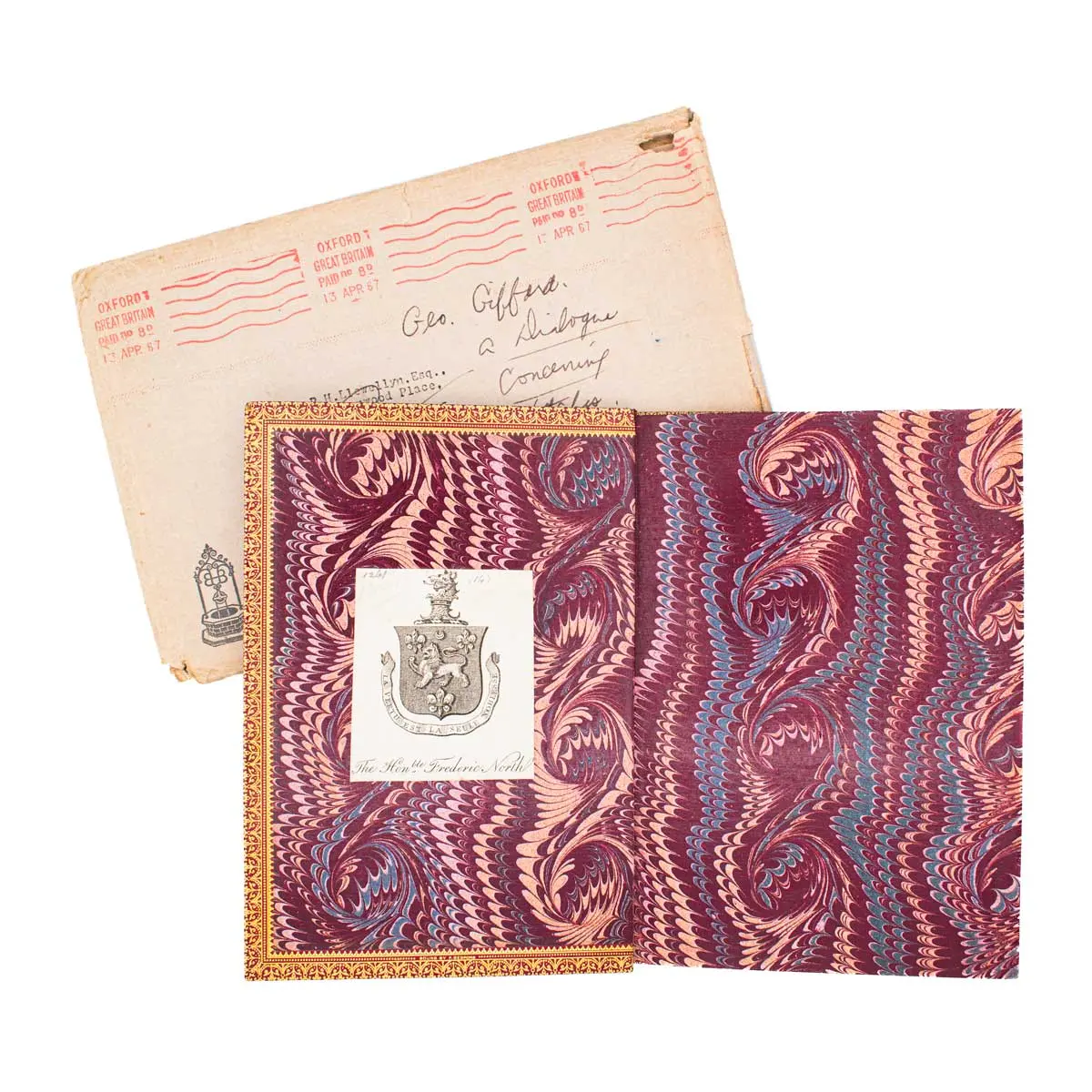
FIRST EDITION, unpaginated (96pp.), from the Library of British Prime Minister Frederick North, with his armorial bookplate on front pastedown, Lord North’s armorial crest illustrated in ink on third blank, two typed letters from previous owner C.D. Irwin of Brookline, Massachusetts, to C.F. Libbie & Co., Booksellers, Boston, and to Cornell University Library, ca. 1920s, laid in, top edge of title-page repaired with top of “A” in manuscript; trimmed close along top edge, old ink pagination faintly present in several top corners; scattered marginalia, later full crimson levant, stamped in gilt, all edges gilt, gilt dentelles, marbled endpapers; by F. Bedford, 8vo, London, Printed by John Windet for Tobie Cooke and Mihil Hart, 1593.
“The Devil hath bewitched your mind with blindness and unbelief, to draw you from God, even to worship himself.”
A rare first edition of Essex Puritan preacher George Gifford’s classic work on witchcraft. Gifford (ca. 1548-1600) was one of the earliest writers to deal with the nature and implications of witchcraft, and this slim text was written for the common Christian believer in a plain language intended to appeal to a wide audience.
Writing from the heart of Witch Country, the noted nonconformist preacher published two works on witchcraft, this being the second, and his major work. Cast in the form of a conversation among Samuel, a superstitious schoolmaster who accepts witchcraft, and Daniel, a cautious doubter, the Dialogue is a somewhat abstruse discussion of delusion. Gifford uses Samuel’s voice to express common English beliefs about witchcraft, particularly that they had power over physical bodies and objects. In contrast, Gifford uses Daniel’s voice to expose his own ideas regarding witches, particularly that while they may exist they have no real power themselves, but are conduits for the work of Satan. He argued that the best defence against witchcraft was not theological or legal, but a spiritual affirmation of God’s power and care.
Gifford attempts to capture the sort of conversation that would have occurred when peasant villagers debated magic and witchcraft with their clerical mentors. The Dialogue opens such a great distance between its participants that it enables him to address the many questions which accurately express popular incomprehension of pastoral aims: how can magical practitioners be evil when they help their clients?; how can they be evil if the means they use are derived from religious sources or inspire a kind of faith?; how can it be evil to resort to them for successful remedies when all others have failed?
There is a strong sense of authenticity about these depictions of Calvinists arguing their way through a barrage of popular objections to the new divinity and its ideals of piety. Throughout the Protestant literature on witchcraft in England, it is on these practices and their moral and cultural significance that demonologists concentrate their attention. Written at a moment of surging witch-hunts and trials in England, especially in Gifford’s Essex, this work sought to guide the reader toward the truth of the Puritan gospel.
The work is also taken up very largely with the methods of what Gifford revealingly called the “other sort of Witches, whom the people call cunning men and wise women” – that is, the unofficial agencies for healing, divination, detection and counter-witchcraft. Gifford’s position is that the Devil is so powerful that he does not need old women to work his evil. The danger is that deluded Christians accept the old women’s claims at face value, and ascribe undue power to Satan by turning to ‘White’ witches for help. The Witch is only the accessory to the Devil.
Gifford asserts the Bible is correct in demanding that witches be put to death simply because they are “the blasphemous enemies of God”. Gifford demanded greater severity in the laws. He concludes with cautioning the juries to use special care and wisdom. A witch’s confession can not be relied on because the main source of information is the devil, nor is the common report of sorcery reliable. “Many guiltless are upon other men’s oaths condemned to death, and much innocent blood is shed”. It was precisely because the 1563 statute dealt mainly with the actual harms wrought by witches that it missed the heinousness of their demonic allegiance, an omission only partly remedied in the legislation of 1604.
ESTC locates only six worldwide institutions with copies: The British Library; Cambridge University Library; Oxford University, Christ Church; Oxford University, Bodleian Library; Huntington Library; Massachusetts Historical Society. Rare Book Hub yields only this copy’s sale at auction, in 1871.
Frederick North, 2nd Earl of Guilford (1732-92), was a British statesman, 12th Prime Minister of England, from 1770-82, as well as Home Secretary and Chancellor of the Exchequer. Popularly known as Lord North, he led Great Britain through most of the American Revolution, but resigned after their defeat at Yorktown. He is remembered as the “man who lost America.”
Provenance:
Frederick North, Lord North
Henry B. Humphrey, Esq.
Leonard and Company, Boston, The Valuable Library of Henry B. Humphrey, Esq., May 9, 1871, Lot 1261
Frank Sabin
Mr. C.D. Irwin, ca. 1920s
[ESTC S105690; Early Modern European Witchcraft: centres and peripheries, Ankerloo, 1993; The Encyclopedia Of Witchcraft And Demonology, Robbins, 1964]