
 Marshall Rare Books
A Fine Autograph Letter Signed ("George Sievers") to Thomas Tunnard relaying his observations aboard the Belleisle at Trafalgar, 27 October 1805.
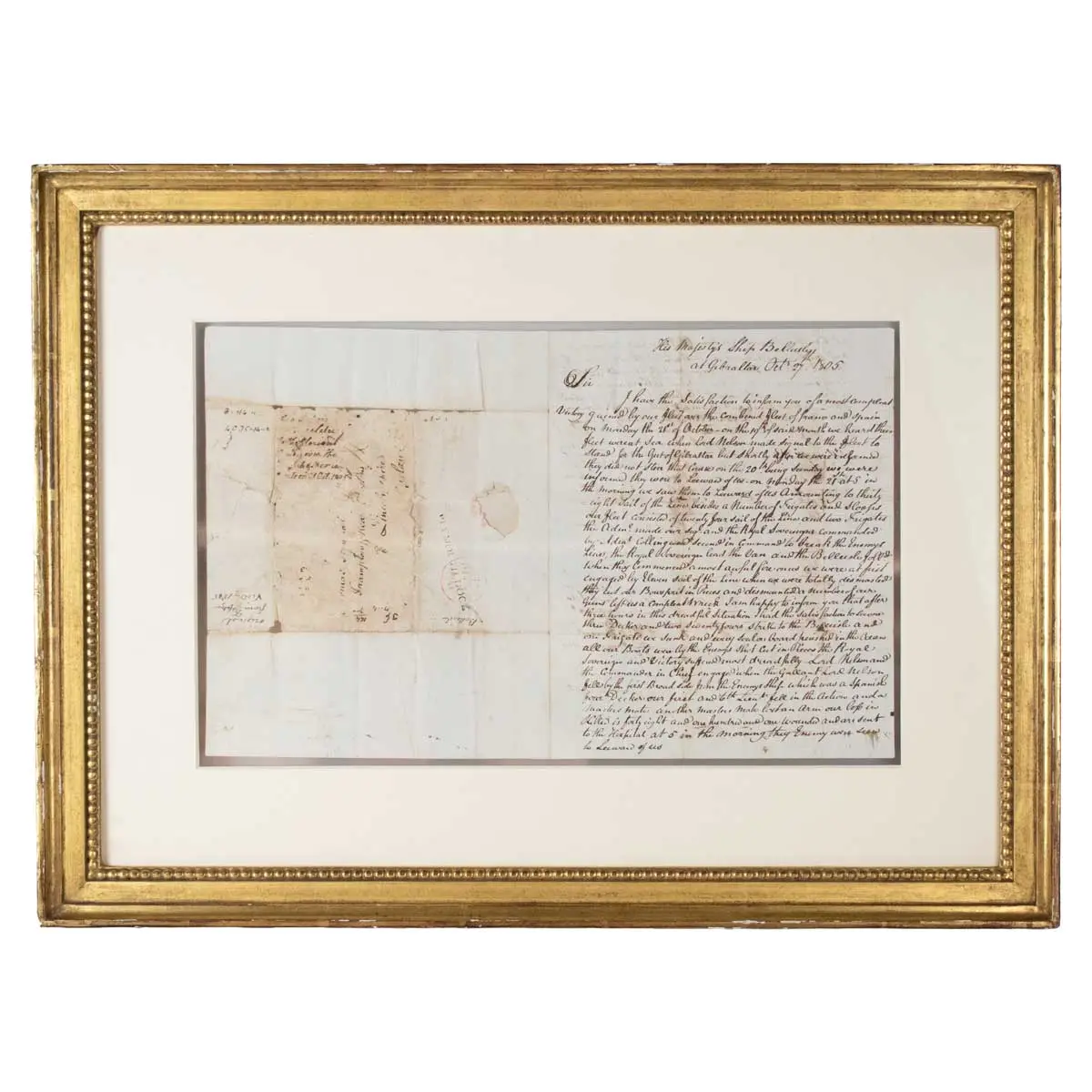
FIRST-HAND ACCOUNT OF THE BATTLE OF TRAFALGAR, INCLUDING A CONTEMPORARY ACCOUNT OF THE DEATH OF LORD NELSON.
Autograph letter from George Sievers to Thomas Tunnard; 2 pp, bifolium (229 x 185 mm), written on recto and verso of first leaf, with integral address leaf, ‘His Majesty’s Ship Belleisle at Gibraltar’, 27 October 1805, small splits in folds without loss of text, address slightly faded.
A long, detailed letter providing a first-hand account of the fighting at Trafalgar, in particular on the Belleisle, which was dismasted early in the fight. Importantly, the letter also offers great contemporary detail on the Death of Lord Admiral Nelson.
AN IMPORTANT FIRST-HAND ACCOUNT OF THE BATTLE OF TRAFALGAR.
‘I have the satisfaction to inform you of a most compleat victory gained by our Fleet over the combined fleet of France and Spain on Monday the 21st of October … When they commenced a most awful fire on us we were at first engaged by Eleven sail of the Line when we were totally dismasted they cut our Bowsprit in Pieces and dismounted a number of our Guns [and] left us a compleat wreck. I am happy to inform you that after three hours in this dreadful situation I had the satisfaction to see one three Decker and two seventy fours strike to the Belleisle and one Frigate we sunk and every soul on board perished in the Ocean All our boats were by the Enemy’s shot cut in Pieces, the Royal Sovereign and Victory suffered must dreadfully … the Gallant Lord Nelson fell by the first Broadside from the Enemy’s ship which was a Spanish four Decker … The French Adm[ira]l Villeneuve is now a Prisoner on board the Mars’.
Sievers, who had been on the Marlborough at the battle of the Glorious First of June in 1794 (‘Lord Howe’s action of the first of June was but a fool to this’), describes the shot which killed Nelson as coming from a Spanish ship. The Naval Chronicle published a corrected account of this widely circulated report early in 1806, saying that it had at first been understood that Nelson received the fatal shot from the main round-top of the Santissima Trinidad, but information since received from Mr Beatty (Dr William Beatty, the surgeon on the Victory) and Mr Bourke (the purser) indicated that the ball had come from the Redoutable.
The Belleisle took part in the pursuit of the French to the West Indies and back. At Trafalgar she followed immediately after the Royal Sovereign (Collingwood’s ship) in the Lee Division and was totally dismasted. In the action two of her lieutenants and thirty-one men were killed and ninety-three wounded. She then narrowly escaped being wrecked off Cape Trafalgar and Tarifa. Her captain, William Hargood, a protégé of the Duke of Clarence (later King William IV) was himself wounded. As master at Arms Sievers would have been a junior lieutenant, and responsible for teaching the use of small arms, supervising prisoners and the enforcement of rules on board. He was a tenant on the Tunnard estate in Lincolnshire.
Provenance: Thomas Tunnard (Descendants)