
 Marshall Rare Books
A fine Pair of Terrestrial and Celestial Library Globes
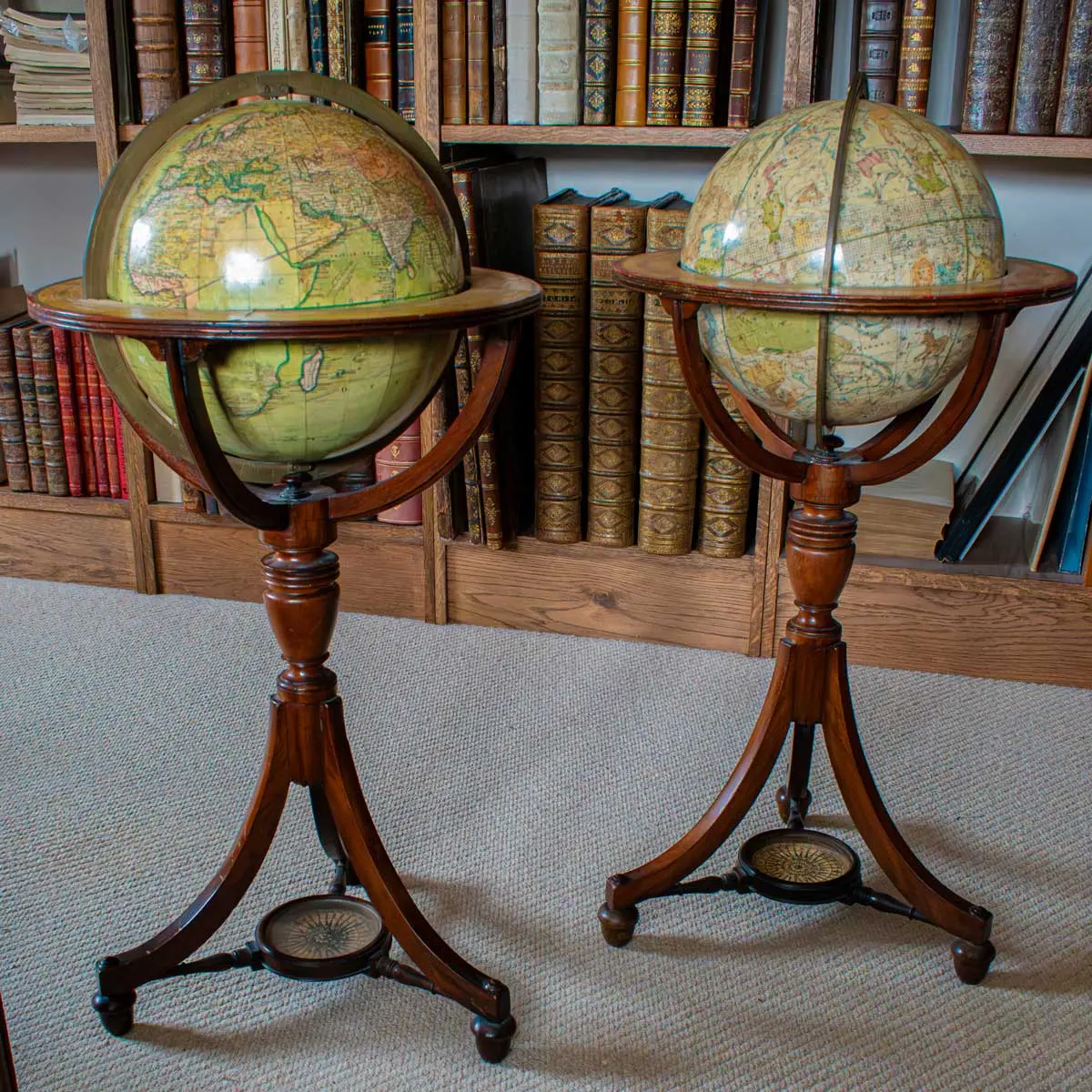
BARDIN’S LIBRARY GLOBES
A fine pair of 12 inch early 19th Century Terrestrial and Celestial globes by T.M. Bardin,Salisbury Square, London, and dedicated to Sir Joseph Banks, Bar, KB, President of the Royal Society.
Each on a mahogany stand with a turned column to splayed down swept legs united by a stretcher and containing a compass.
The terrestrial globe is calibrated full brass meridian, within a circular horizon band with engraved paper calendar and zodiac. As the cartouche notes, the cartography originated with the globe maker James Ferguson (1710-76) as modified by Gabriel Wright (d. 1803-04) in 1782. Wright updated the cartography and added the routes of Captain James Cook’s voyages of exploration between 1769 and 1779, along with the location where Cook was killed in Hawaii. Admiral Anson’s voyage around the world in the 1740s is also indicated.
The celestial globe is comprised of two sets of twelve hand-coloured engraved half gores laid to the ecliptic poles, with the axis through the celestial poles, the South Pole with printed hour dial, the equatorial graduated in degrees and hours, the colours graduated in degrees, the ecliptic graduated in days of the houses of the zodiac. The horizon band has an engraved paper calendar and zodiac, graduated in degrees, with wind directions. The globe has Ptolemaic, non-Ptolemaic, and southern constellations elegantly depicted as figures of animals, mythological characters, and scientific instruments, in a wide range of colours against a cream-coloured background. The stars are shown to six orders of magnitude with s symbol for nebulae; most are labelled with Greek letters or numerals.
The Bardin family was among the greatest globe makers in London from the late eighteenth through the early nineteenth century. Thomas Marriot Bardin (1768-1819) joined his father William Bardin as an apprentice in 1783. William Bardin started the business with Gabriel Write in the early 1780s, their first globes of 9 and 12 in. diameters are dated 1st January 1782. In 1794 Bardin moved his business from Hind Court to 16 Salisbury Square, on the opposite side of Fleet Street, leaving his collaborator behind.
After becoming a freeman in 1790, Thomas Marriott joined his father’s firm in the partnership of W & T. M. Bardin. Around 1798, the globe production of the Bardin firm was extended to include a pair of 18 in. globes. The skill required for the production of these 12- and 18-inch globes was much admired in contemporary accounts. Bardin New British Globes were frequently marketed by the scientific instrument makers and dealers W. & S. Jones. A few years later, another pair of 12 in. globes appeared, now carrying the name of T. M. Bardin only, since the elder Bardin had died in 1798. The globe production of Thomas Marriott Bardin was taken over by Elizabeth Marriott Bardin (1799-1851), his daughter, in 1820, a year after her father’s death. The celestial globe has an undated cartouche signed by S.S. Etkins, Elizabeth’s husband.
The mahogany stands have been refurbished and the compass at the base of the tripod of each stand is later.