
 Marshall Rare Books
A French Polished Specimens Cabinet with Brass Handle Engraved ALFRED RUSSEL WALLACE No.3
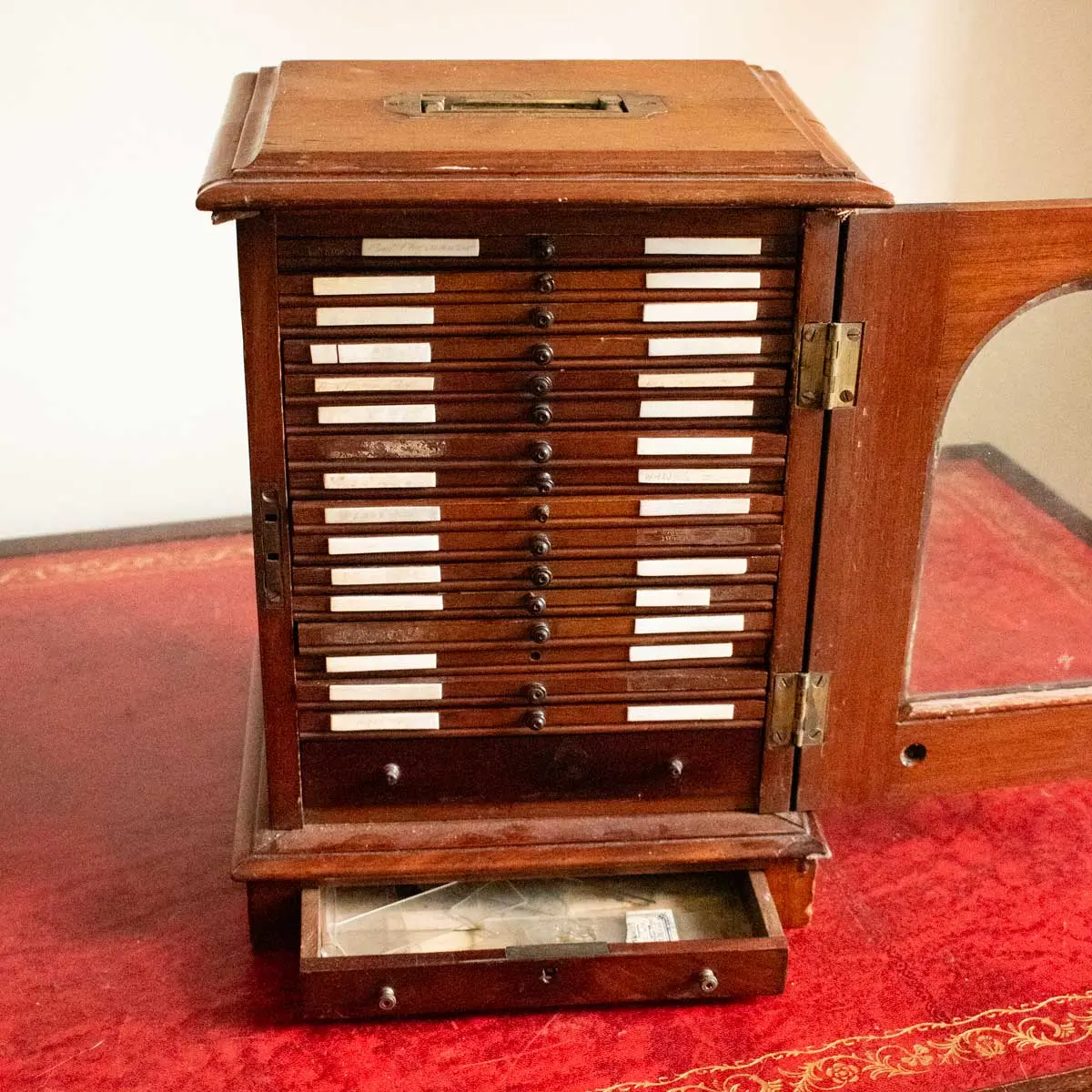
ALFRED RUSSEL WALLACE SPECIMENS CABINET
English, c 1870-80, 33 cm Tall, Glazed Door, Plinth Base with Large Accessories Drawer, 16 Sliding Specimens Drawers and One Deep Drawer with ivory decoration.
Extremely scarce cabinet with contemporary engraved signature of Wallace.
Although there are no natural history samples it is likely this cabinet was used to display beetles and similar creatures.
There does not seem to be any records of Wallace’s library bookcases or cabinets only the occasional photograph illustrating his study. One photograph illustrates the reverse of a small cabinet on his desk that could be this one.
Alfred Russel Wallace (1823-1913) was a man of many talents – an explorer, collector, naturalist, geographer, anthropologist and political commentator.
Most famously, he had the revolutionary idea of evolution by natural selection entirely independently of Charles Darwin.
Wallace was born in 1823 in Usk – now in Monmouthshire. After leaving school he worked at his brother’s surveying firm until he was hired as a teacher in Leicester in 1844. That year he formed a friendship with a local man and keen naturalist, Henry Walter Bates.
Bates introduced Wallace to the methods and delights of collecting beetles. Four years later the pair headed for the Amazon, having been inspired by stories of discovery in the New World and Oceania.
Wallace and Bates arrived at the mouth of the Amazon in Brazil in 1848. Their aim was to investigate the origin of species. They financed the trip by collecting specimens and selling them.
After a short time exploring together, the two men split up in order to cover more ground. Wallace went north by river, collecting in areas previously unexplored by European naturalists. He amassed thousands of animal specimens, mostly birds, beetles and butterflies.After more than four years collecting, Wallace sailed back to England, but disaster struck on the high seas. The ship caught fire in the Atlantic and sank, along with virtually all his specimens and field notes. Fortunately, the crew and passengers were rescued by a passing ship.
Wallace began his travels through the Malay Archipelago – now Malaysia and Indonesia – in 1854.
While Indigenous and enslaved peoples’ contributions to natural history have often been overlooked by history, unusually for this time period, Wallace acknowledged his local guide, a Malay teenager named Ali. Wallace wrote about their relationship in his biography, both about their collecting endeavours and how they supported each other. Over a period of eight years, Wallace accumulated an astonishing 125,660 specimens, including more than 5,000 species new to western science.
In 1858, while feverish and confined to his hut on the island of Ternate – now in Indonesia – Wallace had a realisation. He came to understand how species evolved – they changed because the fittest individuals survived and reproduced, passing their advantageous characteristics on to their offspring. He noticed a striking pattern in the distribution of animals around the archipelago. He proposed an imaginary line dividing the region in two parts. Later known as Wallace’s Line, this marked the boundary between the animal life of the Australian region and that of Asia.
Wallace immediately wrote to Charles Darwin.
Darwin had been working on the very same theory for 20 years, but was yet to publish. He sought the advice of his friends, who determined that the ideas of both men would be presented at a meeting of the Linnean Society. Darwin’s masterpiece, The Origin of Species, came out the following year.
From that time on, Darwin overshadowed Wallace and it has usually been his name alone associated with the theory of evolution by natural selection.
Wallace expressed no resentment at this – in fact he was Darwin’s greatest admirer. His role in the matter, and Darwin’s support, ensured his entry to the highest ranks of the scientific establishment.