Marshall Rare Books
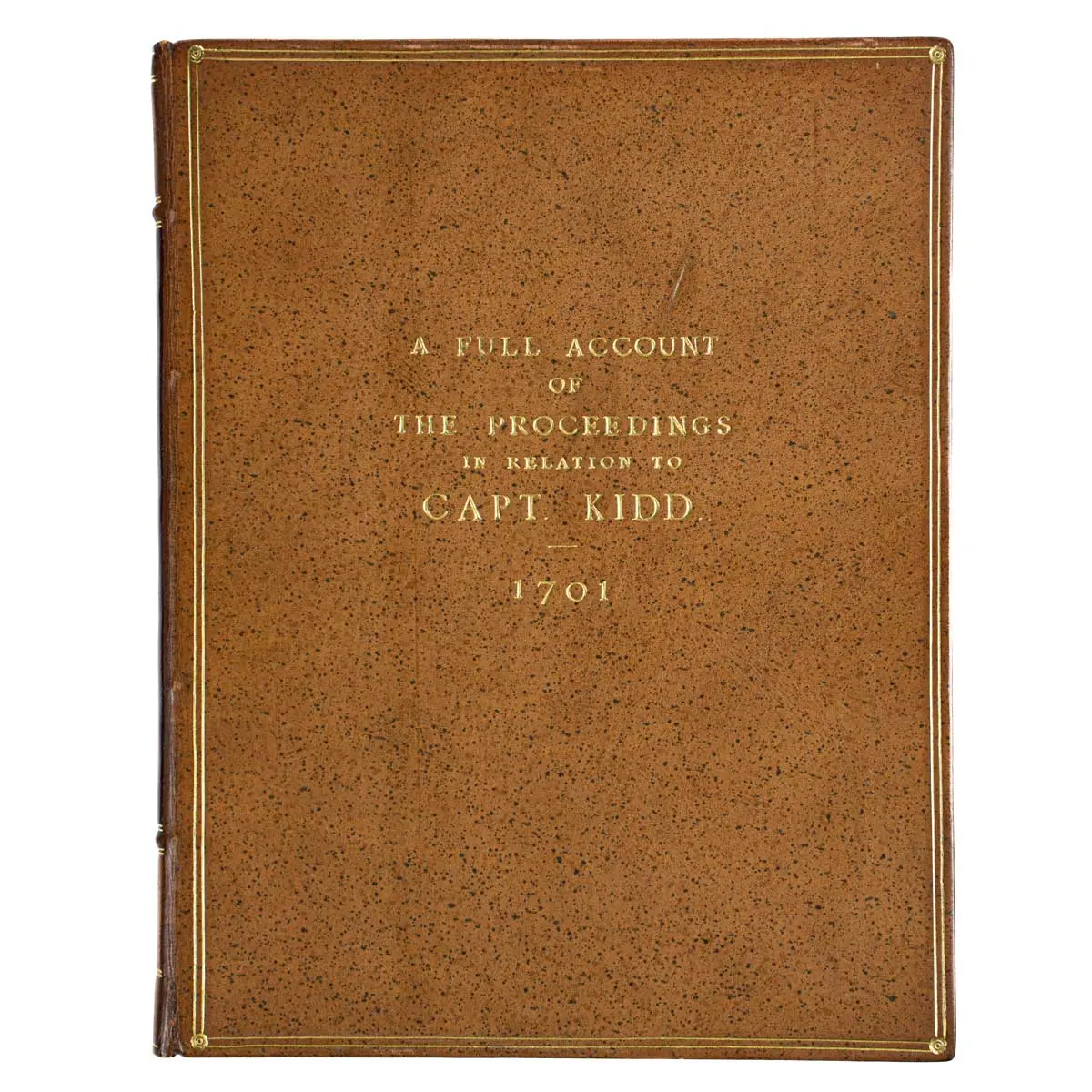
A Full Account of the Proceedings, in relation to Capt. Kidd. In two letters. Written by a person of Quality to a Kinsman of the Earl of Bellomont in Ireland
ONE OF HISTORY'S MOST FAMOUS AND FASCINATING PIRATES
FIRST EDITION, [8], 51 leaves, a fine later binding of mottled calf gilt, fitted case, 4to (205 x 160mm), London: Printed and sold by the Booksellers of London and Westminster, 1701.
Born in Scotland in 1645, William Kidd started out as a privateer, hired by a consortium of English aristocracy to attack foreign ships. When his crew insisted on attacking the Quadegh Merchant, a large Armenian ship laden with treasures on the Indian Ocean, Kidd found himself on the wrong side of the British government. He was hanged in London in 1701, as a warning to other pirates. Legend persists about Captain Kidd and the treasure some believe he buried in the Caribbean, and he remains one of history’s most famous and fascinating pirates.
In 1695, Kidd returned to England to receive a royal commission as a privateer. There, he befriended Lord Bellomont, who had been selected to take over the governorship of New York. Under Bellomont’s direction and financial backing, Kidd was hired to make his way toward the West Indies with a crew and attack French ships and pirate vessels. The confiscated loot would be divided between Kidd, his men and his backers. In May 1696, Kidd set sail on the 34-gun vessel Adventure Galley. Struggles soon enveloped the enterprise. A number of Kidd’s men died of illness, and when Kidd found few French ships to attack, he faced mounting pressure from a weary and frustrated crew.
In early 1697, Kidd steered his crew toward Madagascar, a stopping point for many pirates who made their living on the Indian Ocean. Small successes came in the form of attacks on various Indian ships. Then, in January 1698, Kidd’s luck seemingly changed when he caught sight of the Quedagh Merchant rounding the tip of India.The Quedagh Merchant was no ordinary vessel. A 500-ton Armenian ship, it carried goods—a treasure trove of gold, silk, spices, and other riches—that were owned in part by a minister at the court of the Indian Grand Moghul. The minister had powerful connections, and when news about Kidd’s attack reached him he complained to the East India Company, the large and influential English trading firm. Coupled with many governments’ shifting perceptions of piracy, Kidd was quickly cast as a wanted criminal.Having abandoned the rotting Adventure Galley for the Quedagh Merchant, Kidd set sail on his new ship for the Caribbean and eventually made his way to a smaller ship in Boston, where he was arrested and eventually shipped back to England.
On May 8, 1701, Kidd went on a trial. His crimes and previously close connections with the English elite and government officials caused a sensation. Kidd had expected Lord Bellomont and others to defend him, but he was to be disappointed with his backers, who refused to help him and were more concerned about their reputations.
Kidd was found guilty and hanged on May 23, 1701. To serve as a warning to other pirates, his body was hung in a cage and left to rot for all to see along the River Thames.
Provenance: Greenhill Collection.
Church 797, Howes M677, Sabin 37703