Marshall Rare Books
A Monograph of the Meropidae, or Family of the Bee-Eaters.
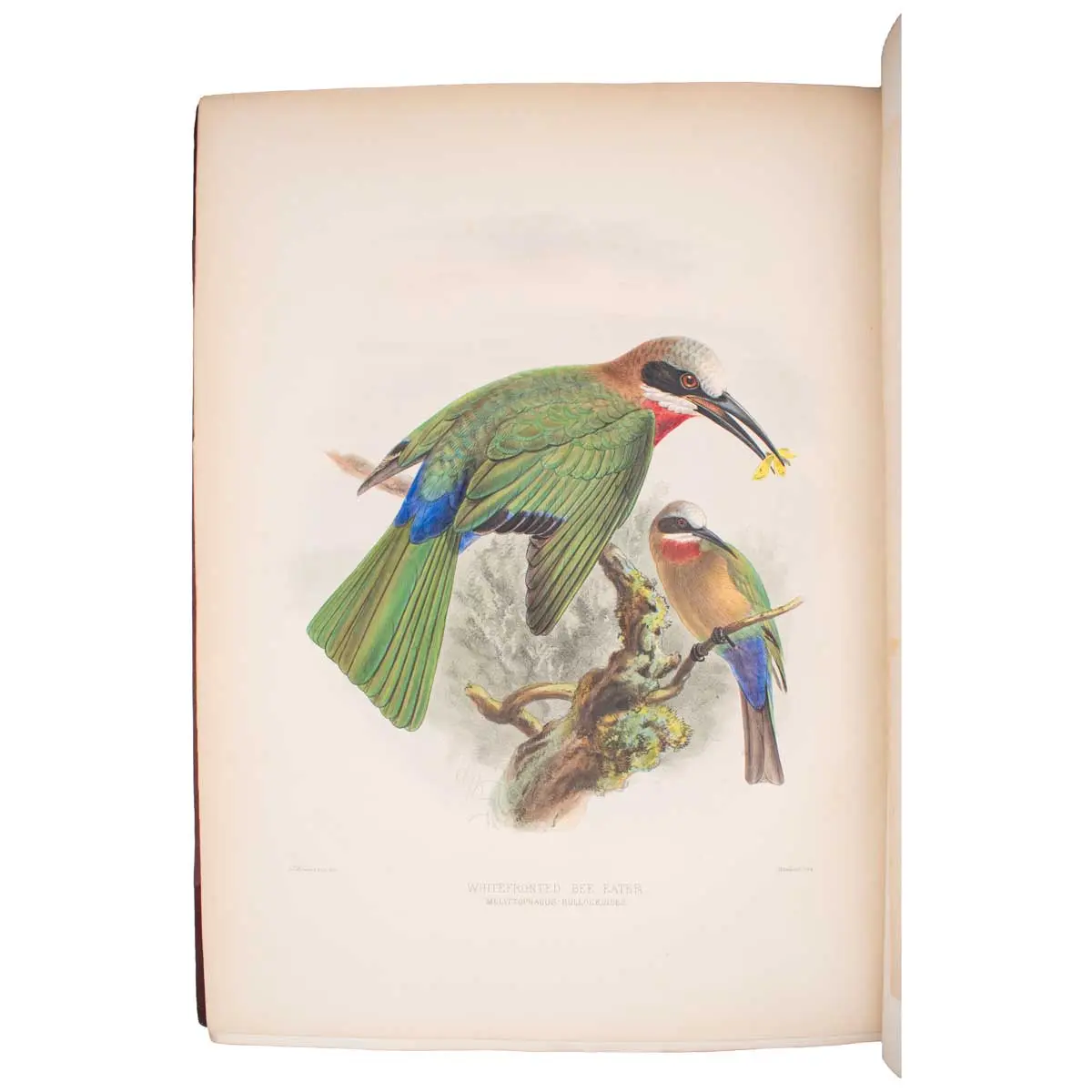
An important monograph, ‘The Meropidae’ is one of three major monographs published by Dresser.The others ‘History of the Birds of Europe 1871-96’ still the largest and most complete work on this subject,and ‘A Monograph of the Coraciidae 1893’.All have illustrations by Keulemans.
London, For the Author, 1884-1886.
34 fine hand-coloured plates, a little foxing contemporary half morocco gilt, hinges repaired, large folio (470 x 390mm).
The Meropidae was published by the author in five parts between 1884 and 1886.The descriptive text of 144pp by Dresser also included introductory notes by Frank E.Beddard mainly on the anatomy of the species.
An important monograph, ‘The Meropidae’ is one of three major monographs published by Dresser.The others ‘History of the Birds of Europe 1871-96’ still the largest and most complete work on this subject,and ‘A Monograph of the Coraciidae 1893’.All have illustrations by Keulemans.
Dresser was also the author of over 100 scientific papers on birds, mostly concerned with geographical distribution and new species. His Manual of Palaearctic Birds (1902) was an important contribution to the delimitation of the ranges of Palaearctic birds.
The artist of these fine watercolours Johannes Gerardus Keulemans (1842-1912) began his career as a taxidermist providing stuffed birds to the State Museum of Natural History at Leiden.The Director of that Museum encouraged Keulemans to pursue his love of natural history,where he obtained a scientific appointment after an expedition to West Africa in 1865-66.His accomplishments in illustration came to the notice of Richard Bowdler Sharpe,later a Director of the British Museum,who encouraged him to move to England.He quickly achieved wide recognition and established himself as the most popular bird artist of the late Victorian period.
He regularly provided illustrations for The Ibisand The Proceedings of the Zoological Society. He illustrated many important bird books as well as those by Dresser, including Buller’s A History of the Birds of New Zealand (1873),Shelley’s Monograph of the Sun-Birds (1876-80),William Vincen Legge’s Birds of Ceylon (1880), Daniel Giraud Elliot’s Monograph of the Hornbills (1887-1892), Richard Bowdler Sharpe’s Monograph on Kingfishers (1868-1871), Henry Seebohm’s Monograph on Thrushes (1902), Osbert Salvin’s Biologia Centrali-Americana (1879-1904).
A leading figure in ornithological circles Henry Eeles Dresser was elected as a Member of the British Ornithologist’s Union in 1865 and served as its secretary from 1882 to 1888. He was also a member and fellow of the Linneanand Zoological Societies of London and an honorary fellow of the American Ornithologist’s Union. He was a close friend of Professor Alfred Newton, Baron Lilford and of Sir Alfred Russell Wallace and he knew all of the leading ornithologists of the day. He was particularly well-known to European, American and Russian ornithologists. He worked with Alfred Newton on the development of a close time for British birds when they could not be hunted during the 1860s, an early part of the development of the bird conservation movement. In spite of his prominence as an ornithologist, this activity had to come second to his business which, from 1870 until 1910, was in the iron business, with premises at 110 Cannon Street in The City.
Dresser left England in 1912 in order to live in Cannes for the benefit of his health; he died inMonte Carlo. His collection of birds had been in the Manchester Museum since 1899 and was purchased for the museum by JP Thomasson (a Bolton businessman). Dresser’s egg collection was acquired by the museum in 1912. The museum also contains some of Dresser’s correspondence and diaries.
The Bee-Eaters are a group of near passerine birds in the family Meropidae. Most species are found in Africa but others occur in southern Europe, Madagascar, Australia and New Guinea. They are characterised by richly coloured plumage, slender bodies and usually elongated central tail feathers. All are colourful and have long downturned bills and pointed wings, which give them a swallow-like appearance when seen from afar.
Books you may also like
A Monograph of the Nectariniidae, or Family of Sun-Birds.
A Monograph of the Nectariniidae, or Family of Sun-Birds.
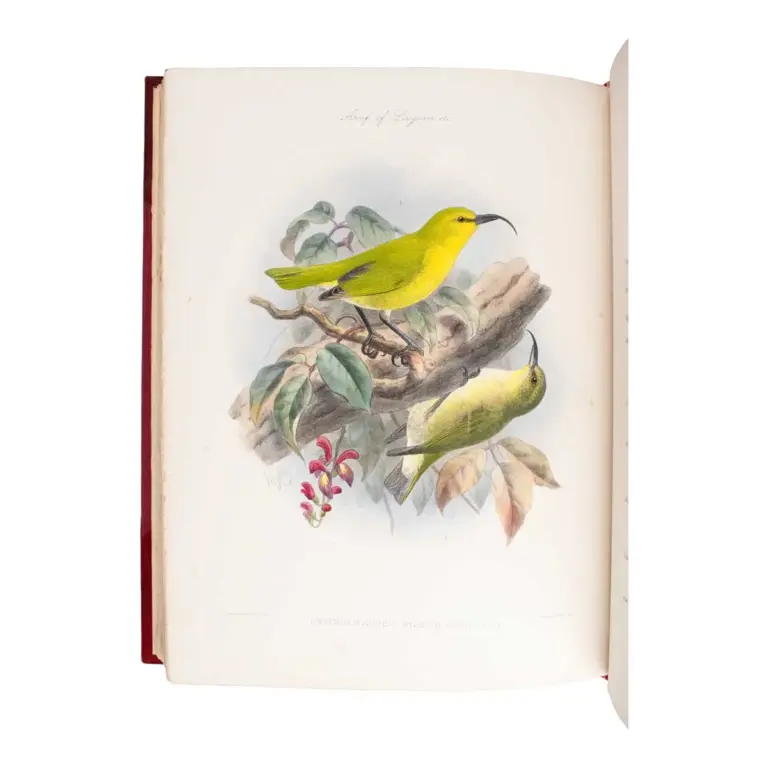
The Avifauna of Laysan and the Neighbouring Islands: with a Complete History to Date of the Birds of the Hawaiian Possessions.
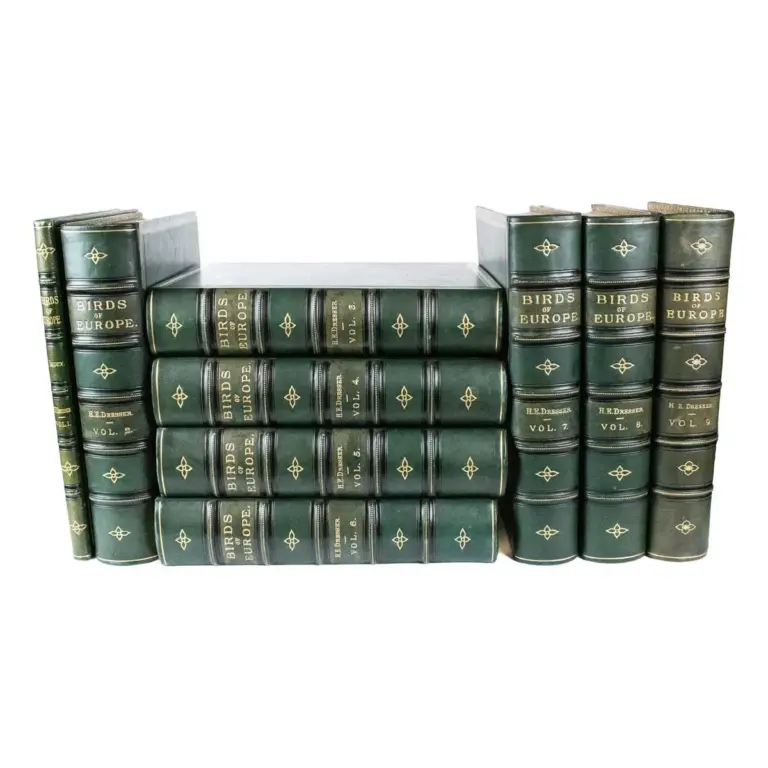
A History of the Birds of Europe, including all the species inhabiting the western Palaearctic Regions.
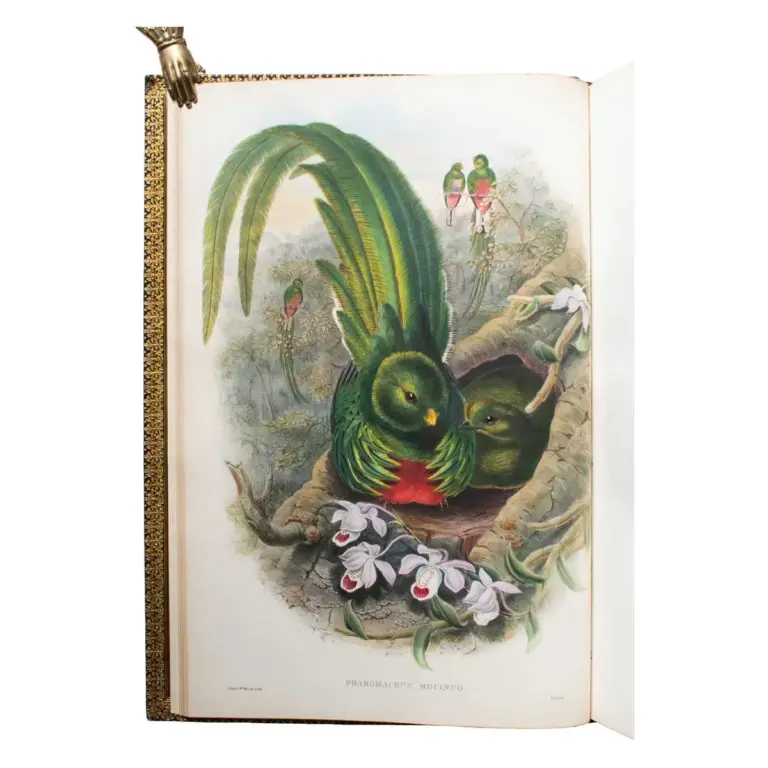
A Monograph of the Trogonidae, or Family of Trogons.
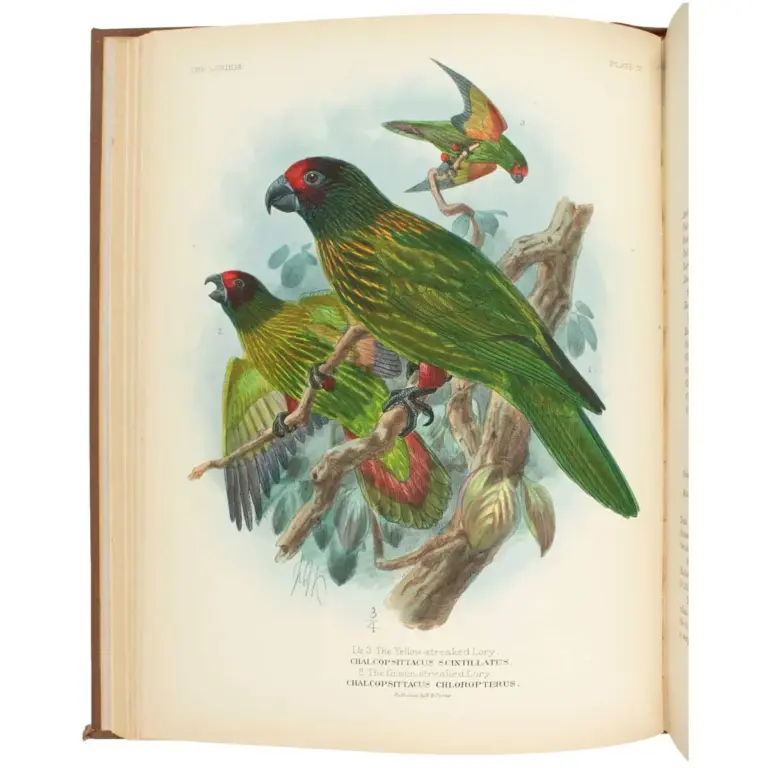
A Monograph of the Lories, or Brush-Tongued Parrots, composing the family Loriidae.