
 Marshall Rare Books
A Monograph of the Turdidae, or Family of Thrushes
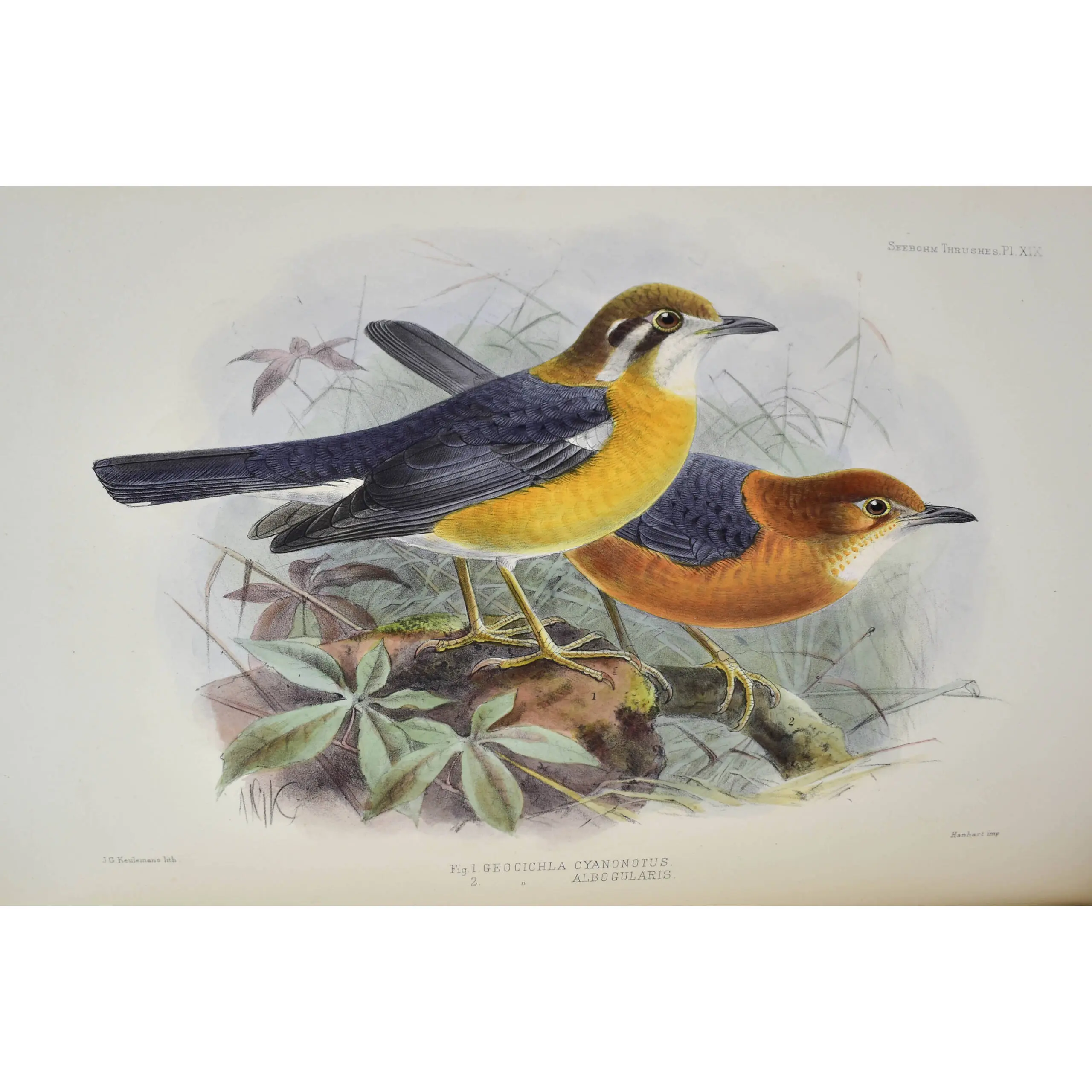
London, Henry Sotheran, [1898-]1902], 2 vols, First edition, large 4to (390 x 300mm), edited by R. Bowdler Sharpe, photogravure portrait of Seebohm, 149 hand-coloured lithographed plates by and after J.G. Keulemans, Contemporary red half morocco gilt, t.e.g., a Large Uncut Copy.
London, Henry Sotheran, [1898-]1902], 2 vols, First edition, large 4to (390 x 300mm), edited by R. Bowdler Sharpe, photogravure portrait of Seebohm, 149 hand-coloured lithographed plates by and after J.G. Keulemans, Contemporary red half morocco gilt, t.e.g., a Large Uncut Copy.
A DELICATELY ILLUSTRATED WORK ON THRUSHES. “The writing of the manuscript had been commenced by Seebohm, and nearly all the coloured plates were ready at his death, although more plates had to be added later. The text dealing with individual forms gives their synonymies, brief diagnosis in Latin, descriptions with other notes; and, most often, information about the geographical distribution and the habits of the birds” (Anker).
“A thorough monograph of a limited section of the family Turdidae… several new species are described. The hand-coloured plates by Keulemans are excellent” (Zimmer).
Henry Seebohm became interested in natural history at school and continued to spend his spare time studying birds on his journeys. He travelled widely visiting Greece, Scandinavia, Turkey, and South Africa. His expeditions to the Yenisey tundra of Siberia were described in his two books, Siberia in Europe (1880) and Siberia in Asia (1882), which were combined in the posthumous publication The Birds of Siberia (1901). His expeditions included the lower Pechora River in 1875 along with John Alexander Harvie-Brown as well as a visit to Heligoland at the home of Heinrich Gätke. In 1877 he joined Joseph Wiggins to Siberia.
He was one of the first European ornithologists to accept the American trinomial system to classify sub-species.
Seebohm’s other publications included A History of British Birds (1883), The Geographical Distribution of the family Charadriidae (1887), The Birds of the Japanese Empire (1890).
He bequeathed his collection of bird-skins to the British Museum. The collection which was received in 1896 consisted of nearly 17,000 specimens. A number of birds were named after Seebohm, including the grey emutail (Dromaeocercus seebohmi) by Bowdler Sharpe. A portrait of Seebohm in oil by Hugh Ford Crighton is in the collection of the Sheffield Museums.
Nissen IVB 852; Fine Bird Boooks, p.106; Anker 458; Wood, p.561; Zimmer, p.570]