
 Marshall Rare Books
A Plan for attacking the Spanish Settlements in the West Indies in the North and South seas in Case of War
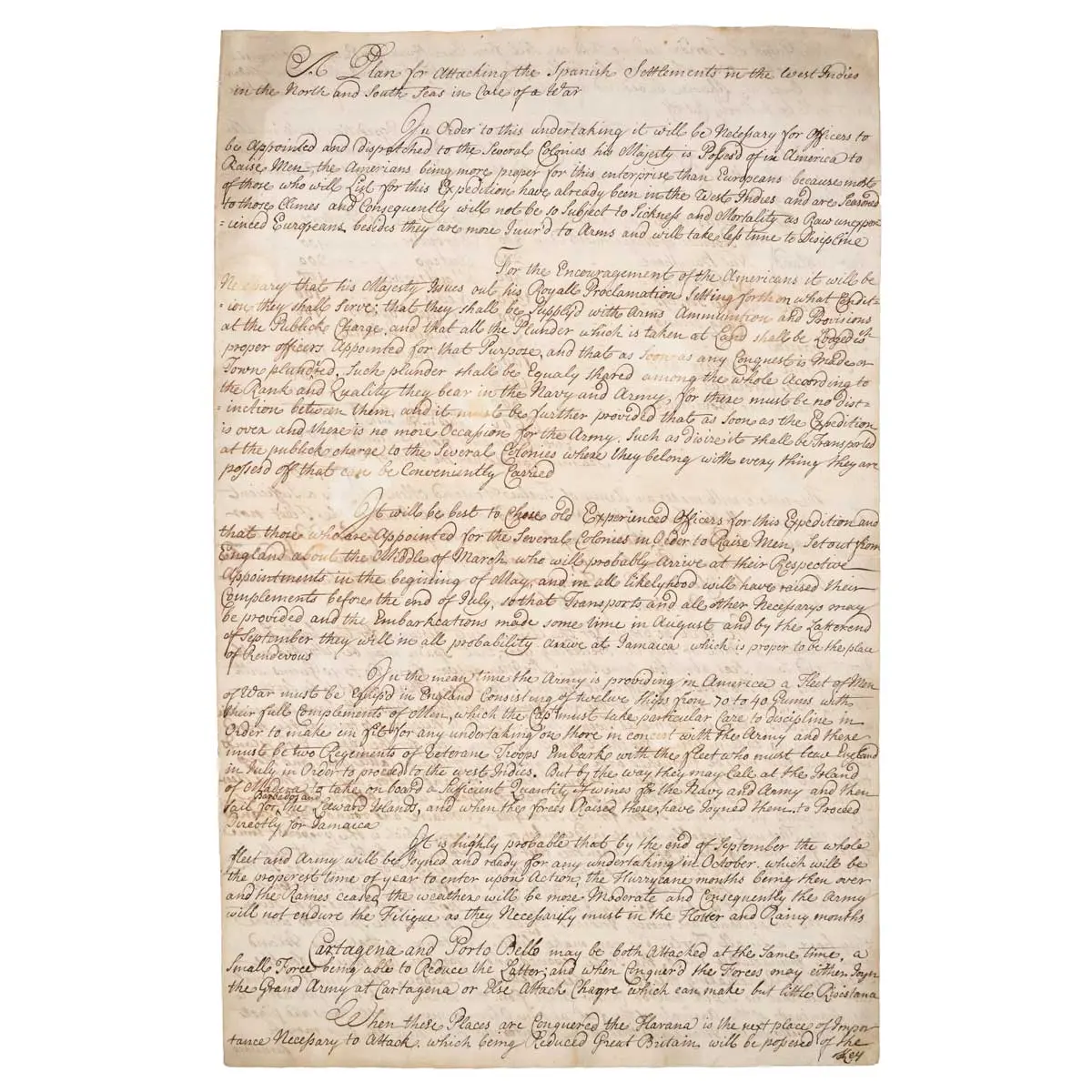
Manuscript, [4pp.], 230 x 370mm, c.1745
AN IMPORTANT NAVAL DOCUMENT CONCERNING THE WEST INDIES, written in a neat hand, comprising detailed plans for raising sufficient militia and also methods of and places to attack “In order to this undertaking it will be necessary for Officers to be appointed and dispatched to the several Colonies his Majesty is Posses’d of in America to raise men, the Americans being more proper for this enterprise than Europeans because most of those who will List for this Expedition have already been in the West Indies and are seasoned to these climes and consequently will not be so subject to sickness and mortality as raw unexperienced Europeans, besides they are more imur’d to arms and will take less time to discipline.”
Going on to suggest the terms which should be agreed with the Americans in order to encourage them, such has the ammunition and provisions coming from the public funds, they will be brought back at the end of the war, and most importantly “…as soon as any conquest is made or Towne plundered, such plunder shall be equally shared among the whole according to the Rank and Quality they bear in the Navy…” . The men appointed should be “old Experienced Officers[…] who are appointed for the Several Colonies in Order to Raise Men.”
A timeline for the preparations is laid out, with considerations made for seasonal weather, with a fleet of Man of War arriving in Jamaica by the end of September so that “the whole fleet and army will be joyned and ready for any undertaking in October. Which will be the properest time of year to enter upon Action, the Hurrycane months being then over…”
Once preparations and recruitment are concluded, the plan of attack is revealed. “Cartogena and Porto Bello may be both attacked at the same time, a Small Force being able to Reduce the Latter… When these places are Conquered the Havana is the next place of importance necessary to attack…Vera Cruze may likewise be reduced and thereby the whole commerce of Spain to those parts will be intirely cut off“, the manuscript provides a breakdown of the 12000 troops required with the quotas of men to be raised in the several Colonies including “New England – The Province of Massechusets Bay 800, New Hampshire 200, Road Island 500; New York and the Jerseys 1500, Long Island 300; Pensilvania 800; Viginia and Maryland 1000; Both the Carolines 1000; Bermuda and Providence 500; Bardados 400; Antego 200; Montserate 100; Nevis 100; St Christophers 100; Virgin Islands 100; Jamaica 1500… two regements from England 1000; seamen landed from the Men of War 2000 …”, as well as detailed plans for securing supplies and ammunitions “…when the fleet arrives in the South Sea it will be necessary to stop at the Island of Chiloe which lyes upon the Coast of Chili … which is stored with plenty of Cattle, Corn and fruits…”.
Following this, the Navy will sail for Lima, “It will be proper to possess all the avenues as soon as possible in order to prevent the Inhabitants from Escaping into the Country with their Treasure. Two thousand men soldiers and seamen are more than sufficient to Conquer this City…being the capital of Peru great part of the treasure of that Kingdom is laid up there.”, dedicating almost an entire page to the riches to be gained from conquering the Spanish in South America. “There would be also great Riches gained by plundering the sea Port Towns in the Kingdoms of Mexico, Peru and Chili…”. Continuing “When Lima is Taken and Plundered the fleet may proceed to the Northward and Plunder all the Towns to Panama… from thence go to the coast of Mexico, and make themselves Masters of Acapulco…” The plans for defeating the Spanish continue to the Philippines and the East Indies. The final paragraph reads optimistically “There is no great reason to doubt but these Expeditions may meet with the desired success and if such is the Case the war with Spain will soon be at an end…”.
The Anglo-Spanish War of 1727–1729 between Great Britain and Spain consisted of a failed Spanish attempt to capture Gibraltar and an unsuccessful British blockade of Porto Bello. It concluded with a truce and final peace following the Treaty of Seville.
Provenance: Townshend Heirlooms: Historical Papers (of Raynham Hall, Fakenham), lot 30.
Sotheby, Wilkinson & Hodge: London, Catalogue of valuable printed books, autograph letters, and historical documents: comprising the Townshend papers, forming part of the Townshend heirlooms (sold by order of the court), Monday, July 14-16th, 1924.