Marshall Rare Books
A 'Tavolette' Painted and Gilded Folio Panel Binding, imitating a 15th Century Sienese Book Cover featuring the Madonna and Child
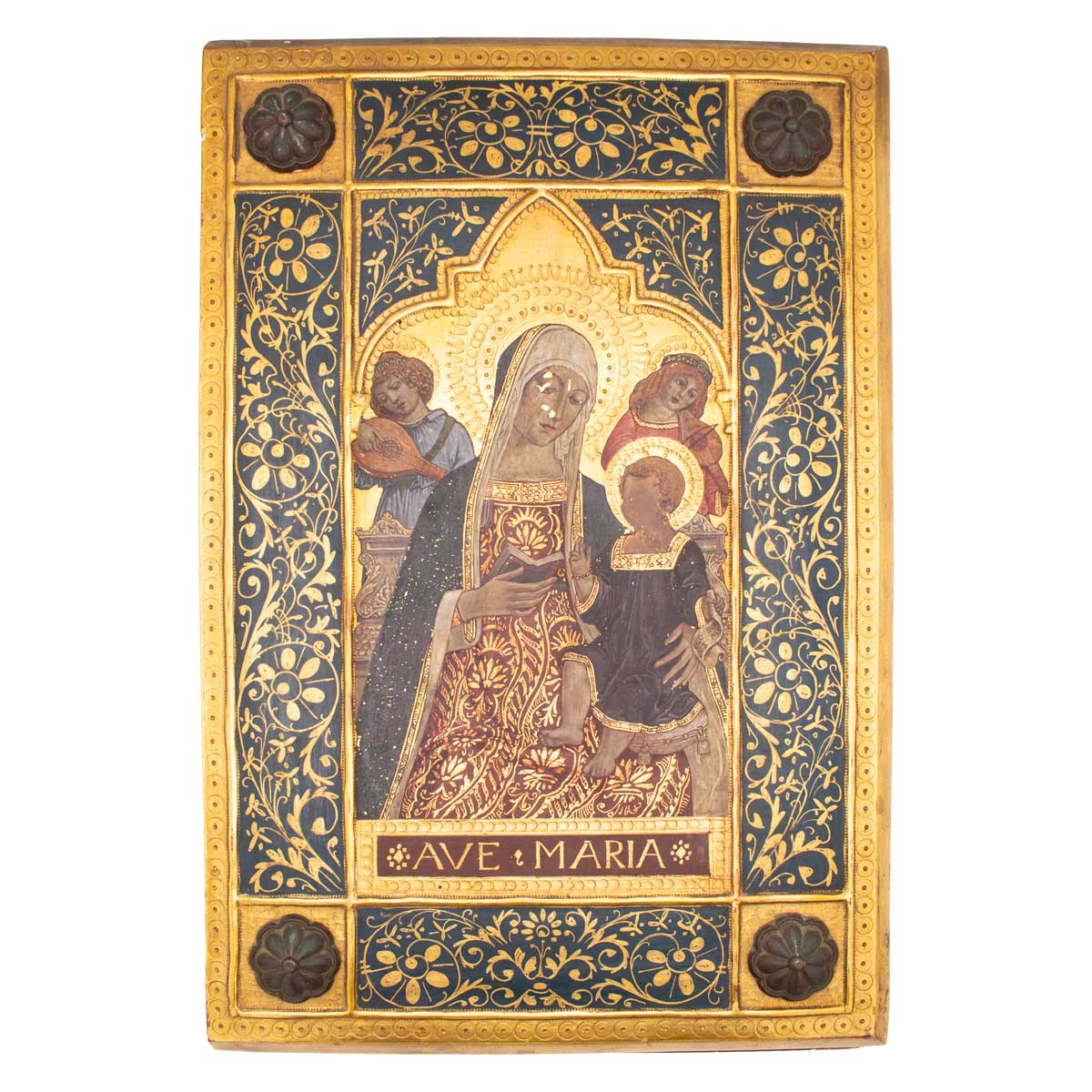
These panels are late-19th-century forgeries by Ilicio Federico Joni of so-called Sienese Tavolette di Biccherna, which were produced for accounts from the 13th to the 17th century.
Two bevel-edged wooden boards joined by a leather spine, tempera and gilt on carved wood, both covers gilt with framed panels carved and embellished with gilt foliate decoration over a painted dark-blue background, aged metal bosses to each corner, intentionally lacking one to the rear panel, the upper cover depicting the Madonna and Child flanked by two angels playing musical instruments, with the inscription ‘Ave Maria’ beneath, the lower cover decorated with three painted armorial shields, one inscribed ‘Libertas’, within elaborate frames, some flaking and chipping, particularly at the edges (some of which may have been by Joni who was in the habit of distressing his bindings), 390 x 260 mm. The gilt and paintwork remain vibrant and bright. [c.1890]
These panels are late-19th-century forgeries by Ilicio Federico Joni of so-called Sienese Tavolette di Biccherna, which were produced for accounts from the 13th to the 17th century. Joni layered these wooden panels with plaster and painted them with tempera to imitate fifteenth-century bindings.
Known as the ‘prince’ of Sienese forgers, Icilio Joni began work in a gilding workshop in Siena as a young man. He started a side business of restoration, which quickly also extended to forgeries, finding the market for these items in Italy. Using tempera and gold on panels, Joni mostly forged panel paintings, triptychs, and wooden caskets, claiming them as fifteenth- or sixteenth-century originals. After reading about the highly decorated Tavolette di Biccherna book covers he started to produce his own. While he sold a number of his imitations as medieval and Renaissance originals, he openly described his forgery work in his autobiography (Le Memorie di un pittore di Quadri Antichi, 1932, English trans. 1936).
Joni bindings — undetected — have graced some of the greatest book collections, including those of Hoe and Wilmerding. Even recognised as imitations, they had great cachet, as the commission by Lady Wantage for a binding in 1904 demonstrates. At least 14 examples of Joni’s work are recorded and more are in circulation.
[H.M. Nixon, ‘Binding Forgeries,’ Transactions of the VIth International Congress of Bibliophiles, 1969, Vienna, 1971, pp. 69-83; and M. Foot, ‘A Pair of Bookcovers of the late 19th Century by I.F. Joni, The Book Collector, 1985, pp. 488-489.]