
 Marshall Rare Books
A Tryal of Witches, At the Assizes Held at Bury St. Edmunds for the County of Suffolk; on the Tenth Day of March, 1664.
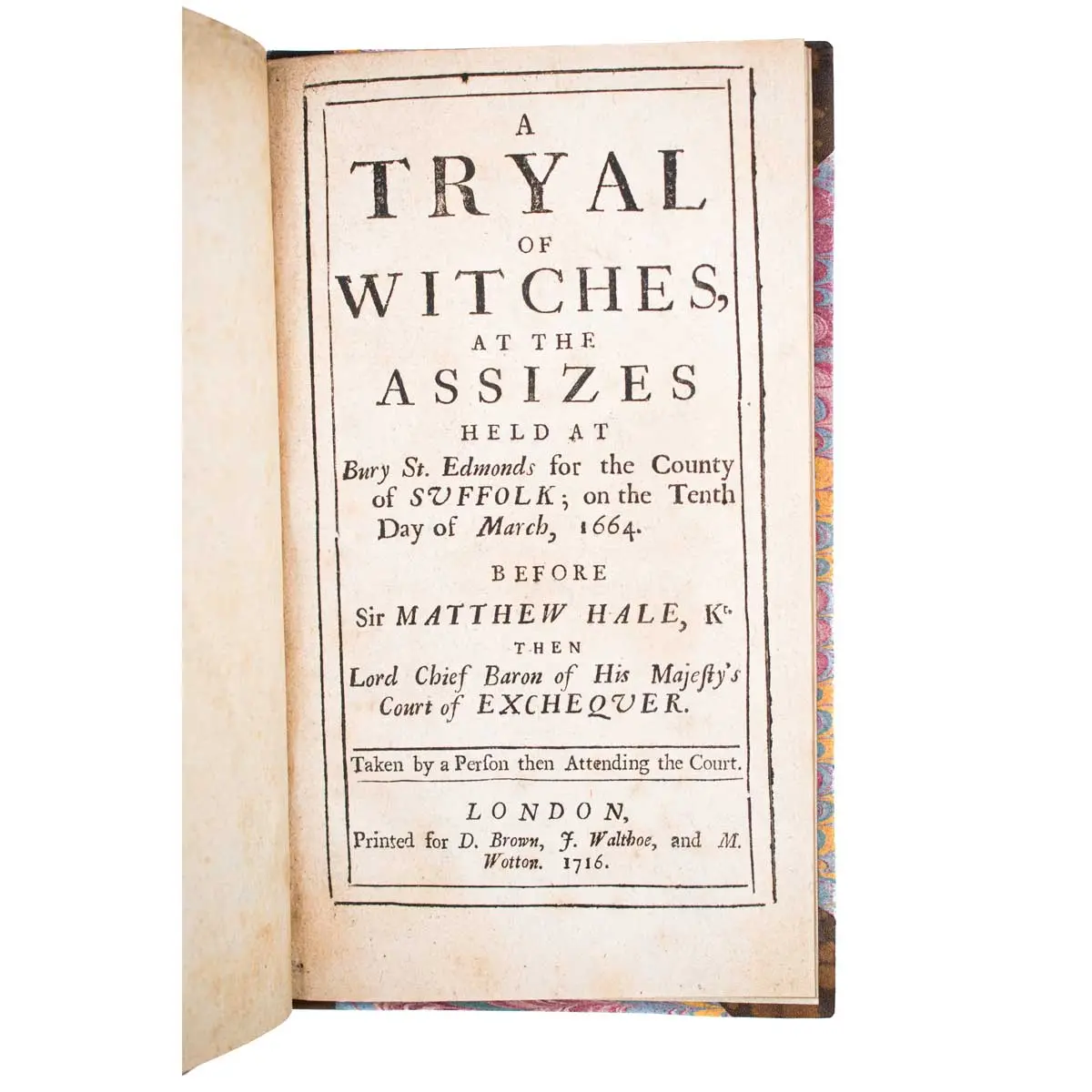
An Infamous Work that Directly Empowered the Salem Witch Hangings
FIRST EDITION, 16ff., [5], 78-104, woodcut printers device to final leaf, small 8vo, later green half calf over marbled boards, slightly rubbed, 8vo, London, for D. Brown, J. Walthoe, and M. Wotton, 1716.
“A most lamentable exhibition of credulity and inhumanity.” – Lord Campbell
Sir Matthew Hale was one of England’s most famous judges who, by his legal decisions, helped continue belief in witchcraft. Hale exercised more influence in the long run than the notorious Matthew Hopkins, the Witch Finder General, whose abhorrent influence lasted less than a year.
The witch trial at Bury St. Edmunds, heard in 1664 before Sir Matthew Hale, later Chief Justice, was one of the most thoroughly documented trials. The indictment charged that Rose Cullender and Amy Duny, two old widows from Lowescroft, Suffolk, had bewitched seven children ranging in age from a few months to eighteen years old. One of the children died, allegedly as a result of witchcraft. The old women were also charged with practising sorcery and malefica for many years. After Judge Hale’s direction to the jurymen, the two defendants were found guilty within half an hour on thirteen indictments. They maintained their innocence but four days later they were hanged.
Sir Matthew Hale has become infamous as the Lord Chief Justice of England, who encouraged the persecution of witches and allowed false testimony. He believed wholeheartedly in the menace of witches, and accordingly he manipulated court procedure to secure convictions. Hale ignored the proof of fraud by a witness, accepted hearsay evidence of five to seven year olds and spectral evidence from single witnesses. By admitting ‘spectral evidence’, Hale made possible the Salem hangings. Cotton Mather followed this trial closely and observed “it was a trial much considered by the judges of New England.” To this extent, the example of Hale fortified the judges at Salem. The importance of this trial therefore extended across the ocean from Suffolk to Massachusetts, and surpassed that of the earlier mass executions of sixty or seventy witches at Bury St Edmunds in 1645.
A scarce work with ESTC locating only one copy (New York Public Library).
[ESTC:N13688, Witchcraft in Early Modern England, Sharpe, 2001; The Encyclopedia Of Witchcraft And Demonology, Robbins, 1964]