
 Marshall Rare Books
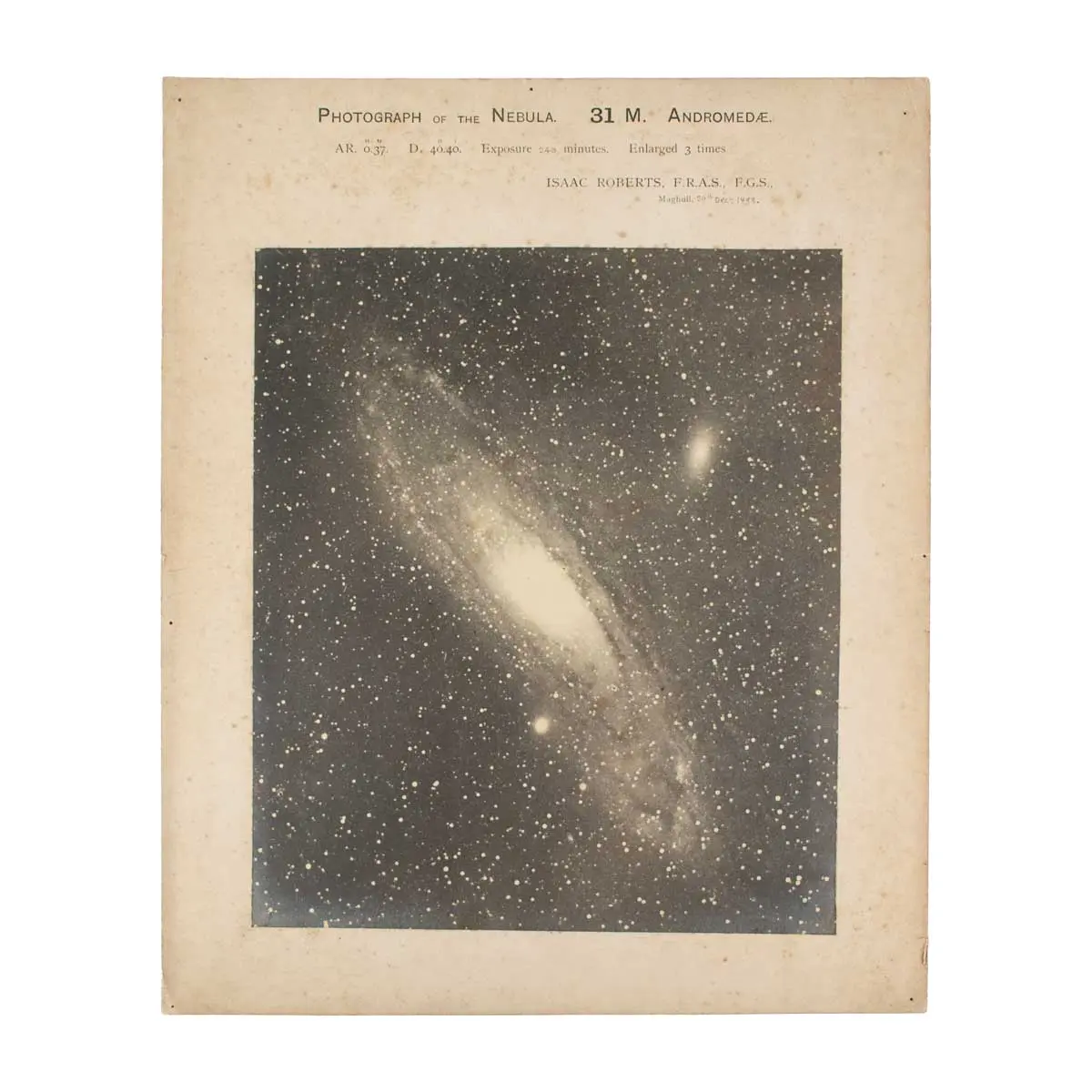
A Very Scarce Collection of Six Astronomical Photographs
From the Birr Castle Estate
Photograph of the Dumb Bell Nebula 27M Vulcuputae, Taken 3 October, 1888, at Maghull. Exposure time, 3 hours, enlarged 15 times. approx. 36 cm x 29 cm (14″ x 11 1/2″) including mount, with letterpress.
Photograph of Nebulae in the Pleiades, Exposure 4 hours, enlarged 4 times, by Isaac Roberts, F.R.A.S., F.G.S., Maghull, 8th Dec. 1888 (date in manuscript) approx. 37 cm x 29.5cms (14 1/2″ x 11 1/2″), including mount with letterpress.
Photograph of the Nebula 31M Andromeda, Exposure 240 minutes, enlarged 3 times. Taken by Roberts, Maghull, 29th December 1888, (date in manuscript), approx. 36 cm x 29 cm (14 1/4″ x 11 1/2″), including mount with title letterpress.
Photograph of Stars in Cygnus, AR 20h – 4m Dec! 35 – 30′, see Monthly Notices RAS, Nov. 1886. Signed & inscribed on reverse by Isaac Roberts. approx. 28 cm x 24 cm (11″ x 9 1/2″), mounted, as a photograph.
Photograph of the Cluster 13M Hercules taken on the 22nd May 1887 by Isaac Roberts – Exposure 60M – Enlarged twenty diameters – Nebula seems to cover the cluster. Inscribed on reverse by Roberts, approx. 29 cm x 24 cm (11 1/2″ x 9 1/2″), mounted.
Photograph of Nebulae in the Pleiades, see papers in the Monthly Notices RAS Nov. 1886 and January 1887. Isaac Roberts. Signed and inscribed on reverse, approx. 29.5cms x 24 cm (11 1/2″ x 9 1/2″), mounted.
Roberts developed an early interest in astronomy and in 1878 had his own telescope sited at his home. He eventually became so interested that he experimented in astrophotography and in 1886 he displayed his discoveries to a meeting of the Royal Astronomical Society. He was showered with honours by the academic world and in 1895 received the Royal Society gold medal, its highest honour. He is accepted as the first person to have taken photographs of the Andromeda Galaxy more than two light years away from Earth. He took the first good photographs of the Orion and the Pleiades cluster which he did using long exposure photography in the main largely pioneered by him and his name in the world of astronomy stands alongside those of Hubble and Huggins at the forefront of those who have developed our understanding of cosmology. With his self-built 20-inch aperture silver-on-glass mirror telescope of 8 feet focal length, he took photographic plates of the sky, intending to create photographic star charts, starting in 1885.
He has a crater on the dark side of the moon jointly named in his honour.
Roberts published his photographs in three volumes of a series, Photographs of Stars, Star Clusters and Nebulae. The first volume was published in 1893, the second in 1899, and the third one posthumously by his widow in 1928. His 20-inch reflector is now in the Science Museum in South Kensington, London (England).
Provenance: Birr Castle Estate.
In the early 1840’s, the Third Earl of Rosse designed and built the largest telescope in the world. With this telescope, he discovered the spiral nature of some of the galaxies, and from 1845-1914, anyone wishing to witness this phenomenon had to come to Birr. And they came, in their hundreds, from across Europe and beyond, to observe the stars with Lord Rosse or simply to marvel at this feat of engineering in the middle of Ireland.
This Reflecting telescope remained the largest in the world for over 70 years. This ‘leviathan’ as it is named, remains in the centre of the Demesne as Ireland’s greatest scientific wonder and represents a masterpiece of human creative genius.
The Science Centre demonstrates how the extraordinary telescope, now magnificently restored, was built in the castle workshops by the people of Birr. Scientific instruments are displayed, alongside interactive models to explain how they were used.