
 Marshall Rare Books
A Voyage to China and the East Indies… Together with a Voyage to Suratte … And An Account of the Chinese Husbandry…
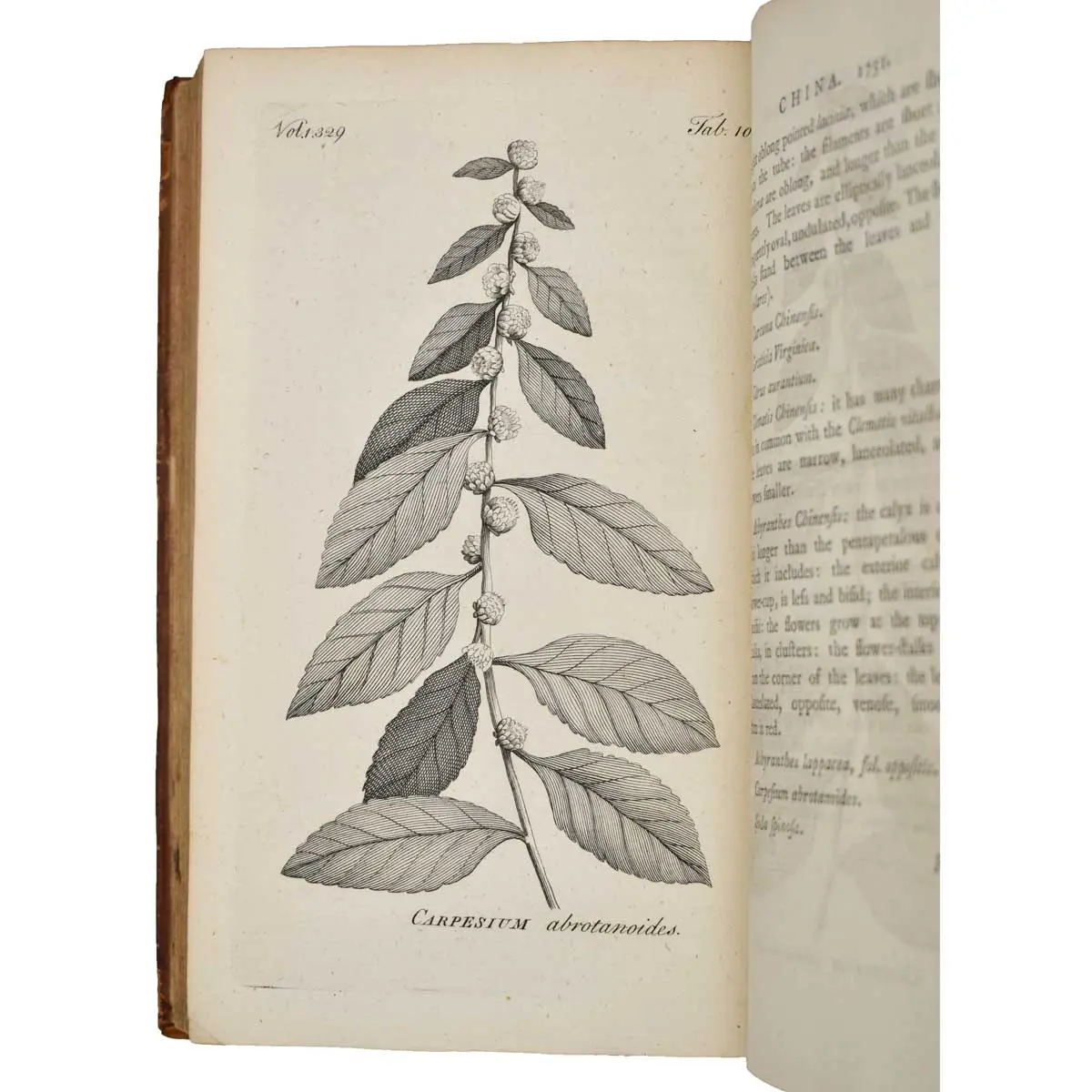
2 vol., FIRST EDITION, translated from German, 13 engraved plates, occasional ink stains, bookplate of Earl of Roden, shelf mark on pastedown, small ink inscription to front free endpapers, contemporary calf, rebacked, original spine laid on, black morocco label, 8vo, London, for Benjamin White, 1771
2 vol., FIRST EDITION, translated from German, 13 engraved plates, occasional ink stains, bookplate of Earl of Roden, shelf mark on pastedown, small ink inscription to front free endpapers, contemporary calf, rebacked, original spine laid on, black morocco label, 8vo, London, for Benjamin White, 1771
Peter Osbeck (1723-1805), a Swedish explorer and naturalist, travelled to Asia in 1750 as chaplain on one of the East India Company ships. He spent four month studying the flora, fauna and people of the Canton region of China. This work is the culmination of the observations he made. The account relays detailed botanical discoveries, as well as a vivid image of Chinese culture and language. Osbeck returned to Sweden in time to contribute more than 6oo species of plant to Linnaeus’ Species Plantarum, published in 1753. Linnaeus named the flower Osbeckia chinensis after Osbeck, a species of family Melastomataceae found by the traveller during his journey in the outskirts of Canton. Today the genus comprises about 100 species.
Charles Gustavus Ekeberg (1716 – 1784), Swedish physician, chemist and explorer, who made several voyages to the East Indies and China as a sea captain. Starting his career as a ship’s doctor, he became an expert navigator and rose to Captain in 1750, sailing for the Swedish East India Company. He brought back reports on the tea tree and numerous botanical specimens from his voyages for Carl Linnaeus. For his contribution, Linnaeus named the genus Ekebergia after him.
John Reinhold Forster (1729-1798) is best known as the naturalist on Cook’s second Pacific voyage. Along with his groundbreaking work in ornithology and anthropology, he was the first person to publicly teach natural history in England. Forster has reputedly mastered 17 languages, learning and dead. His translation of Bougainville’s journal was published in 1771.
At the time of his death he was called the ‘patriarch’ of geography in Europe and was widely recognised as one of the most able naturalists. His influence on German science and scholarship was considerable. There was not one continent to which he did not devote some scholarly work.
Provenance: Robert Joelyn, Earl of Roden (1788-1870)