
 Marshall Rare Books
A Voyage to the Islands Madera, Barbados, Nieves, S. Christophers and Jamaica, with the natural history ... of the last of those islands; to which is prefix'd an introduction, wherein is an account of the inhabitants, air, waters, diseases, trade, &c. ... Illustrated with the figures of the things describ'd ...
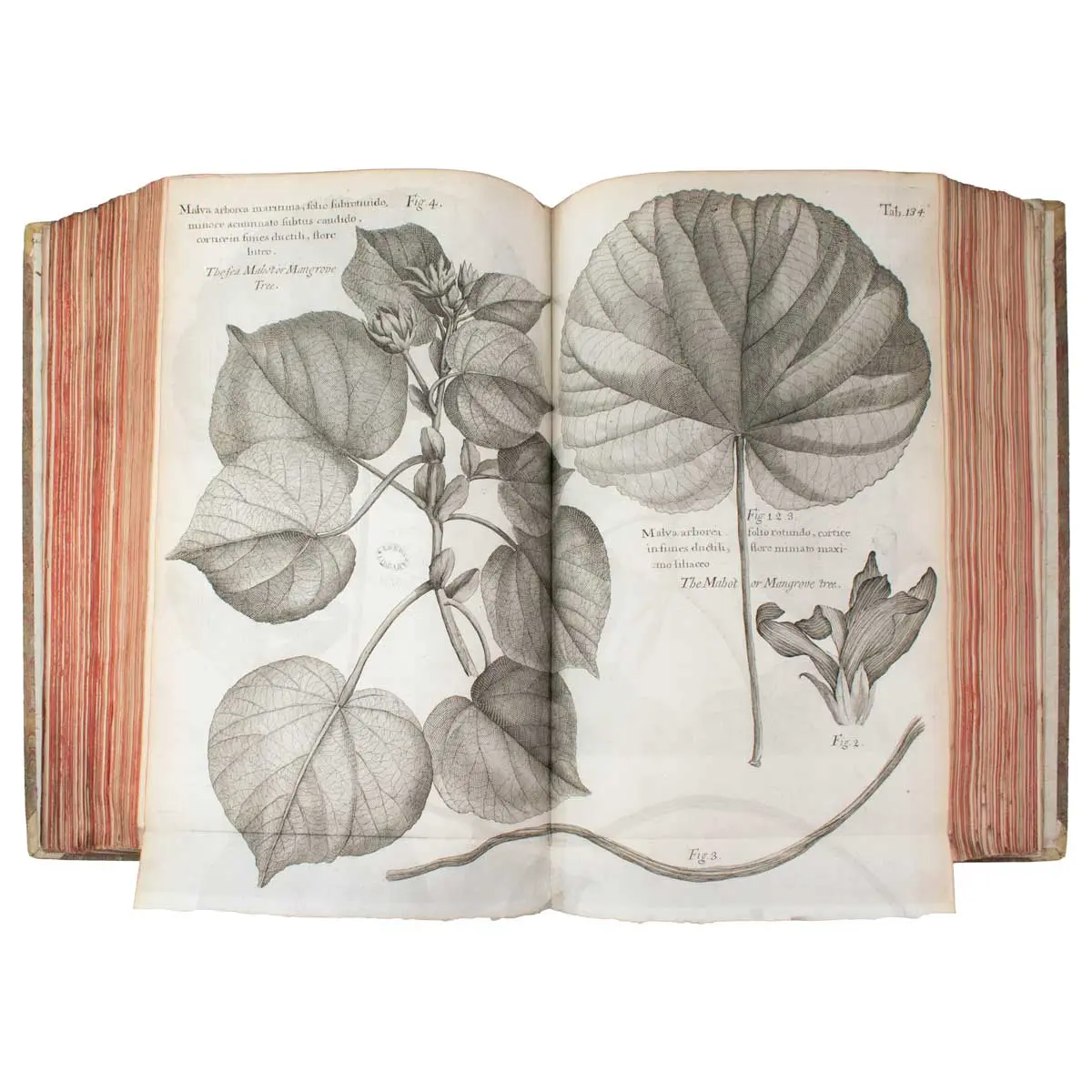
This is the earliest representations of the flora and fauna of Jamaica and neighbouring islands.
Printed by B. M. for the author, London 1707-25. First edition. 2 volumes, folio, title-pages printed in red and black, [xvi], cliv, 264; [ii], xvii, 499pp., 285 double-page or folding engraved plates (I-XI & 1-274), the majority by Michael van der Gucht and John Savage, mostly after drawings by Everhard Kickius based on Sloane’s dried specimens, with a few after drawings made in Jamaica by the Rev. Garett Moore, mounted on guards throughout, ex-library copy , small unobtrusive ink-stamps to vol. 1 title and plates, half calf over old marbled boards.
First Edition
This is the earliest representations of the flora and fauna of Jamaica and neighbouring islands: Sir Hans Sloane (1660-1773), after being elected a Fellow of the Royal Society and a Fellow of the College of Physicians, went to Jamaica as physician to the governor of that colony, the Duke of Albermarle. He remained on the island for fifteen months during which time he sought out and measured more than 800 new species of plants. This collection, which he brought back to London, formed the basis of the botanical part of his great natural history. On his death, and by his wish, these very large collections and his library of 50,000 books were purchased by the government and formed the basis of the British Museum.
‘Sloane tried to bring back live animals from Jamaica. Sadly the ‘guana’ (lizard) fell overboard, the crocodile died, and a yellow snake escaped and was shot. But the descriptions and illustrations in his book provide us with important information about Jamaican vertebrates. He describes, for example, how the snakes were useful for destroying the black rats that had arrived on European ships and ate the sugar cane. Later when the snakes couldn’t keep pace with the rats, the Indian mongoose was imported but they were so effective that the snakes faced starvation. The mongoose also ate many lizards that were native to the islands. Sloane described and illustrated one of these, the great galliwasp, which later became extinct.’ British Museum
Sabin 82169; Anker 474; Casey Wood p570; Hunt 417; Nissen BBI, 1854; Stafleu TL2 12.104.