
 Marshall Rare Books
An Accounts of Roman Antiquities Discovered at Woodchester in the County of Gloucester.
PRESENTATION COPY TO LYSONS DAUGHTER
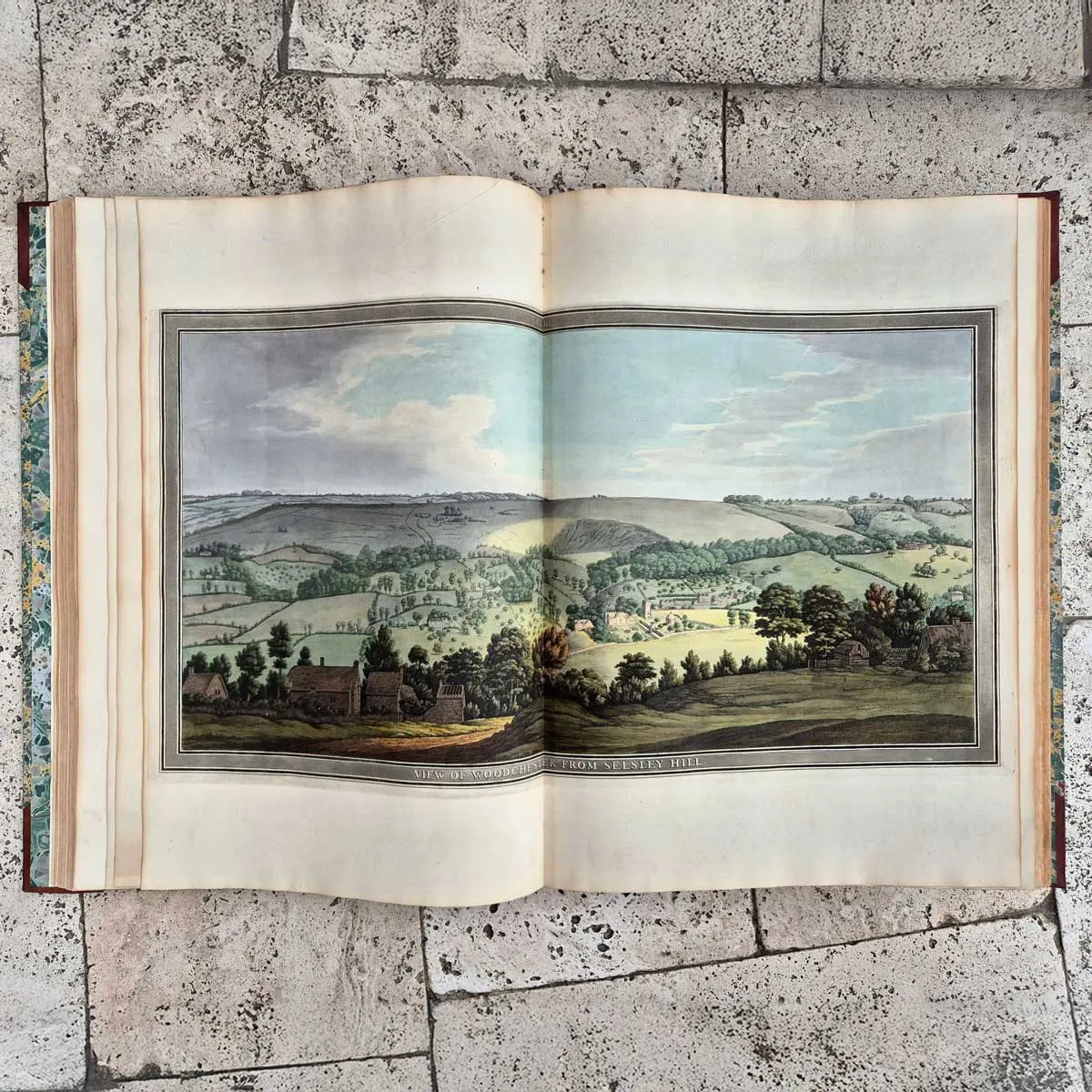
Sold by Cadell & Davies, B.& J. White, Edwards, Payne, Robson, Nicol, Elmsley, and Leigh & Sotheby.London 1797 Large elephant folio, (17½ x 23½ inches). Hand-coloured engraved title + hand-coloured dedication plate to King George III + [ii] + 20 pp. text in English + 20 pp. + [iv] + 21 pp. text in French + 35 finely finished , hand-coloured, etched and/or aquatinted plates, of which 9 are double-page, 5 usually uncoloured plates are coloured in this special copy. Large engraved head- and tail-piece, 40 plates in total, half tan calf over marbled boards, some foxing to text.
Special Presentation copy to Lysons Daughter with all the plates in colour. The family copy.
In 1793 Samuel Lyson commenced the extensive excavations which still today are the main source of our knowledge of the villa. These took place over three years and in 1797 Lysons was able to publish the results of his work in his book “Account of the Roman Antiquities discovered at Woodchester in the County of Gloucester.” He also found a number of very fine marble sculptural fragments, including the headless statue of Diana Luna, with the sacrificial bull at her feet, which are now in the BritishMuseum. The quality of the carving is exceptional for statues found in British villas and these finds indicate the luxurious character of the villa.
These very fine aquatint illustrations include three coloured aquatint views of Woodchester, two of which are double-page. Samuel Lysons was one of the first archaeologists to investigate the Roman sites in Britain, as well as being a leading intellectual of his time and a benefactor of the British Museum, to which he donated many artifacts. Between 1793 and 1796, he undertook extensive excavations of Roman ruins which were published with his illustrations in 1797.That year he was made a fellow of the Royal Society and later served as its vice-president and treasurer. He was also an antiquary professor in the Royal Academy 1818.
Woodchester is most famous for its magnificent Orpheus mosaic, the largest in Britain and perhaps the most intricate.
However, a single ‘owner’ is of course misleading. The villa was built and rebuilt over two centuries or more. Giles Clarke, writing in Britannia in1982, feels that it was unlikely to have had an ‘official’ function. He argues that more likely, the villa was built and lived-in by the descendants of the pre-Roman tribal leader at Rodborough.The reason for building the villa on this particular site also has to be a matter of conjecture. Certainly the beauty of the surrounding area is a factor; the villa is sheltered in the valley and there would have been a plentiful supply of stone and wood for building. A constant supply of freshwater from the spring line would have also been a key consideration.
Interestingly, a recent excavation of another large villa, in Turkdean in the Cotswolds, has also thrown up evidence that it was actually built by the native Dubonni. The Dubonni were a civilized tribe, whose kingdom encompassed southern Worcestershire, most of Gloucestershire and north Somerset. It seemed, rather than resisting the Romans, they quickly adopted all the benefits of the new Roman civilisation and remained part of the hierarchy. Like the Romans they shared a reverence for nature and natural forces such as springs and, only a few hundred yards away from the villa, was the spring line which provided water for the villa.
The area immediately surrounding Woodchester is remarkably rich archaeologically: there are at least seven other villas within a five mile radius. Also, the Woodchester area is characterized by abundant evidence of religious activity. There have been found a number of alters to Mars in the Nailsworth Valley; there is a temple dedicated to Mercury found near Uley. This all suggests that the area was an important cultural and religious centre even before the Romans arrived.
In the latter half of the fourth century the villa was partially destroyed by fire probably by the Pict or Saxon invaders who had overwhelmed the island. It may have continued to be occupied during Saxon times but was certainly gradually dismantled and the stone reused to build housing and most probably the church.
There are comparatively few of this layout in England. It had two large courtyards surrounded by buildings with 65 rooms including a main residence, a farm, a sun terrace, a spa and bath complex, and a large hall that contained the wonderful mosaic, The Great Pavement. This is one of the most complex and intricate mosaic designs found in northern Europe, and is 2,209 square feet and when complete contained one and a half million pieces of stone. This great mosaic was made around AD. 325 by craftsmen from Corinium, with the main design based around Orpheus and his relationship with nature.
In all thirteen mosaics have been recorded in situ.