
 Marshall Rare Books
An Act for rendering more effectual an Act made in the Fourteenth Year of the Reign of His Majesty, for promoting the Discovery of a Method for finding the Longitude at Sea, so far as relates to the Encouragement and Reward of Persons making lesser Discoveries for finding the same, or making other useful Discoveries and Improvements in Navigation; and to the making of Experiments relating thereto.
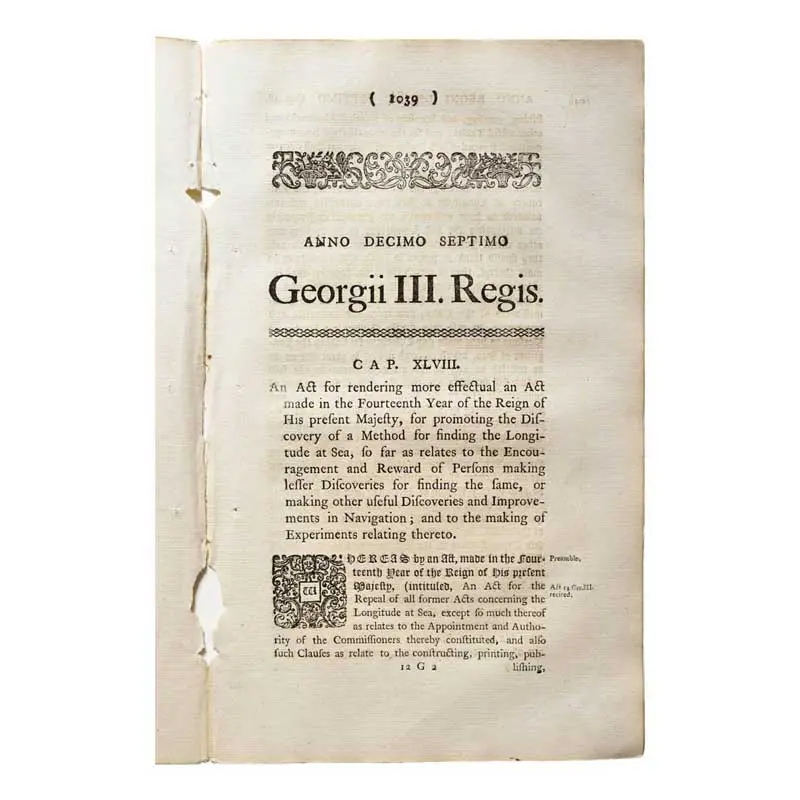
Anno Regni GEORGII III REGIS Magnae Britaniiae, Franciae, & Hiberniae, DECIMO SEPTIMO. At the Parliament Begun and holden at Westminster, the Twenty-ninth Day of November, Anno Domini 1774, in the Fifteenth Year of our Sovereign Lord GEORGE the Third, by the Grace of God, of Great Britain, France, and Ireland, King, Defender of the Faith.... FIRST EDITION, [4], 1039-1042 woodcut coat of arms on title, woodcut floriated initial, text in black letter, unbound, folio (320 x 200mm), London, Charles Eyre and William Strahan, 1777 This important act emphasised the Government’s dedication to improving general science and navigation by offering rewards to those who could find an accurate method for determining longitude at sea.
Anno Regni GEORGII III REGIS Magnae Britaniiae, Franciae, & Hiberniae, DECIMO SEPTIMO. At the Parliament Begun and holden at Westminster, the Twenty-ninth Day of November, Anno Domini 1774, in the Fifteenth Year of our Sovereign Lord GEORGE the Third, by the Grace of God, of Great Britain, France, and Ireland, King, Defender of the Faith….
FIRST EDITION, [4], 1039-1042 woodcut coat of arms on title, woodcut floriated initial, text in black letter, unbound, folio (320 x 200mm), London, Charles Eyre and William Strahan, 1777
This important act emphasised the Government’s dedication to improving general science and navigation by offering rewards to those who could find an accurate method for determining longitude at sea.
The first Longitude Act of 1714 was Parliament’s response to the loss of 2,000 lives in 1707, when four British navy ships ran aground after miscalculating the longitude. The Act offered prize money of £10,000 (reduced from £20,000) for a reliable and accurate method of determining longitude at sea. Research and related experimentation were also encouraged, and award money was made available for lesser discoveries and specific improvements. The competitions attracted the skill and imagination of the greatest scientific minds and mariners of the time.
The most prominent and successful competitor was John Harrison (1693-1776), who received disbursements of £22,000 over a period of 35 years for his brilliant discoveries and invention of the marine chronometer. This was, however, not without a struggle for recognition. The marine chronometer was quicker, but the preferred avenue of institutionalisation was the Lunar Distance Method. The Lunar Distance method was a method to determine longitude using certain astrological measurements and specific corrections marked in yearly almanacks. The Act of 1765 put caveats and conditions on the original act of 1714, and included stipulations that applied specifically to Harrison. It even named him in the opening language and described the current status of his contrariety with the board. Only with the relentless championing from his son, and the personal intervention of King George III, Harrison was awarded the monetary prize he was due. The Longitude Act (1777) reiterated specific goals of the program (as revised by the 1774 Longitude Act), and approved an additional £5,000 for continued research work and experimentation and for awards to recognize lesser contributory discoveries as approved by the Commissioners of the Board of Longitude.
The Longitude at Sea program was successful in multiple ways, and facilitated important advances in mathematics, astronomy, horology, navigation, and Arctic exploration. Over the life of the program, a total of £53,000 in prize money was awarded to more than sixty participants.