
 Marshall Rare Books
An Act to amend an Act made in the Eleventh Year of the Reign of King William the Third, intituled, An Act for the more effectual Suppression of Piracy.
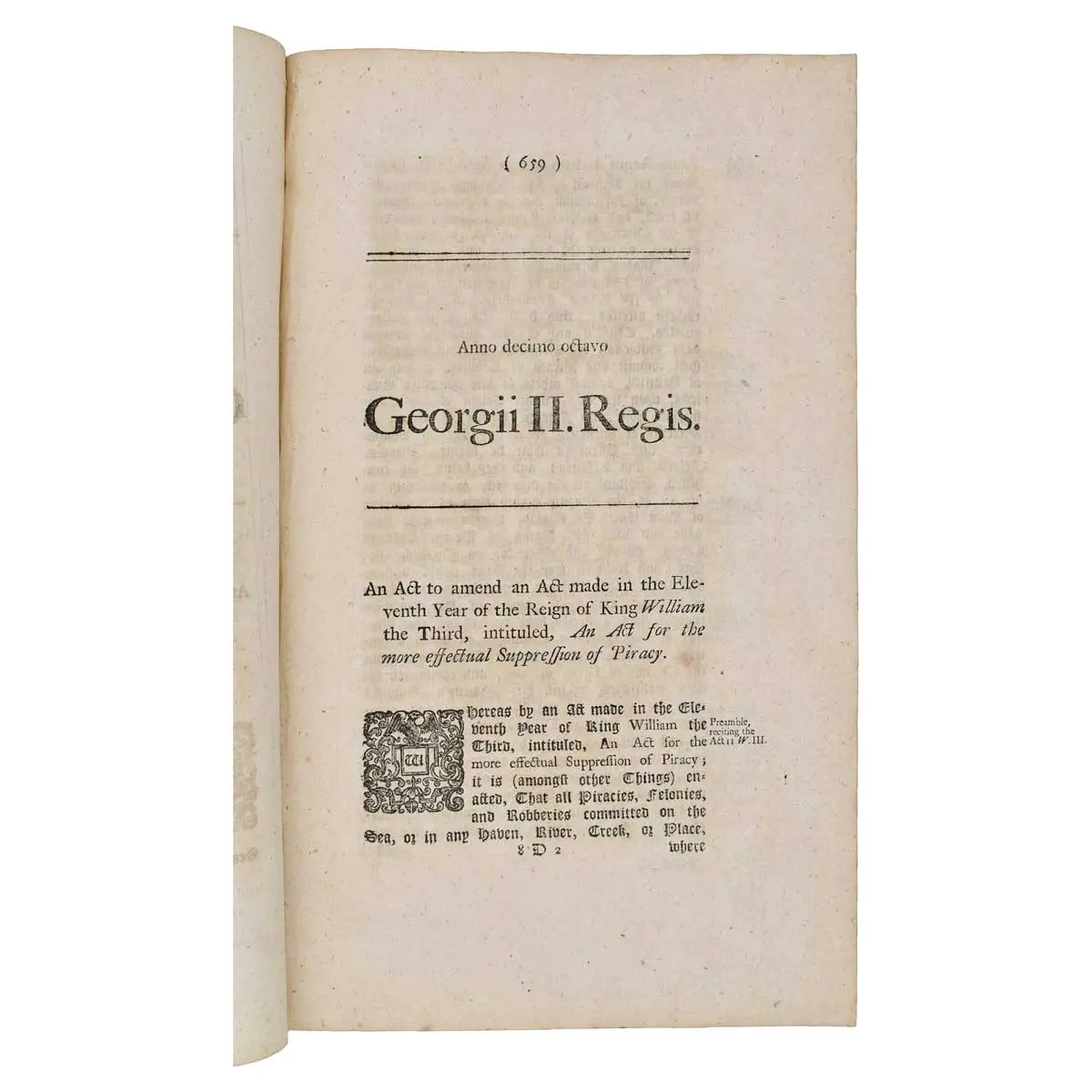
FIRST EDITION, [2], 659-662, woodcut coat of arms on title, woodcut floriated initial, text in black letter, unbound, slight toning, folio (320 x 200mm), London, Thomas Baskett, 1745
Anno Regni GEORGII REGIS Magna Britannia, Francia, & Hibernia, DECIMO OCTAVO. At the Parliament Begun and Holden at Westminster, the First Day of December, Anno Dom. 1741. In the Fifteenth Year of our Sovereign Lord GEORGE the Second, by the Grace of God, of Great Britain, France, and Ireland, King, Defender of the Faith….
FIRST EDITION, [2], 659-662, woodcut coat of arms on title, woodcut floriated initial, text in black letter, unbound, slight toning, folio (320 x 200mm), London, Thomas Baskett, 1745
An Act published in Public General Acts 1744-1745. This work is an amendment to the extremely effective 1700 “An Act for the more Effectual Suppression of Piracy”, passed during the Golden Age of Piracy. The Act was responsible for the creation of regular colonial courts with the authority to try pirates, proving to be a tremendous boon to the government’s assault on sea robbers. Parliament originally designed the 1700 Act to expire in only seven years. But owing to the great effect it had in permitting the more regular prosecution of pirates, Parliament renewed it several times following the War of the Spanish Succession and made the law permanent in 1719. The Act for the More Effectual Suppression of Piracy stuck two thorns in the side of pirates. First, it treated active pirate sympathisers as accessories to piracy and stipulated the same punishments for them as for actual pirates – death and property forfeiture. Second, the law encouraged merchantmen to defend themselves against pirate attacks by providing them a reward “not exceeding two Pounds”. Since the Act was passed it has been strengthened several times. The 1745 Amendment bolstered the act by including anyone of British nationality working as a Privateer for France or Spain be tried under a felony with the same punishments as those for pirates. Being tried for a felony, rather than high treason, creates a stronger case for the prosecutors being less subjective than High Treason.
[ESTC: N52063. AMERICAN UNIVERSITY LAW REVIEW:Vol. 59 p1221-1222]