
 Marshall Rare Books
AN EARLY 18TH CENTURY COCONUT CHALICE MOUNTED IN 17TH CENTURY 'PIRATE' SILVER
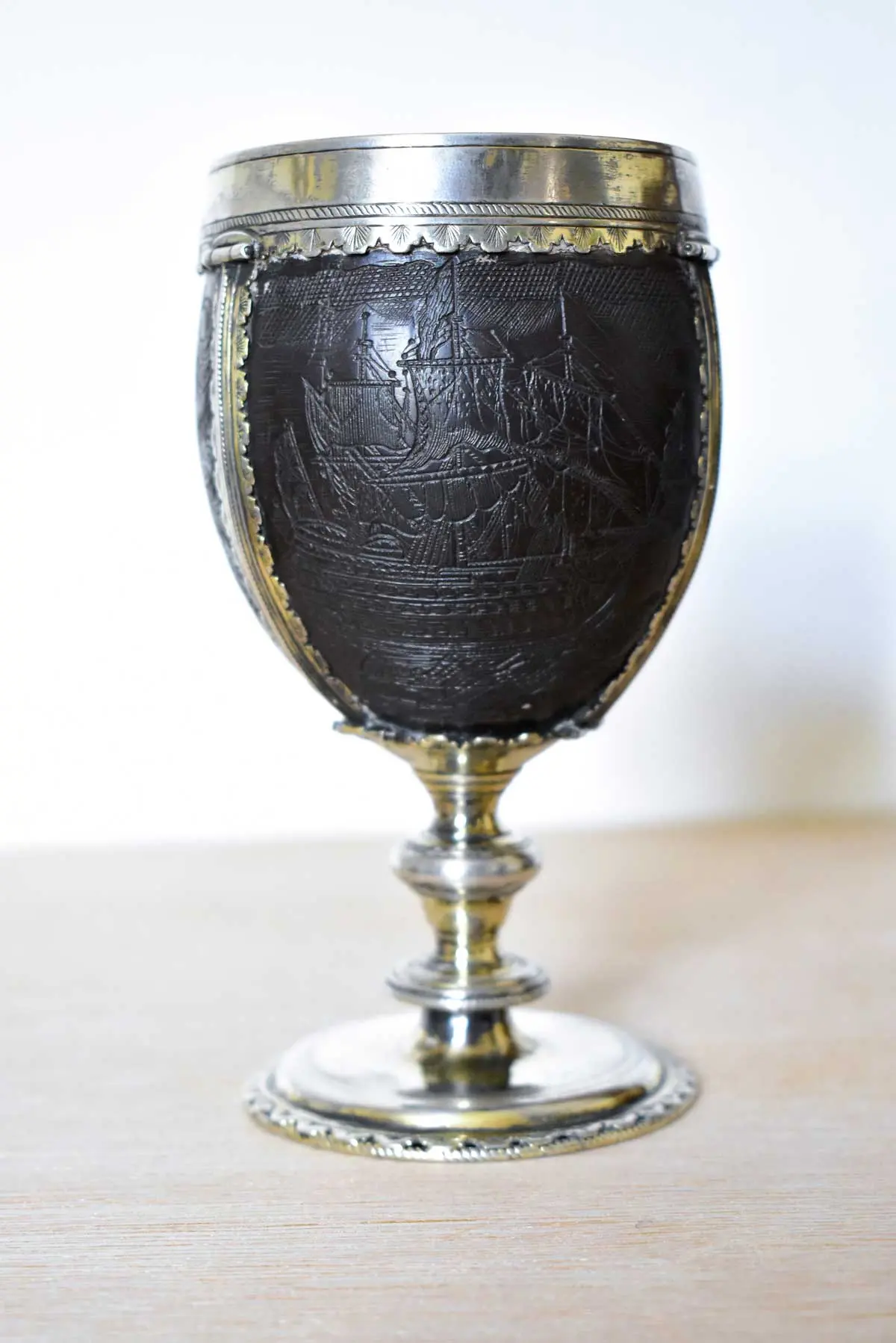
The coconut finely carved with three panels depicting a fouled anchor, a Man o'War, the coat of arms of Admiral Sir Chaloner Ogle and mounted within straps of silver with cut-card foliate edging beneath a similarly decorated rim, plain baluster stem and circular foot, 6in. (15cm.) high.
The coconut finely carved with three panels depicting a fouled anchor, a Man o’War, the coat of arms of Admiral Sir Chaloner Ogle and mounted within straps of silver with cut-card foliate edging beneath a similarly decorated rim, plain baluster stem and circular foot, 6in. (15cm.) high.
Sir Chaloner Ogle (1680/1-1750) had a long and distinguished career in the Royal Navy, seeing service in the War of the Spanish Succession and rising to be Admiral of the Fleet. However, his most celebrated exploit was hunting down and killing the notorious pirate Bartholomew Roberts (1682-1722) in a sharp action off the coast of Gabon, West Africa. In a spectacular career raiding shipping off the Americas and West Africa, ‛Black Bart’ had taken some 400 prizes, developed his own pirate code and adopted the iconic skull and crossbones flag. In 1721, having wrought havoc in the Caribbean and bringing shipping there to a near standstill, Roberts in Royal Fortune with some 250 pirates, made for West Africa. After taking French prizes off the Guinea coast, Roberts headed for Sierra Leone and then, in January 1722, into the slave-trading port of Ouidah (now Republic of Benin) where, a Royal African Company sloop, Whydah, having refused to surrender like the other shipping at anchor there, Roberts’s pirates set it alight, killing its chained cargo of eighty slaves. Those that escaped the inferno were devoured by the encircling sharks. Roberts then led his men away to rest, carouse and count their earnings.
Having heard reports of pirate degradations on the African coast and witnessing the aftermath of the tragedy at Ouidah, Chaloner Ogle, in command of Swallow, had gone looking for Roberts and his pirate crew. On 5 February he found them at anchor under Cape Lopez, with most of the pirates drunk. Believing Swallow to be a merchantman, one of the pirate ships had given chase and out of sight of the others, was promptly taken. Ogle then returned to Cape Lopez under French colours where he was attacked by Royal Fortune with Roberts on deck: ‛dressed in a rich crimson damask waistcoat and breeches, a red feather in his hat, a gold chain round his neck, with a diamond cross hanging to it, a sword in his hand, and two pairs of pistols slung over his shoulders ‛.
Hauling down his false colours and raising his ensign, Ogle engaged the enemy and brought a broadside to bear which raked Royal Fortune, mortally wounding Roberts whose throat was torn away by grapeshot. To deny Ogle his trophy, the pirate crew straightaway wrapped Roberts body, still armed and dressed in all his finery, into a sail and committed it to the sea. They then fought on until Royal Fortune’s mainmast fell and they asked for quarter. Of the 272 pirates captured by Ogle: 52 were hanged (18 of the bodies being tarred and put in gibbets), 65 were sold back into slavery, 20 were taken into the service of the Royal African Company and the remainder sent back to prison in London.
The death of ‛Black Bart’ was a sensation. Known as The Great Pyrate in the “Golden Age” of Piracy, he captured the public imagination and ‛Black Bart’ was the most important figure in Captain Johnson’s General History of the Pirates (1724), more so even than Blackbeard or Captain Kidd. In the years since, Roberts’ celebrity has only grown, with frequent mentions of his career in popular culture: from Robert Louis Stevenson’s Treasure Island to the film franchise Pirates of the Caribbean.
Chaloner Ogle, Black Bart’s nemesis, garnered no such posthumous fame but he did reap all the financial benefits of his exploit during his lifetime. On his return to England, he was knighted and awarded, by special permission of the King, all of the pirates’ captured ships and their treasure, estimated at £10,000. The windfall oiled Ogle’s path to the heights of the Royal Navy.
Of unknown origin, and possibly decorated by a member of Ogle’s crew, this coconut chalice features the silver that may represent one small surviving fragment of the countless jewels, chains and baubles discovered by Ogle in Black Bart’s treasure chests.