
 Marshall Rare Books
An Elegant Italian Armillary Sphere.
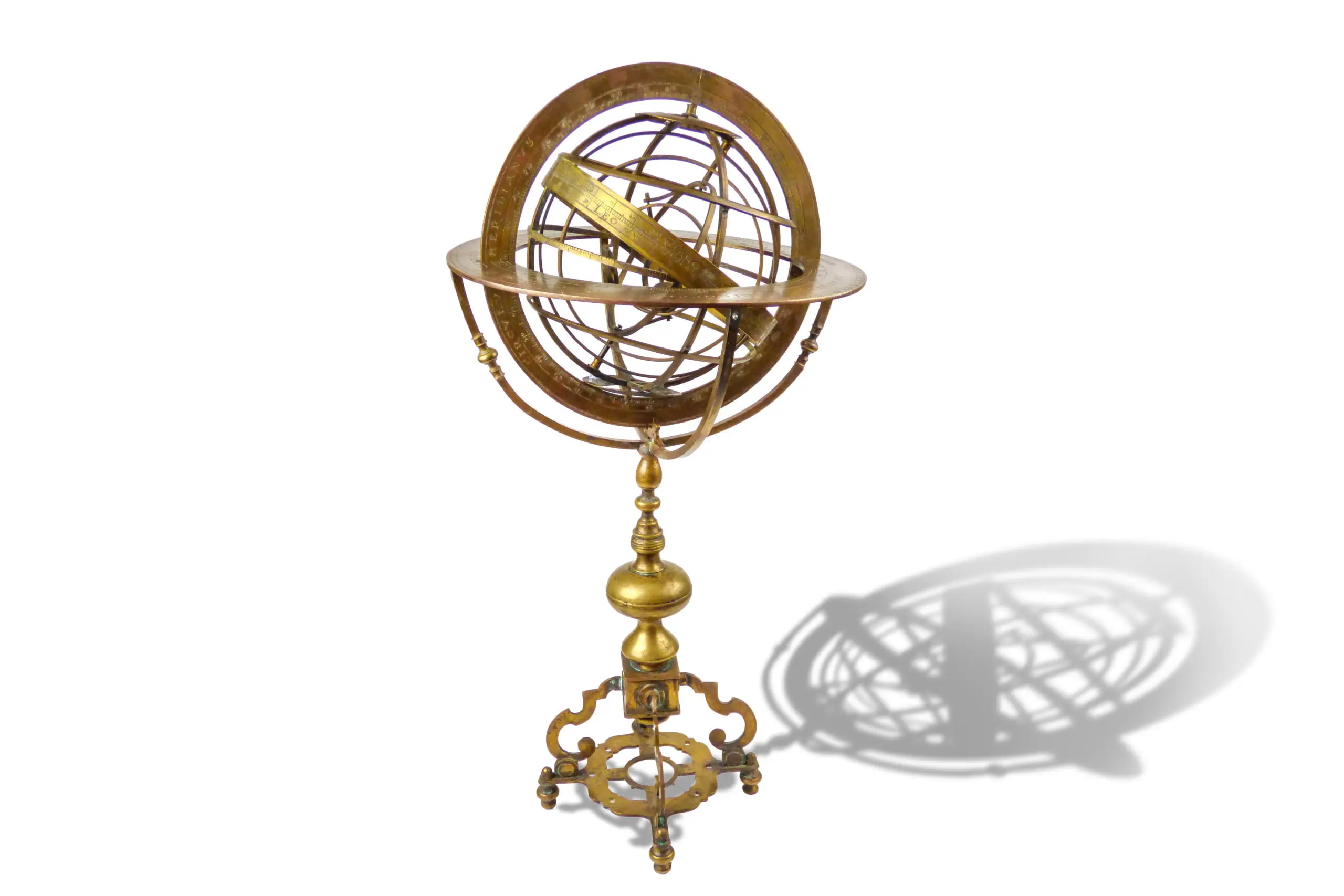
A Very Fine Armillary Sphere in the style of the workshop of Domenico Lusuerg ( 1650- 1720). Italian brass armillary sphere, late 18th Century, Height 560 x Diameter 280mm. Unsigned. Horizon ring labelled "CIRCVLVS PARALLELVS" and engraved with the names of the winds at the points of the directions "LEVANTE", "SCIRROCO", "MEZZOGIORNIO", "LIBECCIO", "PONENTE", "MAESTRO", "TRAMONTANO", "GRECO".
Italian brass armillary sphere, late 18th Century, Height 560 x Diameter 280mm. Unsigned. Horizon ring labelled “CIRCVLVS PARALLELVS” and engraved with the names of the winds at the points of the directions “LEVANTE”, “SCIRROCO”, “MEZZOGIORNIO”, “LIBECCIO”, “PONENTE”, “MAESTRO”, “TRAMONTANO”, “GRECO”.
Ecliptic ring with the names and signs of the Zodiac; Meridian ring labelled “CIRCVLVS MERIDIANVS” and divided every ten degrees; Arctic Circle labelled “CIRCVLVS ARTICVS”, Antarctic Circle, colures, and tropic rings unlabelled.,
A Very Fine Armillary Sphere in the style of the workshop of Domenico Lusuerg ( 1650- 1720). In 1677 he established a workshop near the Collegio Romano and had strong links with the Jesuits.
The Greek Astronomer Hipparchus (c. 190 – c. 120 BC) credited Eratosthenes (276 – 194 BC) as the inventor of the armillary sphere. The name of this device comes ultimately from the Latin armilla (circle, bracelet), since it has a skeleton made of graduated metal circles linking the poles and representing the equator, the ecliptic, meridians and parrallels. Usually a ball representing the Earth or, later, the Sun is placed in its centre. It is used to demonstrate the motion of the stars around the Earth. Before the advent of the European telescope in the 17th century, the armillary sphere was the prime instrument of all astronomers in determining celestial positions.
In its simplest form, consisting of a ring fixed in the plane of the equator, the armilla is one of the most ancient of astronomical instruments. Slightly developed, it was crossed by another ring fixed in the plane of the meridian. The first was an equinoctial, the second a solstitial armilla. Shadows were used as indices of the sun’s positions, in combinations with angular divisions. When several rings or circles were combined representing the great circles of the heavens, the instrument became an armillary sphere.
Armillary spheres were developed by the Hellenistic Greeks and were used as teaching tools already in the 3rd century BC. In larger and more precise forms they were also used as observational instruments. However, the fully developed armillary sphere with nine circles perhaps did not exist until the mid-2nd century AD, during the Roman Empire, Eratosthenes most probably used a solstitial armilla for measuring the obliquity of the ecliptic. Hipparchus probably used an armillary sphere of four rings. The Greco-Roman geographer and astronomer Ptolemy (c. 100–170 AD) described his instrument, the astrolabon, in his Almagest. It consisted of at least three rings, with a graduated circle inside of which another could slide, carrying two small tubes positioned opposite each other and supported by a vertical plumb-line