
 Marshall Rare Books
An essay towards a Natural History of Serpents: In Two Parts
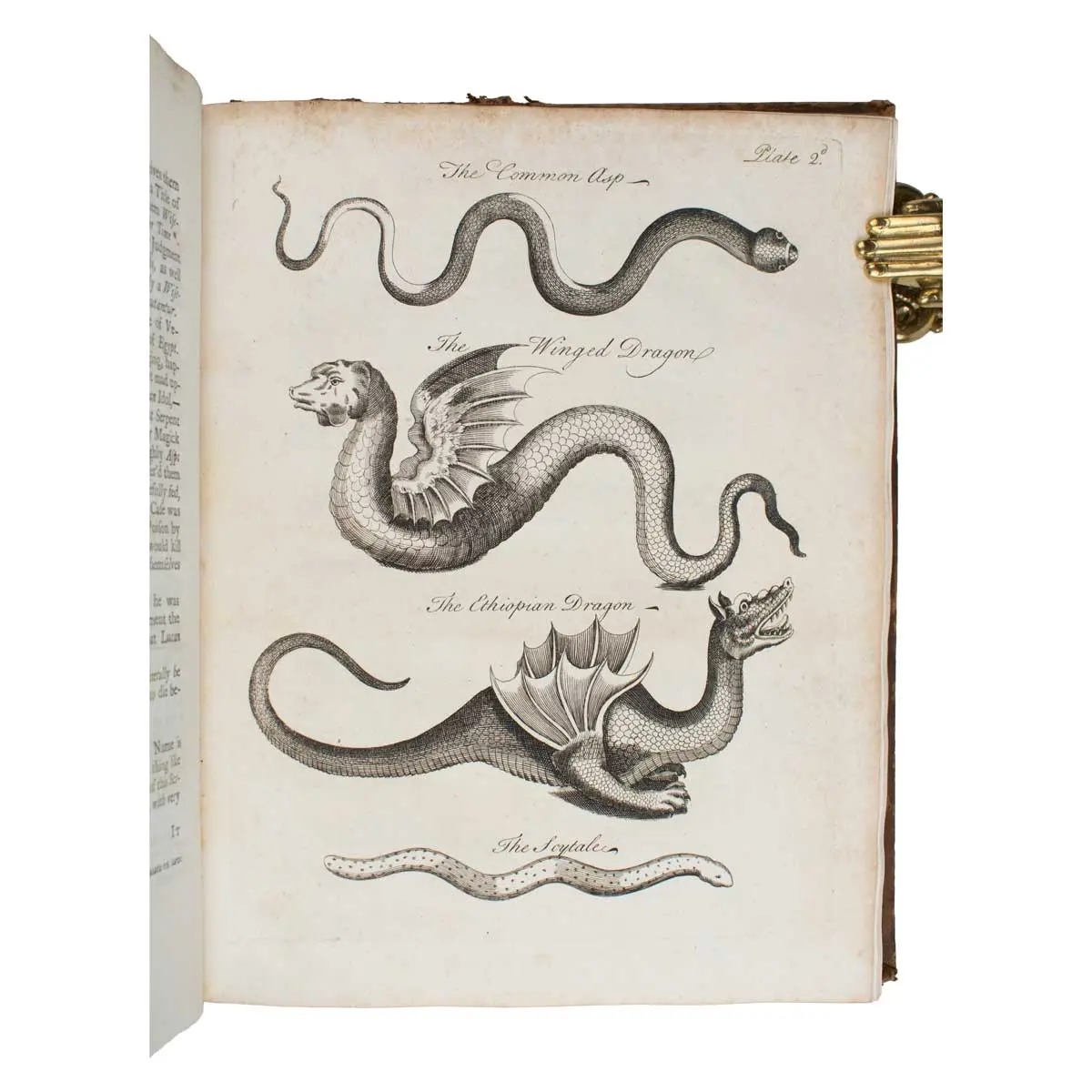
Dragons and Snakes.
FIRST EDITION, 7 engraved plates, 15-page list of subscribers, contemporary calf twice ruled in gilt, spine gilt, spine rubbed, 4to, London, for the Author, 1742.
A work by Presbyterian minister and political dissenter, Charles Owen. This work on natural history is a strange mixture of fact and fable, as much symbolic as it is scientific. Owen draws on classical, Biblical and mythological sources for his information on snakes, turtles, wasps and scorpions. He also examines the physical nature of serpents, including a section on poison and antidotes, and describes the folklore associated with such animals in all countries of the world. Owen’s aim was not just to inform and entertain, but to share his belief that the natural world, as created by God, had moral qualities, which could guide people as to how to live their lives.
Some of the snakes Owen describes are familiar link adders and blind snakes but others are purely mythological, such as dragons, basilisks and griffins, all of which he classified under the title ‘serpent’. There is a surprising amount of biological information on dragons, given that they don’t exist. “Dragons are Inhabitants of Africa and Asia; those of India exceed most in Largeness and Longitude: In the Tower of London, is the Skin of one, which is of vast Bulk”. p. 74. It is possible that these reports are sightings of the large snakes that inhabit these areas. Burmese pythons and reticulated pythons are found across South East Asia, and African rock pythons in Africa. These species are the giants of the snake world, with reticulated pythons reaching over seven and a half metres.
[ESTC: T99397.; Nissen ZBI 3033]