
 Marshall Rare Books
An Historical, Physiological and Theological Treatise of Spirits, Apparitions and Witchcrafts, and other Magical Practices. Containing An Account of the Genii or Familiar Spirits, both Good and Bad, that are said to attend Men in this Life; and what sensible Perceptions some Persons have had of them: (particularly the Author's own Experience for any Years) Also of Appearances of Spirits after Death, Divine Dreams, Divinations, Second Sighted Persons &c…
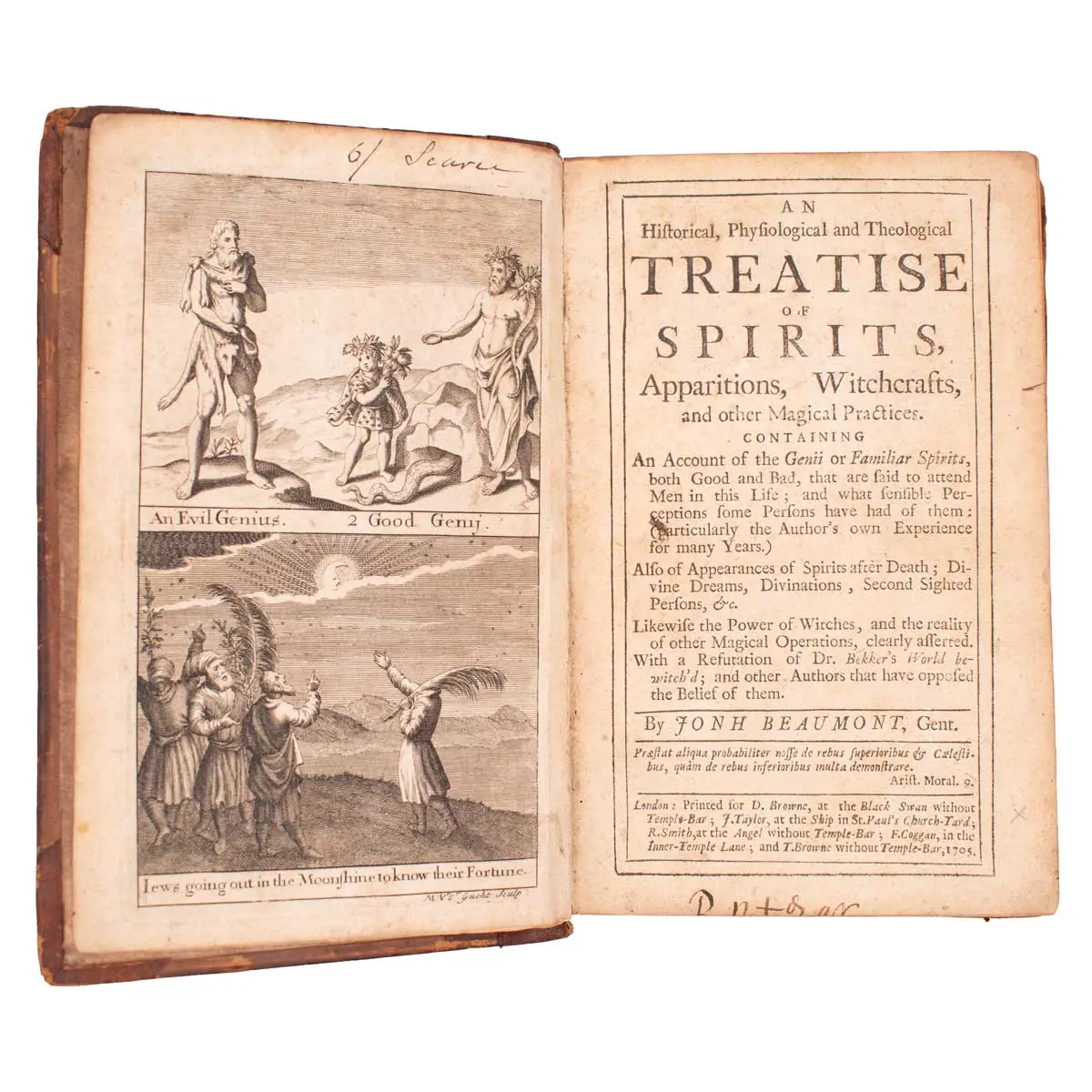
Physician, John Beaumont’s (c.1640-1731) First hand account of “some extraordinary Visitations having happened to me.”
EARLY ENLIGHTENMENT FIRST HAND ACCOUNT OF SPIRIT VISITATION
FIRST EDITION, [16], 400p., engraved frontispiece, occasional light spotting, uniform slight toning but otherwise clean and crisp, Armorial bookplate of John Stuart of Inchbreck, contemporary Cambridge style blind panelled calf, rebacked with later label, original endpapers, repairs to the inner joints, 8vo, London, for D. Browne, 1705.
Physician, John Beaumont’s (c.1640-1731) First hand account of “some extraordinary Visitations having happened to me.”
Along with practising medicine, Beaumont was also keenly interested in natural history, especially geology. He was elected Fellow of the Royal Society in 1685, on account of his work on fossils. He shared an interest in apparitions and the occult with other members of the Society, including Robert Boyle and Joseph Glanville.
In his Treatise of Spirits, Beaumont presents his ideas about the nature of spirits using accounts of what he considered to be related phenomena: cases of second sight, prophetic dreams, oracles, visions, witchcraft, fairies and magical feats. He was careful to choose modern accounts with credible sources, making particular use of stories from America, including the Salem witch trials. He also demonstrated a familiarity with other occult texts.
What made Beaumont’s Treatise of Spirits exceptional from other collections of ghost stories and supernatural tales (and there were many at this time), was his own involuntary first hand experiences with apparitions over two decades. His experiences impacted him on a deeply personal level and prompted him to write his book. Although he was careful to note he never summoned spirits and was surprised each time they appeared to him.
In one of the incidents, Beaumont describes how five spirits, two women and three men, appeared to him in his home in Somerset and stayed with him for two months. They threatened to kill him if he told anyone of their presence or if he went to sleep. After three nights of not sleeping he finally told someone that there were spirits tormenting him and he finally slept, although they continued to trouble him. He states that the spirits never tried to make him do anything, but spoke to him and each other constantly, including in his dreams.
Despite his profession, he did not accept the diagnosis of melancholia for his affliction, instead he used a pragmatic approach, acting as an investigator into his own case and others. He believed his own experience could provide a frame of reference for others, and went as far as to fault other writers in the subject for not having personal experience with spirits and being therefore incapable of truly understanding the subject. Although he also noted that he did not think his particular case could be used to prove the existence of spirits conclusively.
As a Fellow of the Royal Society and an enthusiastic naturalist, Beaumont adopted a similar enlightenment approach for explaining his encounter with spirits as those substantiating new discoveries in the natural world. One could not rely on observations alone, a multisensory approach must be taken. He dedicates full chapters to examples of multisensory experiences, as well as sight and sound. By focusing on the senses, Beaumont was able to adopt an empirical approach to understanding the supernatural.
Beaumont developed the theory that spirits – regardless of the label demon, angel, fairy or ghost – had nearly unlimited power to contravene the laws of nature. This was a significant divergence from the arguments of previous centuries, when many writers ascribed these powers specifically to the Devil. Yet he struggled to explain his visual and auditory encounters with spirits so he used history to support his accounts. Beaumont bases his treatise on the premise that genii or spirits were an ancient phenomena that had continued into his own day. He attributed all unusual events to these spirits, while other natural philosophers were arguing over whether these phenomena were caused by God, witchcraft or demons. He also interpreted contemporary accounts of witchcraft through his theory of spirits, mixing in examples from all over Europe and the wider Atlantic world, including the Americas. Beaumont argued that familiar spirits, genii, spectres, angels, and demons were essentially the same and that there were both good and bad ones.
Beaumont’s work was met with some resistance. Hans Sloane, collector and friend of Beaumont, later interpreted Treatise of Spirits as a symptom of a diseased mind and suggested that he could have cured Beaumont of this affliction through a course of heavy purging. After Beaumont’s death, the anonymous author of The compleat Wizzard (1770), wrote that ‘enlightened’ society had progressed beyond such beliefs with ‘more elegant and refined ideas.’
Beaumont’s contribution may not have been recognised by his contemporaries, but his arguments and sources are worth exploring. Early modern people could look at the same evidence and conclude that it may have been caused by witchcraft, the Devil, spirits, divine intervention, or fraud. Many demonologists and natural philosophers were arguing over the qualities of apparitions and witchcraft as the new science shifted the understanding of these phenomena. The correct interpretation was critically important, and accounts like Beaumont’s reveal the complex process by which early modern people made sense of their world. Beaumont evaluated the information available to him, and he interpreted the received knowledge about spirits found in books through the lens of his own experience.
Provenance:
Bookplate of John Stuart of Inchbreck (1751-1827), Professor of Greek at the Marischal College, Aberdeen and one of the founders of the Royal Society of Edinburgh.
[ESTC T111486; Invisible worlds: magic, spirits, and experiences in the early Enlightenment – Peone, 2022]