
 Marshall Rare Books
Analyseis geometricæ sex librorum Euclidis. Primi et quinti factae à Christiano Herlino : reliquæ unà cum commentariis, & scholiis perbrevibus in eosdem sex libros geometricos : à Cunrado Dasypodio. Cum indice gorismatōn kai lēmmatōn : item aliarum rerum atque verborum memorabilium. Pro schola Argentinensi
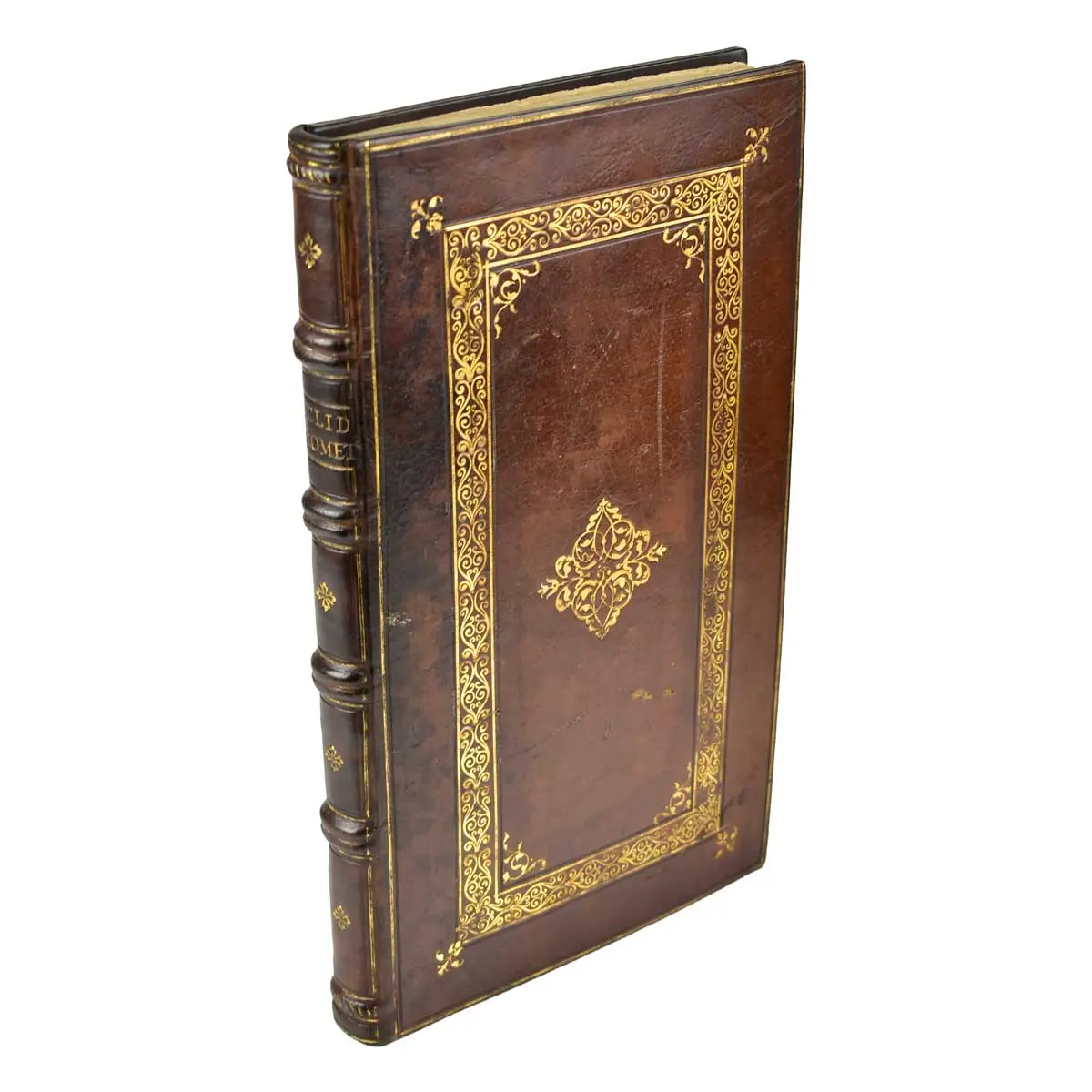
Euclid in Contemporary Arabesque Binding
[Strasbourg]: Josias Rihelius, 1566, folio (301 x 173 mm), Contemporary calf with gilt arabesque design within gilt borders, gilt central tool on both covers, rebacked, Woodcut device on title-page, woodcut initials and headpieces, woodcut illustrations throughout.
FIRST EDITION
Christian Herlin and Conrad Dasypodius’s collaborated to produce Analyseis Geometricae sex librorum Euclidis (Geometric Analysis of the Six Books of Euclid), first published in 1566.
Herlin and Dasypodius taught mathematics in Strasbourg and designed the second Astronomical clock in the Strasbourg Cathedral. The clock represented the synthesis of the most advanced scientific knowledge of the day in the fields of mathematics, astronomy, and physics.
Analyseis Geometricæ sex librorum Euclidis (The explanation of the six books of geometry of Euclid), which Dasypodius published it is specified on the title page that the books I and V were made by Christian Herlin. Little is known about this scholar, who does not seem to have left any writing other than what is taken up here by Dasypodius.
Christian Herlin and Conrad Dasypodius (ca.1530-1600) were both associated with the teaching of mathematics at the gymnasium in Strasbourg. Herlin was the first “mathematicus publicus” of the school, a position he held for thirty years, while Dasypodius was a student of Herlin and later held the chair of mathematics of the institution from 1562 until his death.
In the Analyseis , the two authors propose a transcription in terms of syllogisms of the proofs of the propositions of Books I to VI of Euclid’s Elements . A syllogism is a reasoning in which two premises, called major and minor, lead to the conclusion.
The most commonly cited example is this:All men are mortal, but Socrates is a man,
therefore Socrates is mortal.
The three propositions revolve around three terms, the middle term, man, the major term, mortal, and the minor term, Socrates. The conclusion establishes the link between the major and the minor, a link established thanks to the means, which is found in the two premises. In order for the reasoning to be valid, that is to say so that from two true premises one can draw a true conclusion, the syllogism must follow certain rules, which were first stated by Aristotle in the first analytics. The theory of syllogisms was of particular interest to medieval philosophers, and the art of reasoning was part of teaching in Renaissance schools and universities.