
 Marshall Rare Books
Archive of unpublished original photographs taken on the Daniels Ethnographical Expedition in British New Guinea, 1904.
DANIEL’S EXPEDITION TO BRITISH NEW GUINEA ONE OF THE MOST IMPORTANT SCIENTIFIC EXPEDITIONS TO BRITISH NEW GUINEA
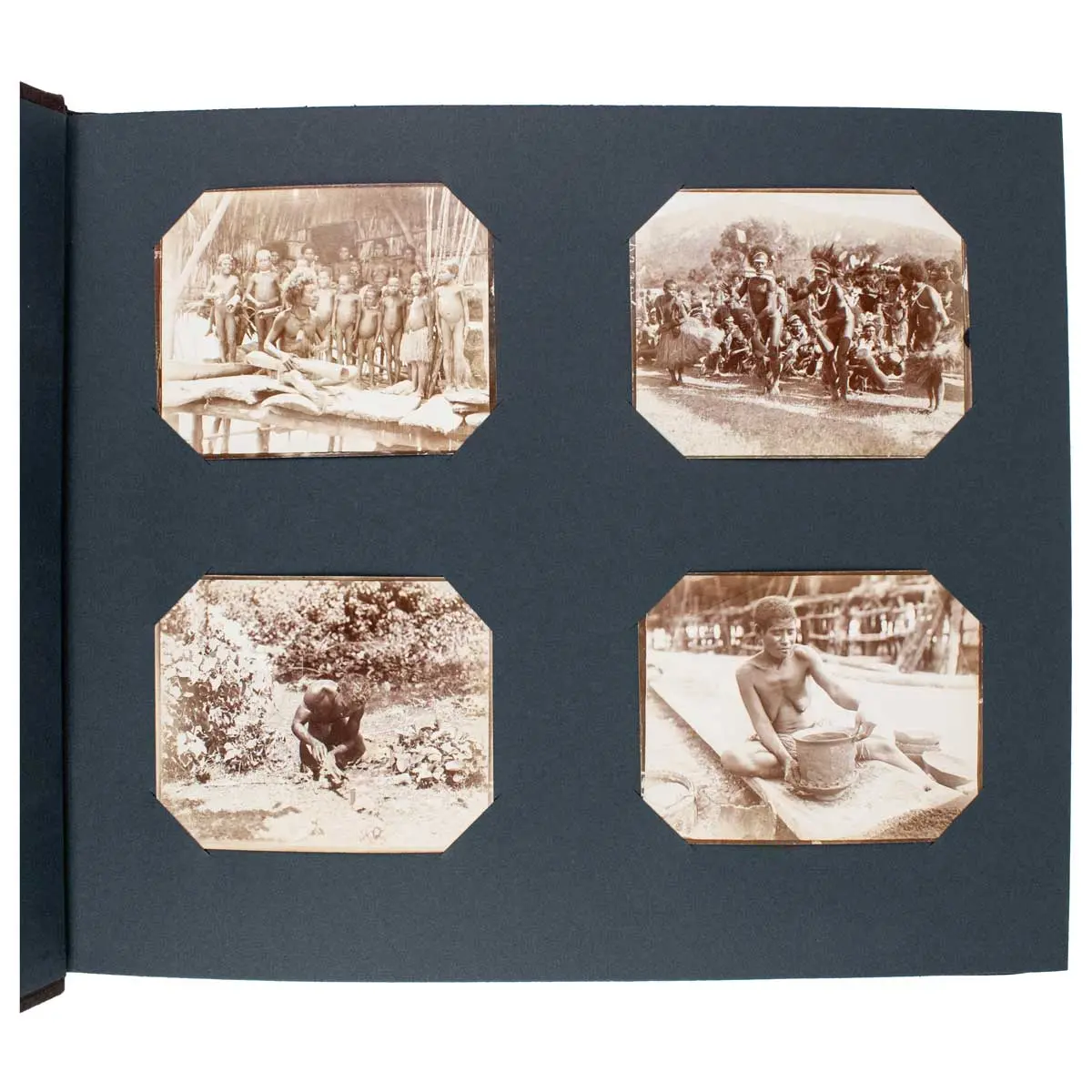
New Guinea, 1904, Oblong small folio, (320 x 270mm), half maroon Morocco over contemporary cloth side, photographs mounted 4 to each page and can be removed to read the annotations on the veso.
Group of 51 (fifty-one) FINE ORIGINAL PHOTOGRAPHS, in uniform 107 x 76 mm format; versos all with fully contemporary inscriptions in pencil (by expedition member Charles Seligmann) comprising the location of the scene and an informative caption, occasionally also with the initials ‘A. H. D.’ in blue pencil and a page reference in red (presumably for an intended publication); almost all the photographs in excellent condition.
A substantial photographic archive documenting one of the most important scientific expeditions conducted in British New Guinea prior to World War One, the Daniels Ethnographical Expedition of 1904.
These photographs were taken on the expedition: Daniels’ name is mentioned in the captions; the initials A. H. D. are those of expedition member Arthur Henry Dunning and the locations of the photographs accord perfectly with the expeditions itinerary.
Together, these images constitute a pictorial record of the fast-vanishing traditional cultures found in parts of Central Province, Milne Bay and the Trobriand Islands.
The following overview of the expedition is published on the website of the British Library, which holds a collection of precious wax cylinder recordings, as well as photographs, made on the Daniels Ethnographical Expedition:
‘The Daniels Ethnographical Expedition was led and financed by Major William Cooke Daniels (1870–1918), a wealthy American retailer who met the British anthropologist Charles Gabriel Seligmann (1873–1940) by chance on a fishing trip in Hampshire, UK. Seligmann had taken part in the 1898 Cambridge Anthropological Expedition to Torres Straits and had visited what was then British New Guinea. His interest continued after his return to the UK. The other members of the Daniels expedition were Walter Mersh Strong (1873–1946), a doctor who left midway through to become Assistant Resident Magistrate in Mekeo district, and Arthur Henry Dunning (1884–1959).
Seligmann, Strong, and Dunning arrived in the capital, Port Moresby, on 19 December 1903. The first recordings were made on 5 January 1904 in Port Moresby, when Dunning, assisted by British Resident Magistrate Francis Rickman Barton, recorded three cylinders of lagatoi songs. Lagatoi are the double-hulled sailing canoes used in the hiri, the annual trading expedition that Motu/Koita people took to the Papuan Gulf to trade their clay pots for sago; the hiri is still celebrated today and remains an important symbol for the Motu/Koita people.
Seligmann, Strong, and Dunning joined a government expedition to the western part of British New Guinea in January but left early when Seligmann and Dunning fell ill. They did not take the phonograph, the machine used to record and play wax cylinders, on this trip as they could not find any spare cylinders.
Daniels and his yacht, the Kori, arrived in Port Moresby on 23 May. Over the next five months, the team visited Hula and the Mekeo and Rigo districts in what is now Central Province, and islands in Milne Bay including Samarai, Tubetube, Muyua, Gawa, Kwaiawata, Iwa, and the Trobriand Islands. They also visited Dogura in Bartle Bay, and Wagawaga, a village on the coast of Milne Bay.
Seligmann and Dunning recorded eleven cylinders in the Rigo district, including songs in the Sinaugoro, and possibly the Uare and Doromu-Koki languages. They travelled from Rigo to the village of Hula, where five cylinders were recorded. In what is today, Milne Bay Province, they recorded five cylinders on Tubetube, two on the Trobriand Islands, and six at Wagawaga.
In October, the expedition returned to Port Moresby and Daniels left. Seligmann and Dunning stayed in Port Moresby, spending time with Barton and Ahuia Ova, the Koita Chief and Village Constable of Hanuabada, the Motu/Koita village near Port Moresby. Ahuia had previously worked with members of the 1898 Cambridge Expedition. Seligmann and Dunning recorded seven cylinders in the Koitabu language, including one by Ahuia Ova himself. Two other lagatoi songs were performed by a Motu man named Igo who had travelled with the expedition in Central district….’
A splendid archive.
See: Ann Lazarsfeld-Jense. Two Against the Tide. The shared career and lost legacy of Brenda and Charles Seligman.