
 Marshall Rare Books
Battle Scene: Soldiers Coming down a river fire a canon from their galleon. a castle on a hill and greenery in the background with a burnished golden sky. the canon ball is aimed at a large castle with archers on the roof toward the river and three noble ladies in between the turrets. on the ground, Knights surround a Queen on horseback with a lady in waiting and banner men. a noble man is kneeling and presenting the keys to the castle with three knights behind him pleading allegiance.
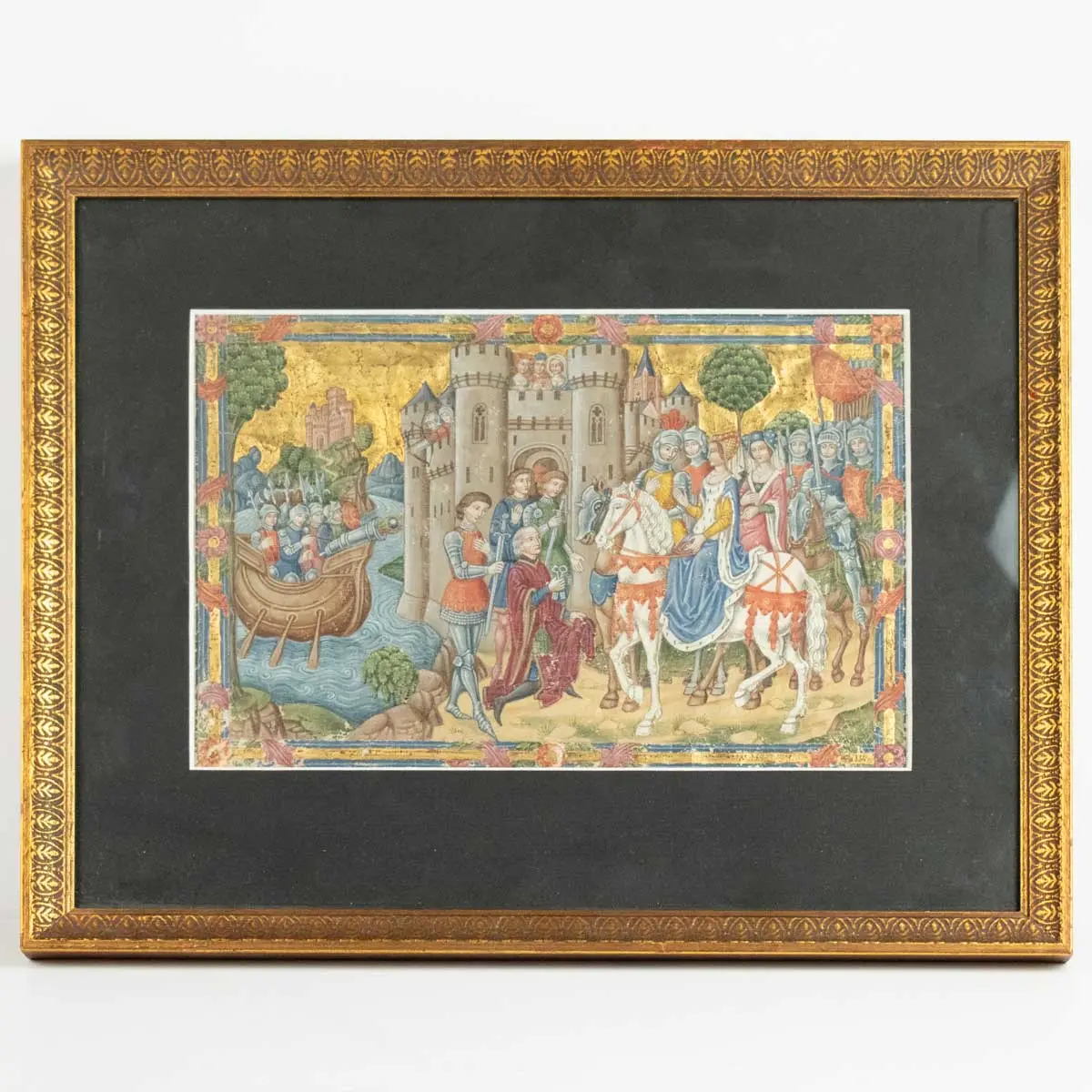
A very attractive illuminated miniature of one of the finest medieval scenes by the forger.
Illuminated Miniature, on vellum. 25.5 x 18.2 cm,Framed, verso with two lines of text with Music on a 4-line stave. rubbed around the edges. circa 1900.
A very attractive illuminated miniature of one of the finest medieval scenes by the forger.
Bella da Costa Green, then director of the Pierpont Morgan Library, unmasked the Spanish Forger in the 1930s. He has retained the name “Spanish Forger” because scholars originally believed him to be a Spanish painter of primitives—panel paintings as well as manuscript illumination–working in a northern style in the fifteenth century.
Today he is known as “the most skilful and successful and prolific forgers of all times.” Indeed, he may be the only forger to have enjoyed a one-man retrospective at a major museum with an accompanying catalogue raisonné of his works, and to be collected by museums and private collectors in his own right. The artist was already active in the 1890s, perhaps in the early 1880s, and he was still painting in 1920. He borrowed freely from chromolithographic editions published in Paris for his compositions, which suggests that he may have been employed by one of the Parisian publishing houses (Auguste Firmin-Didot?).
Stuffed inside some of the original frames were remnants of old Parisian newspapers. Scientific analysis of his paintings discloses the presence of green copper arsenate, which was not available before 1814, among other modern pigments, and he applied his gold leaf last, rather than first, in a glaring departure from medieval technique.
William Voelkle and Roger Wieck, The Spanish Forger, New York, Pierpont Morgan Library, 1978