
 Marshall Rare Books
Bemühung den Aberglaube zu stürzen
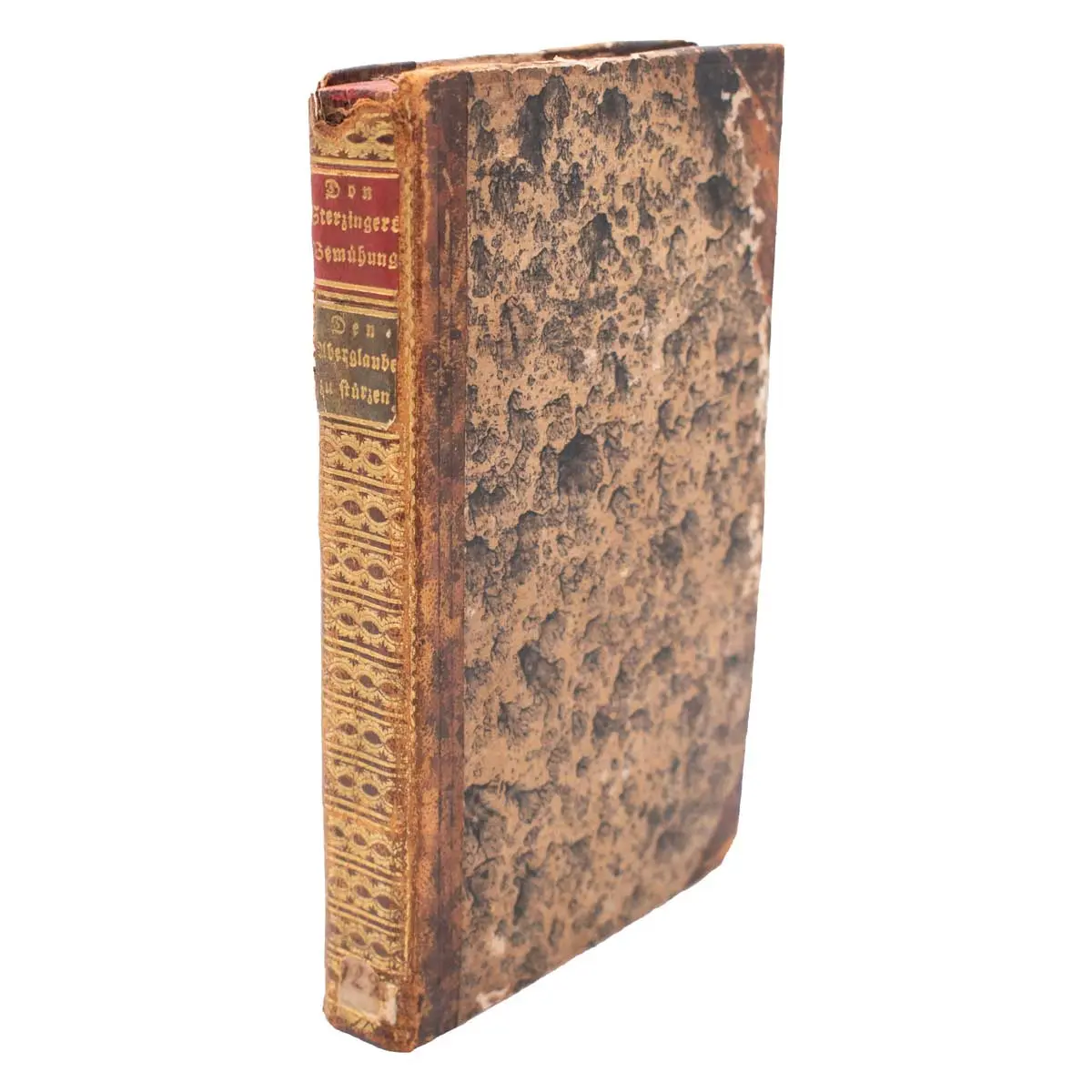
The Bavarian ‘Witchcraft War’
FIRST EDITION, [12], 187pp., woodcut printers device, head and tail-pieces, slight foxing to first few leaves, marginal tear to 135/136pp not affecting text, contemporary half calf over marbled boards, spine gilt, red and green morocco labels, a.e.r., marbled endpapers, 8vo, Munich, Lentner, 1785.
First Edition of this important work on the witch hunt craze that was so endemic in Bavaria during the mid eighteenth century. Ferdinand Sterzinger (1721-1786), a Bavarian priest of the Theatine order and one of the leaders of the Bavarian attack on witchcraft in the 1760s, wrote this deeply sceptical work. As an Enlightened Catholic thinker, he found the notion of physically dangerous demons silly and unbiblical. As a prominent member of the Bavarian Academy of Sciences, Sterzinger ignited a noisy discussion on witchcraft in his “Academie Address” which he delivered on 13th October 1766, a decade after the last execution of a witch in Bavaria.
In a speech that was only sanctioned on a technicality, Sterzinger launched a full-frontal assault on witchcraft beliefs. He defined witchcraft beliefs as “common prejudice”, skirting around the Academy’s rule forbidding the discussion of religious topics. Sterzinger treated the belief in witchcraft as a laughable superstition, relegating the theological authority of St. Augustine and Thomas Aquinas into the era of fairy tales. Sterzinger was tactful enough to establish certain reservations to avoid offending church authorities. His concessions reveal some of the fundamental paradoxes of the early Catholic Enlightenment, which was considerably more tradition-bound than its Protestant counterpart. Sterzinger could not dare take the decisive step of rehabilitating all the victims of the persecutions as innocents. However this did not diminish Sterzinger’s resilient insistence that “witchcraft is […] in and of itself an empty and vain nothingness, a prejudice and imagining of unstable minds”.
His speech, swiftly issued in printed form, touched on the Bavarian witchcraft war (Bayrischer Hexenkrieg), the last major public debate on the subject in early modern Europe. Sterzinger’s presentation was well received in all German speaking regions, winning approval from champions of the Enlightenment.
[ VD 18 13823132; Ackermann IV, 918; Exorcism and Enlightenment, Midelford, 2005; Witchcraft Persecutions in Bavaria, Behringer, 2002]