
 Marshall Rare Books
Bibliopegia; or, the Art of Bookbinding, in All its Branches
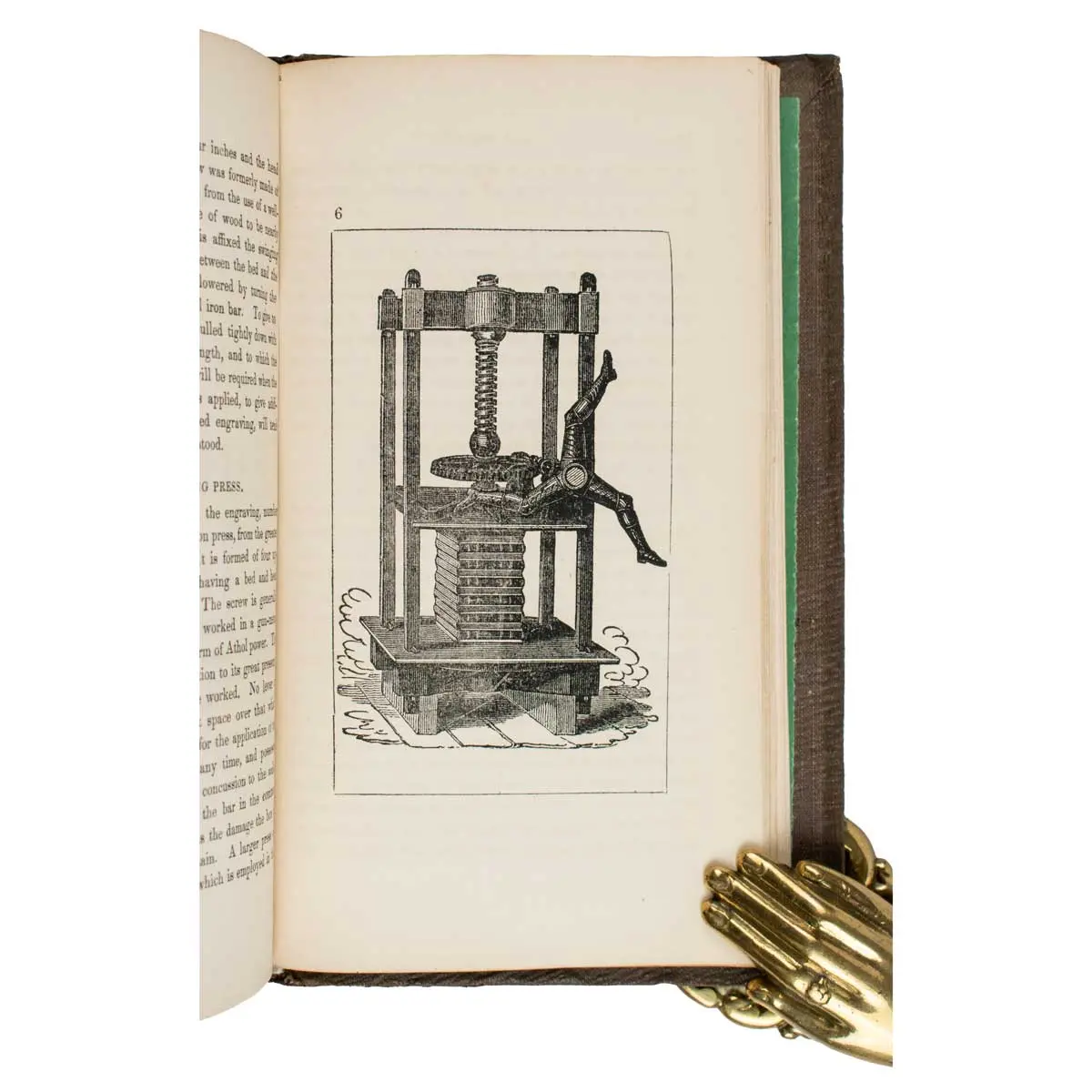
This was the sixth bookbinding manual to be published in England
9 steel engraved plates (including frontispiece), slight spotting throughout, publishers decorative cloth, rebacked, original spine laid on, 12mo, London, Richard Groombridge, 1835.
This was the sixth bookbinding manual to be published in England. Although this volume lacks the interesting trade lists and tables contained in Cowie’s manual of 1829, it is the more significant, and it is interestingly illustrated. It was published at a time of many changes in the structure of the trade which were brought about by the introduction of new techniques and equipment, which in turn resulted from the rapid evolution of industry and society in general.
Bibliopegia was the first English manual to carry illustrations of equipment, the frontispiece depicting the machine that led to one of the most significant changes in trade binding in the 19th century; the Imperial Arming Press. “The invention of the blocking machine in the 1830s made stamping into the cloth casing possible – the first blocked title appeared in 1832.” The making of the cases became an operation of mass-production, and also of cost-reduction.
“The effect of the new regime on working practices and conditions, and the bindings themselves, was profound. The development of the case binding market created within the bookbinderies a new class of work and a recomposition of labour, the skilled job of 29 forwarding in leather becoming marginalised in favour of the segregated mass-production of the simply constructed cloth cases.” – Factory Manoeuvres Trade Binding and Labour in London: 1780-1850 – Dominic Riley and John DeMerritt.
It is interesting to note that Arnett, an intelligent man of integrity and kindly disposition, appears to accept current practices without question, as did almost everyone else, at least in public. Changes were rapid and commercial pressures were very strong, so it was likely to be hazardous to demur, and it should be noted that Arnett was working for a large publisher at this time.
The illustrations and fairly detailed descriptions of techniques makes this work a useful source of information about early nineteenth-century binding practices. It was reprinted several times, including in 1980, with an introduction by Bernard C. Middleton.
[Bookbinder Vol. 19 Dominic Riley and John DeMerritt; Middleton, 17]