
 Marshall Rare Books
Birds of Prey
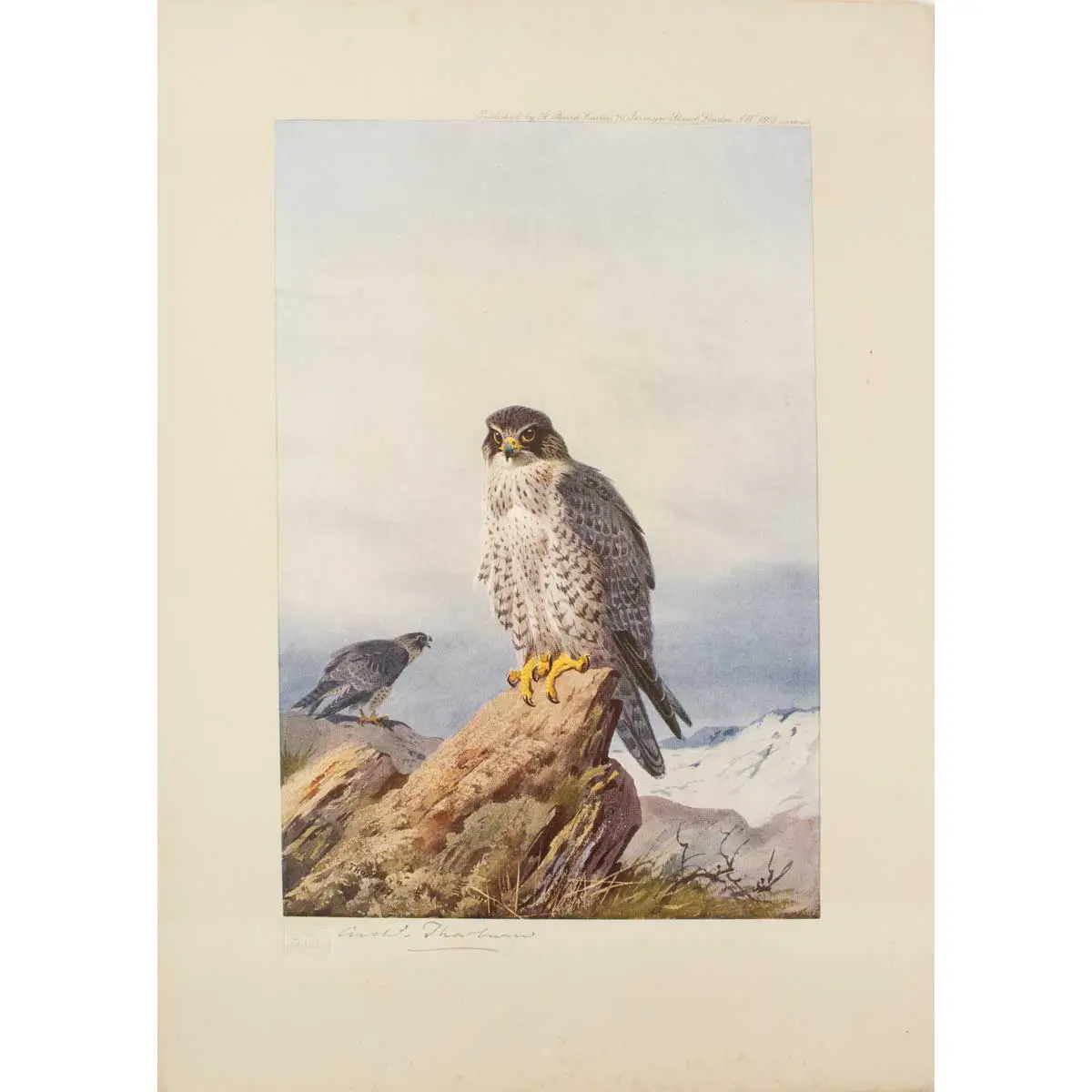
The scarcest of Thorburn’s works and one of the rarest British Bird Books
London: W. F. Embleton, 1919. Small folio (355×253 mm), Original Paper boards with Title on Upper Cover, Silk Ties,
One of 150 sets of proofs, 12 colour plates by Thorburn, each signed by him in pencil and with small stamp to lower margin as issued, text leaves with 2 holes punched in upper inner or outer corner as published, previously held together with silk ties.
Archibald Thorburn lived in the final phase of the era of great illustrated bird books. He was undoubtedly the most popular bird artist of his generation. He contributed splendid illustrations to publications including Henry Eeles Dresser’s A History of the Birds of Europe, Charles William Beebe’s A Monograph of Pheasants, Leonard Irby’s Ornithology of the Straits of Gibraltar, Lord Thomas Lilford’s Coloured Figures of the Birds of the British Isles, as well as his own books, notably Birds of Prey, British Birds and A Naturalist’s Sketchbook. He illustrated John Guille Millais’s British Diving Ducks. Yet his reputation rests as much, if not more, on his accomplished watercolour compositions.
Thorburn was a Scot, born at Lasswade, near Edinburgh, on 31 May 1860, the son of the miniature painter Robert Thorburn (1818-1885). He was educated at Dalkeith and Edinburgh before being sent by his father to the newly founded St John’s Wood School of Art in London. The first important book he illustrated was Familiar Wild Birds by Walter Swaysland, a Sussex naturalist and taxidermist; this work, published in four small volumes between 1883-1888, dealt with all the familiar birds of the English countryside from owls to sparrows, which Thorburn illustrated with one specimen to each plate, setting them with suitable foregrounds. His accomplishment in delineating the bird and in capturing the detail and texture of its plumage immediately attracted the attention of Lord Lilford. He was in the process of publishing his major work on the birds of the British Isles, to which Thorburn eventually contributed over 250 plates. Unlike most other artists, Thorburn concentrated almost entirely on species native to the British Isles rather than exotic species. A member of the British Ornithologists’ Union and Fellow of the Zoological Society, Thorburn was also a keen sportsman. It was in his depiction of game birds, birds of prey and wildfowl that he truly excelled. He died at Hascombe, near Godalming in Surrey, on 9 October 1935.