
 Marshall Rare Books
Burmese Parabaik Tattoo Flash Book
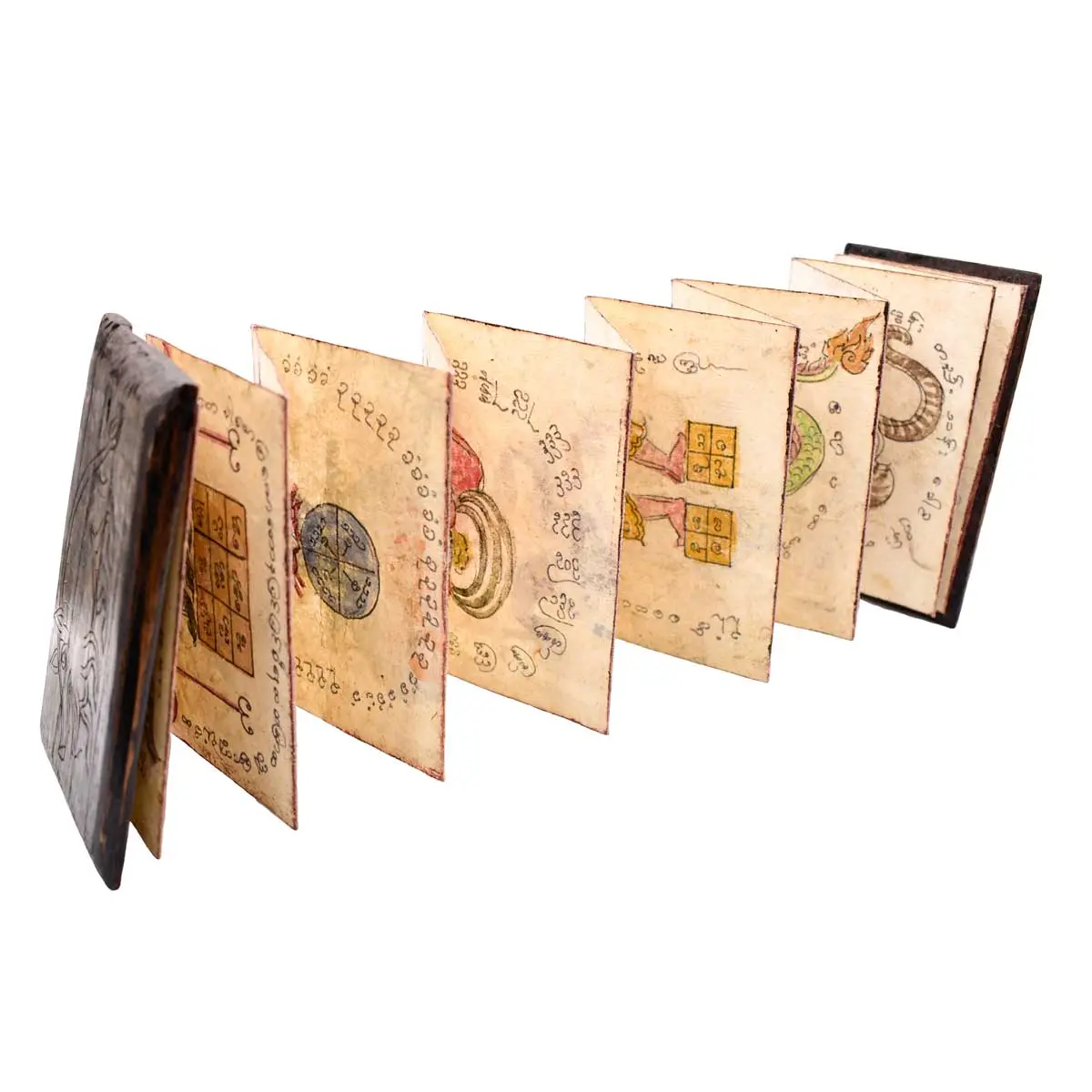
RARE AND BEAUTIFUL MANUSCRIPT BURMESE TATTOO DESIGN BOOK
16 leaf , 16 hand painted illustrations on saa paper, accordion or concertina-style, double sided, original wooden board hand carved with a pig and a tiger, a.e.r., 8vo (16.5 x 11cm, 150cm unfolded), Shan Region, Burma, c.1800s
A Rare and unusual manuscript tattoo design book from the Shan region of Burma, (currently Myanmar). This work is made from foldout mulberry (saa) paper with sacred symbols of mythology, as well as numerology and sacred Buddhist texts. The Shan are a Southeast Asian ethnic group who live primarily in Myanmar, but are believed to have originated in China. The majority of the Shan are Theravada Buddhists. Tattoos related to Buddhism would often be created at temples by monks, thus ensuring that the wearer would be protected from harm. Other common motifs for tattooing in Myanmar include cats of various sizes from house cats to tigers, dragons, geometric patterns, and figures from Myanmar’s and Buddhism’s history and culture. Both Chinese and Buddhist influences can be seen in their art, though the uniquely Burmese style of the Shan is undeniable. Interestingly, until the 20th century, tattooing was a widespread practice among the Burmese (even women), particularly among the Shan who boasted one of the oldest tattooing traditions.
“The traditional art of tattooing is deeply rooted in Myanmar’s history: from kings to Commoners, tattoos were exemplars and devices of state bondsmen, masculine strength, feminine beauty, cultural identity and aesthetic appeal, while endowed as well with spiritual powers serving as protection from evil forces.”- Moe Moe Oo
Due to the Shan belief that tattoos imbued the wearer with spiritual strength and/or held magical significance, tattooing came to have great importance. It was practised—and has recently regained popularity—during times of turmoil. As tattooing frequently took days, opium was the preferred anaesthetic, accounting, along with Western influences, for the tradition dying out at the beginning of the 20th century.
[“Tattoo Art in Myanmar Culture: Special Reference with State Bondsmen of Cavalry Corps 2016” written by Moe Moe Oo from the Ministry of Education, Myanmar]