
 Marshall Rare Books
Cosmographicus Liber a Petro Apiano Mathematico Studiose Collectus.
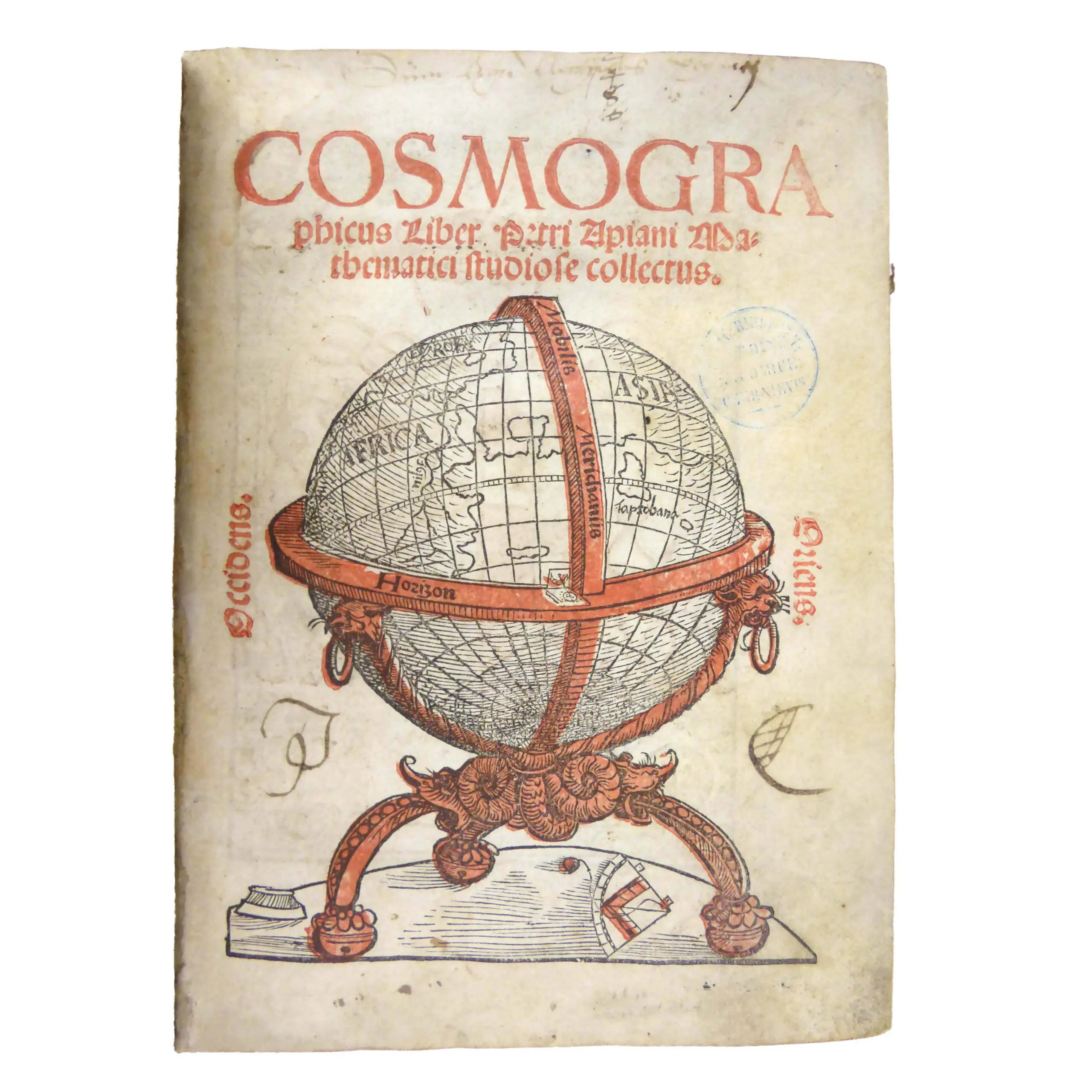
Cosmographicus Liber a Petro Apiano Mathematico Studiose Collectus. Landshut, Johann Weissenburger für Petrus Apianus, 1524. Numerous woodcuts and 4 volvelles. (8), 104, (8, last blank) . Small 4to (195 x 152mm), contemporary limp vellum, Very Scarce First Edition of one of the most important geographical and astronomical texts of the Renaissance, and one of the most signi cant and in uential of the 16th century instrument books for navigators and travellers.
Landshut, Johann Weissenburger für Petrus Apianus, 1524. Numerous woodcuts and 4 volvelles. (8), 104, (8, last blank) . Small 4to (195 x 152mm), contemporary limp vellum,
Very Scarce First Edition of one of the most important geographical and astronomical texts of the Renaissance, and one of the most significant and influential of the 16th century instrument books for navigators and travellers.
Title-page with large woodcut illustration of a globe, woodcut coat- of-arms of Archbishop Matthäus Lang of Salzburg on title-page verso and last leaf of the foreword with a large woodcut depicting a sphere are printed in red and black. Borba de Moraes calls for 4 mobile diagrams (volvelles) on page 17, 24, 63 and on the first leaf of the appendix. This copy has these four mobile diagrams. The most important illustration with mobile parts is on page 63: it shows the world seen from the North Pole with quite a large piece of America.
Petrus Apianus (1495-1552) was born in Saxony as Peter Bienewitz. He studied at the University of Leipzig from 1516 to 1519, where he took a Latinised version of his German name: Petrus Apianus. In 1520 he moved to Vienna, where he was part of the second Vienna school of cartography and produced his first world map there. He then moved again to Landshut, where he produced the ‘Cosmographicus liber’ in 1524, his first major work.
The system for cartographic projection which Apianus used attained enormous success and was popularized by Münster and Ortelius. It was Petrus Apianus who designed the first map printed in a book to contain the name America (Solinus). The maps on page 2 and 63, and the following passage in the text: “America quae nunc Quarta pars terrae dicitur ab Americo Vespucio eiusde(m) inve(n)tore nomen sortita est. Et non immerito: Quoniam mari undig clauditur Insula appellatur…” make this edition of the “Cosmography” much sought after. As can here be seen, the discovery of America is attributed to Vespucci, and it is called an island because it is surrounded by water on all sides.
Apianus “Cosmography” had countless editions, and translations into Spanish, French and Dutch, with annotations and additions by Gemma Frisius, and new, more correct maps. The copies of the first Latin editions (1524, 1529, 1533) with all mobile diagrams are very rare.
Based on the theories of Ptolemy, it contains paper instruments called volvelles, which Apianus would use so effectively in his work that they are sometimes known as Apian wheels. It covers “the division of the earth into climatic zones, the uses of parallels and meridians, the determination of latitude, several methods for determining longitude including that of lunar distance, the use of trigonometry to determine distances, several types of map projections, and many other topics” (Karrow). America is depicted on the globes on pp. 2 and 63 and described on p. 69.
Copies are very rarely found with the full complement of volvelles: the British Library copy, for instance, lacks the volvelle on p. 50. The book is uncommon. We have been able to trace only five examples of the first edition selling at auction.
VD 16, A 3080; Sabin I,1738; Borba de Moraes I,35; Harrisse 237; Suarez 91,46; Kleinschmidt (Ruling the Waves) 223.