
 Marshall Rare Books
Cosmographicus liber Petri Apiani mathematici studiose correctus, ac erroribus vindicatus per Gemmam Phrysium.
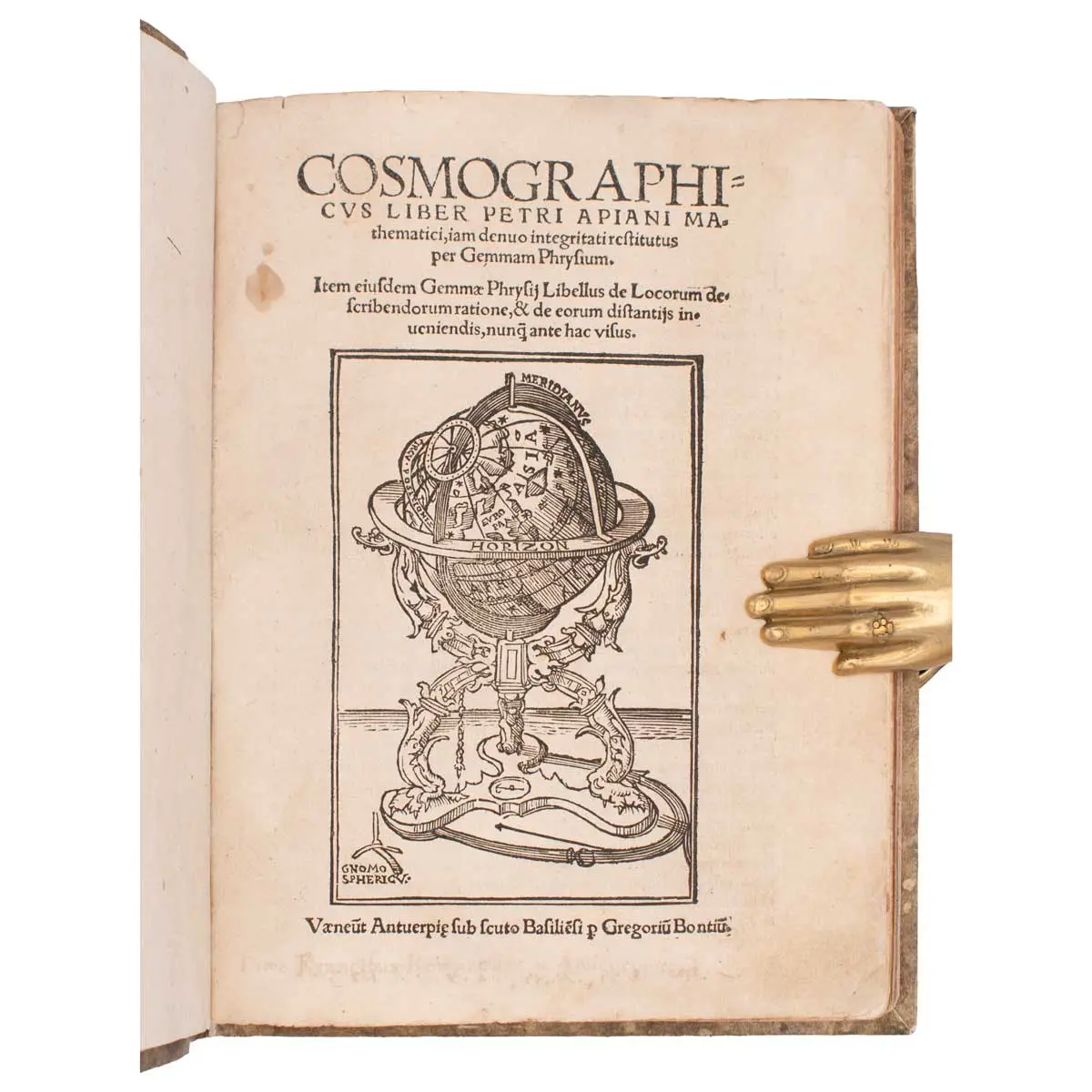
First published in 1524, the Cosmographia provided a layman’s introduction to a range of subjects including astronomy, geography, cartography, surveying, navigation and mathematical instruments. Cosmographia is divided into two main parts; one discussing the principles of cosmography, the other providing cosmographical data, e.g. a general geographical description of four continents, and a table of 1417 places with their coordinates.
Sig. A-P4,Q6, 4 moveable volvelles, numerous wood cut text illustrations throughout of globes, astronomical instruments, calendars and volvelles, final leaf lower corner skillfully repaired, not affecting text, early vellum, remboîtage, 4to, Antwerp, Gregoriu Bontiu, 1534
First published in 1524, the Cosmographia provided a layman’s introduction to a range of subjects including astronomy, geography, cartography, surveying, navigation and mathematical instruments. Cosmographia is divided into two main parts; one discussing the principles of cosmography, the other providing cosmographical data, e.g. a general geographical description of four continents, and a table of 1417 places with their coordinates.
Gemma Frisius produced a new edition of Cosmographia just five years after the original was published. In 1533, the original, corrected work was enlarged by the addition of two short works by Frisius; De locorum describendorum ratione (Concerning the method of describing places) and De eorum distantijs inveniendis (Concerning determining their distances). Gemma described the theory of trigonometric surveying and in particular it contains the first proposal to use triangulation as a method of accurately locating places. It was with Frisius’s additions that the popularity of the Cosmographia soared.
The manual became a highly respected work on astronomy and navigation that was to see over forty reprints in 14 languages and that remained popular until the end of the 16th century. Although one of the reasons for the book’s enormous popularity was undoubtedly its discussion of the newly discovered lands in the New World, available in all editions. Another was the book’s inclusion of ingenious volvelles or paper devices which enabled one to solve practical mathematical problems relating to time-telling, the calendar, astronomy and astrology.
Regnier Gemma Frisius was born in 1508, and went on to become the leading theoretical mathematician in the Low Countries and also to become professor of medicine and mathematics at the University of Louvain. He was the first to describe how an accurate clock could be used to determine longitude. While still a student, Frisius set up a workshop to produce globes and mathematical instruments. Frisius created or improved many instruments, including the cross-staff, the astrolabe and the astronomical rings. In 1530 he produced a combined terrestrial and celestial globe, which was engraved by the goldsmith Gaspar Van der Heyden and by the end of the year the globe could be bought from his workshops in Louvain. To supplement the globe he published in the same year in Antwerp the treatise De Principiis Astronomiae Cosmographicae. In the first part of it are explained geographical and astronomical terms such as latitude, longitude, meridian, poles, eclipses, signs of the zodiac etc. The second part gives instructions how the globe could be used while the third part vividly describes for the reader the peoples, geographical discoveries, navigation to the New World and the possible route to Cathay and many more distant lands.
He became noted for the quality and accuracy of his instruments, which were praised by Tycho Brahe, among others. His students included Gerardus Mercator (who became his collaborator), Johannes Stadius, John Dee, Andreas Vesalius and Rembert Dodoens.
(cf. G. Kish, Medicina, mensura, mathematica: The Life and Works of Gemma Frisius, Minneapolis, MN, 1967, passim).Index Aureliensis 106.444; J. Alden & D.C. Landis, European Americana: a chronological guide to works printed in Europe relating to the Americas, 1493-1776, (New York, 1980-1997), 550/3; F. van Otroy, Bibliograhie des oeuvres de Pierre Apian, (Besançon, 1902), no. 38; F. van der Haegen & M.-Th. Lenger, Biblioteca Belgica. Bibliographie générale des Pays-Bas, (Bruxelles, 1964), I, A-222; H. Röttel & W. Kaunzner, Die Druckwerke Peter Apians, in: “Peter Apian. Astronomie, Kosmographie und Mathematik am Beginn der Neuzeit”, K. Röttel, ed., (Eichstätt, 1995), p. 263.