Marshall Rare Books
Daemonologie, in Forme of a Dialogue, Divided in three books.
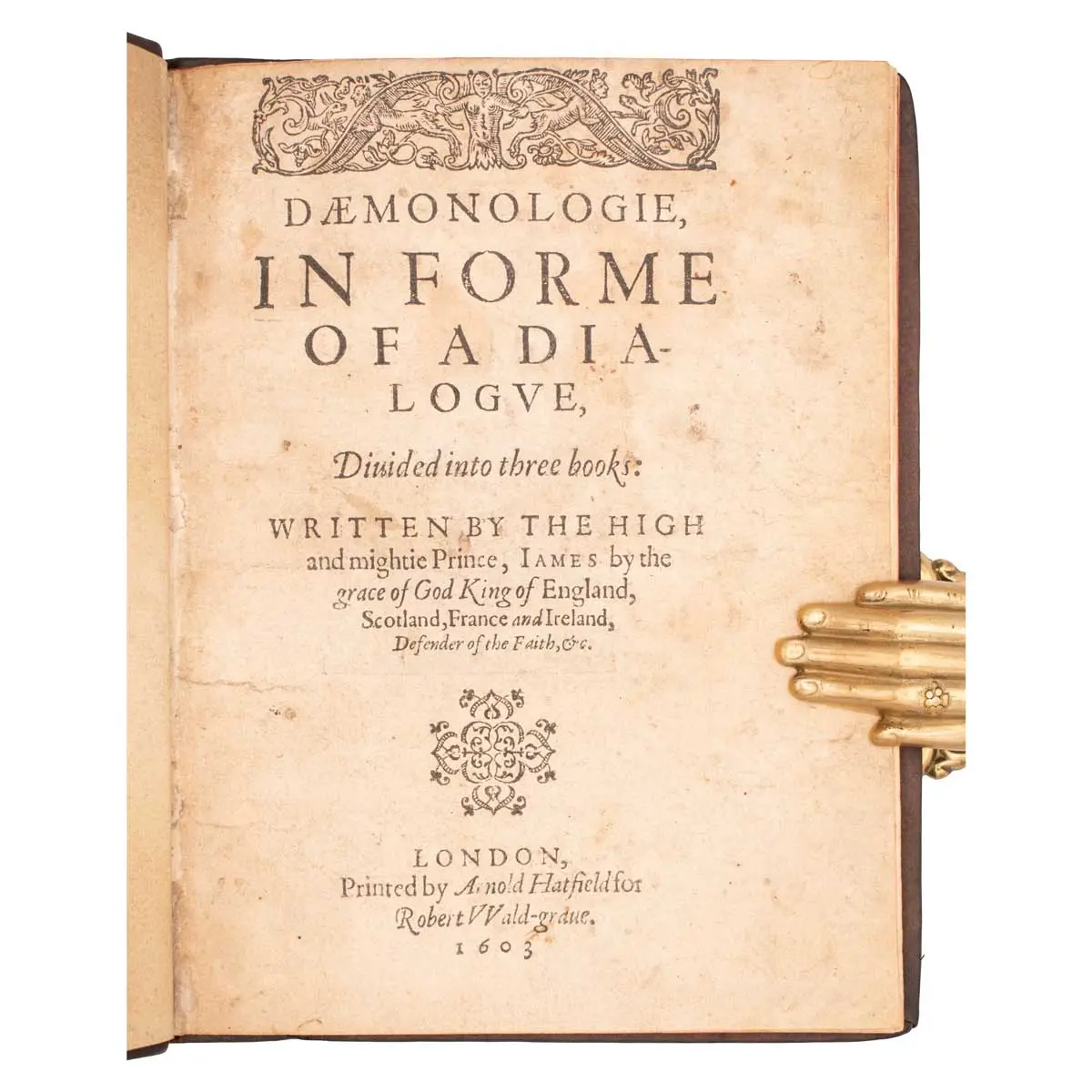
WRITTEN BY KING JAMES I/VI – THE MOST FAMOUS ENGLISH WORK ON DEMONOLOGY AND WITCHCRAFT
64pp[I.E. 80].,minor ms. restoration to few letters on final leaf, small label to flyleaf, small 4to (180x140mm), later full calf, London, by Arnold Hatfield for Robert Waldgrave, 1603.
An excellent example of a very scarce work.
“A deep work on Demonology, embracing, in their fullest extent, the most absurd and gross of the popular errors on this subject” – Watler Scott on James I’s Daemonologie
First published in 1597, in Daemonologie James I attempted to refute a number of rationalist texts that had argued against the existence of witchcraft.
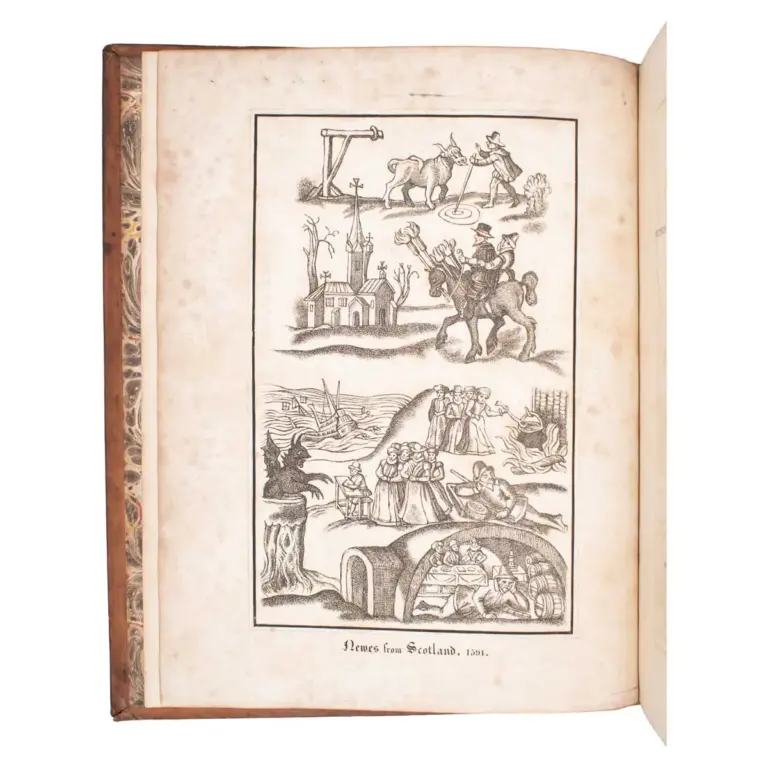
At the beginning of his reign in Scotland, King James was a firm believer in witchcraft. He was personally involved in two of the five great witchcraft panics in Scotland. The first was in 1570-1, involving the famous North Berwick Witches. The accuseds confessions, extracted using torture as part of the criminal process, included information on an attempt to murder King James VI and his bride in Denmark. They were forced to confess they had gone to sea in sieves and had tried to raise a storm to wreck the King’s ship en route to Norway. The King fully accepted this account. When the jury acquitted one of the accused, James was so incensed that he charged the jury with “an assize of error” and they agreed to “yield themselves to the king’s will.”
King James’ interest in the North Berwick witches no doubt led him to start on his Daemonologie. It is a dialogue written in three parts, following the classic tradition of European demonologists with the overall argument: witches exist, they should be prosecuted by the lawful authorities, and those who deny these points are at best badly astray, and at worst actually in league with witches. The three books are divided thus: Book one focuses on magic in general and necromancy, Book two covers sorcery and witchcraft, and Book three discusses spirits, spectres and different diabolical accounts.
James also includes in this book a denial of the existence of lycanthropy, which served to create the illusion that this was a measured and considered work. In reality, the book details extreme views, including advocating for trial by water and devils marks in order to root out “so odious a treason against God”.
Although the work had been conceived and written, at least in part, as an immediate reaction to the witch trials of 1590-1, its publication clearly represents a reaction to the trials of 1597, as it describes a situation in which witch hunting is actively occuring. The Daemonologie was also written to refute the Discovery of Witchcraft (1584) by Reginald Scot, and De Praestigiis Daemonum (1563) by Johann Weyer.
When James VI of Scotland became James I of the united kingdoms of England and Scotland in 1603, he brought out a new edition of his demonology, which no doubt received special attention because of its royal author and it was often quoted in contemporary witch trials. That same year he tried to have extant copies of Scot’s Discovery of Witchcraft destroyed, and within one year of his accession, he had coerced Parliament to pass a new witch act. The 1604 statute changed the emphasis from maleficia to the pact with the Devil, in line with continental thinking, and certainly heightened the attack against witches.
James, like all demonologists, did draw on popular beliefs as these presented themselves in witches’ confessions – but he also displayed consistent scepticism about any popular testimony that did not fit his intellectual system. The first break in the King’s creduality was in 1605, when he was forced to quash a witch trial when, after questioning, the accuser admitted to fraud. From this point on James became more obsessed with routing out fraudsters and imposters than destroying witches. In the final nine years of James’ reign there were only five people executed for witchcaft.
This is a very scarce copy of the 1603 edition. A Dutch translation appeared in 1604, and two Latin editions in 1604 and 1607. The work was a source for Shakespeare in creating his witches in Macbeth.
Provenance:
Devid Leigh, psychiatrist.
[STC 14366; Robbins, The Encyclopedia of Witchcraft and Demonology; Goodare, The Scottish witch-hunt in context]
Books you may also like
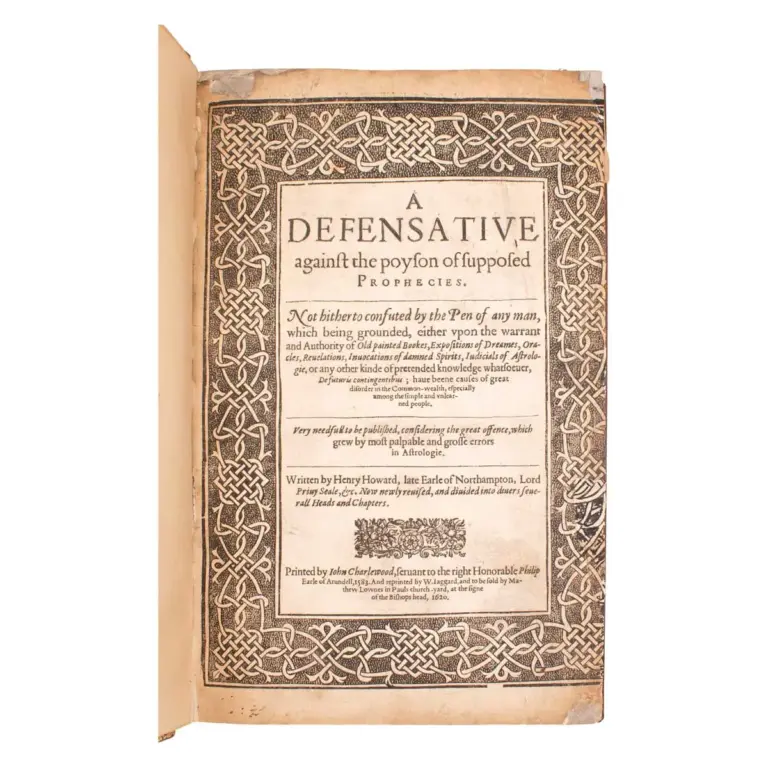
A Defensative Against the Poyson of Supposed Prophecies
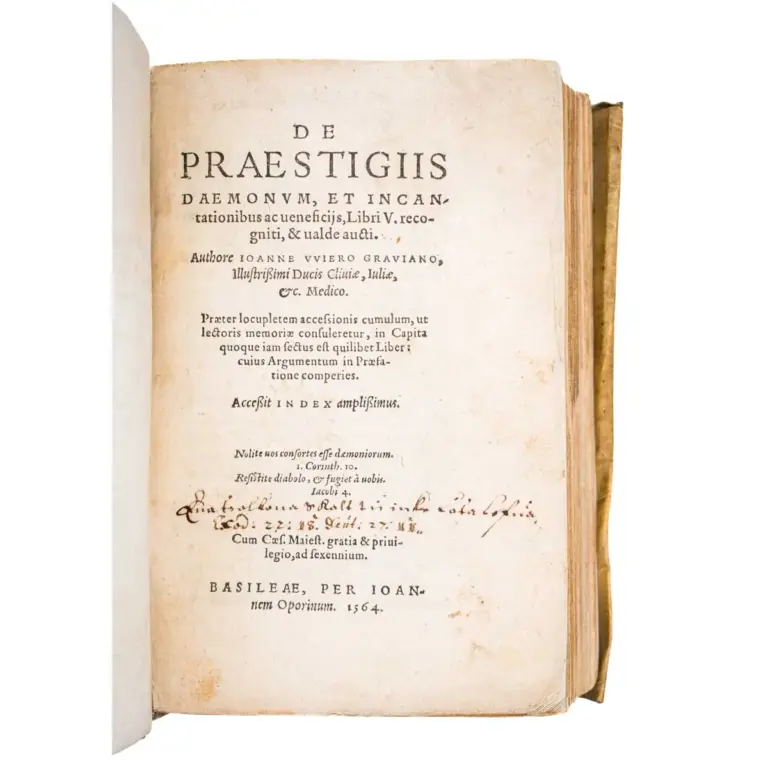
De Praestigiis Daemonum, Et Incantationibus ac ueneficiis, libri V. recogniti, & ualde aucti. Authore Ioanne Vviero Graviano, illustrißimi ducis Cliuiae, Iuliae, &c. medico.
Memorialls; or, The Memorable Things that Fell Out Within This Island of Britain from 1638 to 1684. Edited from the MS. by Charles Kirkpatrick Sharpe, Esq.