
 Marshall Rare Books
De Jure Maritimo et Navali: Or a Treatise of Affairs Maritime and of Commerce. In three books. The seventh edition, carefully corrected, with (...) many modern cases never before printed.
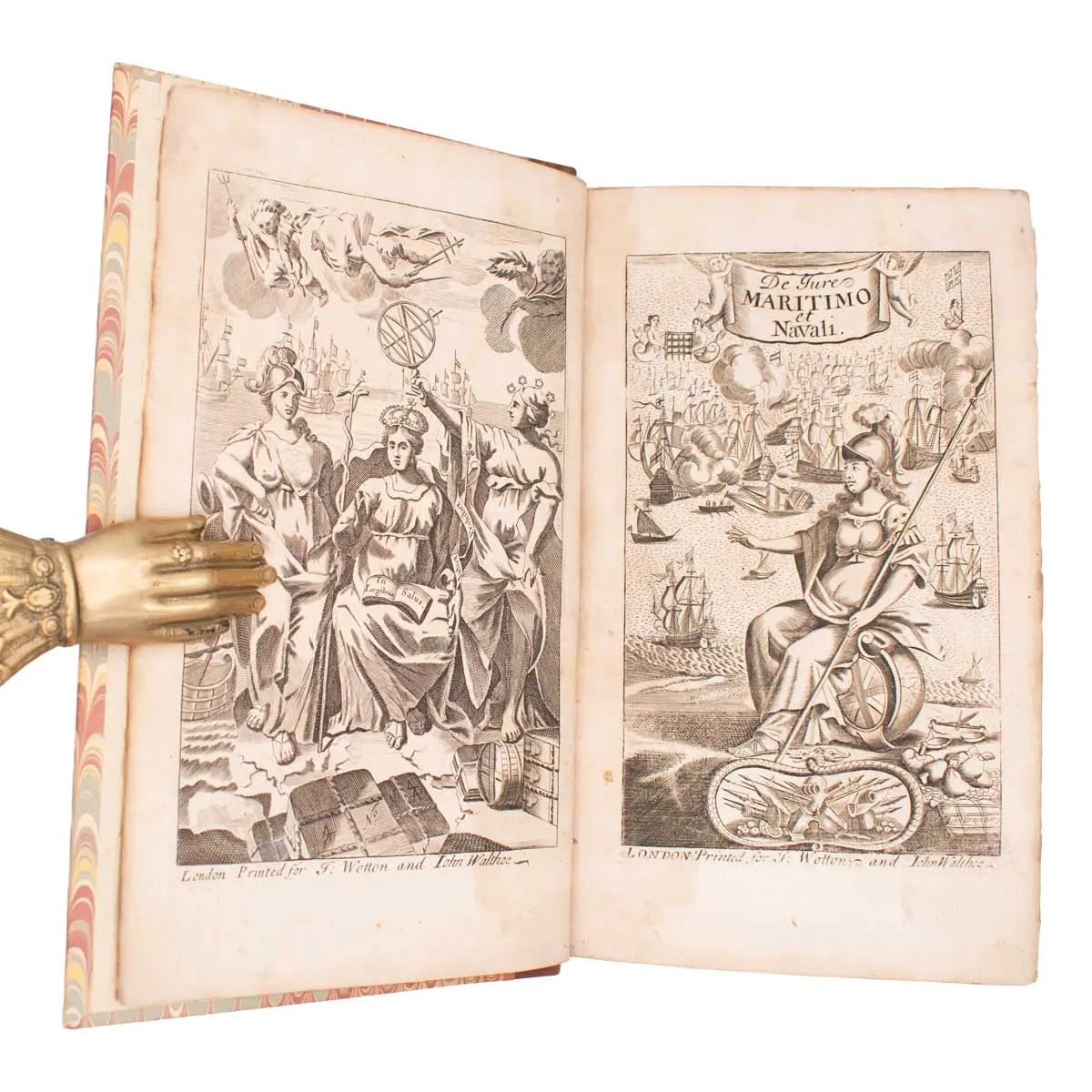
For many years this was the standard treatise on international, commercial and maritime law, and went through many editions, the first published in 1676, the last in 1778.
[4], xvii, [3], 479, [17]pp., engraved frontispiece, engraved pictorial half title, ownership mark to title, occasional light toning, modern half calf over marbled boards, London, John Walthoe Junior and J. Wotton, 1722
For many years this was the standard treatise on international, commercial and maritime law, and went through many editions, the first published in 1676, the last in 1778.
Charles Molloy (1640–1690), who was both a civilian and a member of Lincoln’s Inn and Gray’s Inn, summed up the conventional wisdom of centuries of writers on the law of nations by holding that “[a]gainst Pirates and such as live by Robbery at Sea, any Prince hath power to make War.]
The treatise contains extensive citation of common and statutory law and has been referenced by many subsequent legal treatises, including Lex Mercatoria Rediviva. The extensive references reduce the likelihood that Molloy included his personal views instead of the principles of maritime law. Nevertheless, the mere nature of common law tradition, which is based on previous jurisprudence, is readily inviting for legal interpretation to which to some undetermined extent Molloy has resorted. In the treatise, Molloy devotes a separate chapter to English, piracy law with all its different provisions depending on the citizenship of the perpetrators, the dominion of the waters, the injury inflicted, and the diplomatic relations of the country’s perpetrators with England.
Molloy argues that pirates should be “executed by the Captors” if “the Judge openly rejects the Tryal, or the Captors cannot wait for the Judge without certain peril and loss.” Molloy’s canonical views on summary execution of pirates were quoted and endorsed in a House of Commons debate in 1699.
Molloy’s popular treatise was frequently cited in litigation in U.S. courts, including in the Supreme Court.
[ Holdsworth, Sources and Literature of English Law 210. ESTC T129181.]