
 Marshall Rare Books
Deliciae naturae Selectae of Uitgeleezen Kabinet van Natuurlyke Zeldzaamheden.
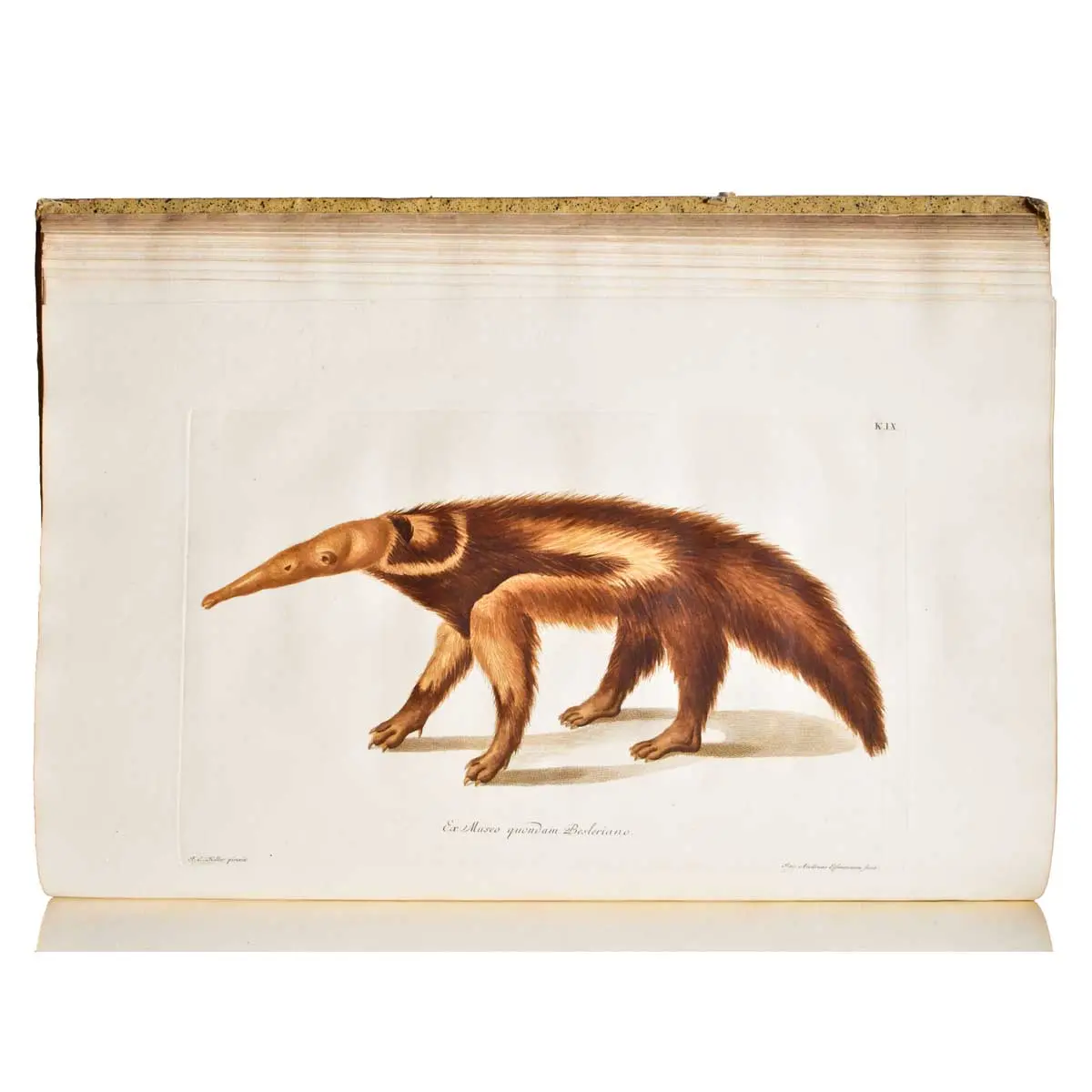
Dordrecht: by Abraham Blussé and Son, 1771. 2 volumes in one, Folio (524 x 345mm) 2 volumes, folio (524 x 345mm). Hand-coloured engraved frontispiece and 91 fine hand-coloured engraved plates, one double-page, by or after Knorr, B.R. Dietschlin, G.F. Dietsch and others, 4pp. list of subscribers). Contemporary calf-backed speckled boards, title labels on spines. FIRST EDITION in Dutch, Number 64 of 99 Copies.
Dordrecht: by Abraham Blussé and Son, 1771.
2 volumes in one, Folio (524 x 345mm) 2 volumes, folio (524 x 345mm). Hand-coloured engraved frontispiece and 91 fine hand-coloured engraved plates, one double-page, by or after Knorr, B.R. Dietschlin, G.F. Dietsch and others, 4pp. list of subscribers). Contemporary calf-backed speckled boards, title labels on spines.
FIRST EDITION in Dutch, Number 64 of 99 Copies.
One of the finest colour-plate natural history books, illustrating specimens from the leading collections of Nuremberg. The plates depict mainly marine and zoological subjects, but also include a number of fine depictions of minerals. It is often said that the beauty of these illustrations exceeds that of their models.
Georg Wolfgang Knorr (1705-1761), German palaeontologist, painter, engraver and art dealer, engraved portraits, landscapes and animal studies after Dürer.
In the eighteenth century, Nuremberg became the leading city in the production of fine illustrated natural history books. This was due to the stimulus of J. Trew, a wealthy Nuremberg physician, who assembled a number of artists and scientists around him like Knorr himself, J.F. Dietsch, J.C. Keller, C.N. Kleemann, C. Leinberger, A. Hoffer, J.A. Eissenmann and J.F. Schmidt. They contributed to the drawings, engravings and hand-colouring of the plates of the present work. Trew owned a natural history collection and menagerie. Many animals and curiosities described and depicted in the Deliciae Naturae Selectae originated from his collection. This is indicated by the text: ‘Ex. Museo Excell. D.D. Chris. Jac. Trew’ at the bottom of each plate. But there are also contributions by other natural history collections made by P. L. S. Muller, D. Schadeloock, Knorr himself and others.
The plates are arranged as follows; vol I: corals and seaweeds 15 , shells 7, butterflies 6, urchins 4, minerals 6; vol II: crustaceans and spiders 7, starfishes 4, fishes 9, birds 7, quadrupeds 14, reptiles and amphibians 12 (one folding).
Nissen ZBI 2228; Brunet III, 682.