
 Marshall Rare Books
Discours des Sorciers, avec six advis en faict de Sorcellerie. Et une instruction pour un juge en semblable matière. Par Henry Boguet Dolanois, grand Juge en la terre S. Oyan de Ioux, dicte de S. Claude au Comté de Bourgogne. N'estnt ce que l'Autheur a cy devant mis en lumière sur la mesme suiect, qu'un eschantillon de ce qui est traitté en ce livre. Troisième édition.
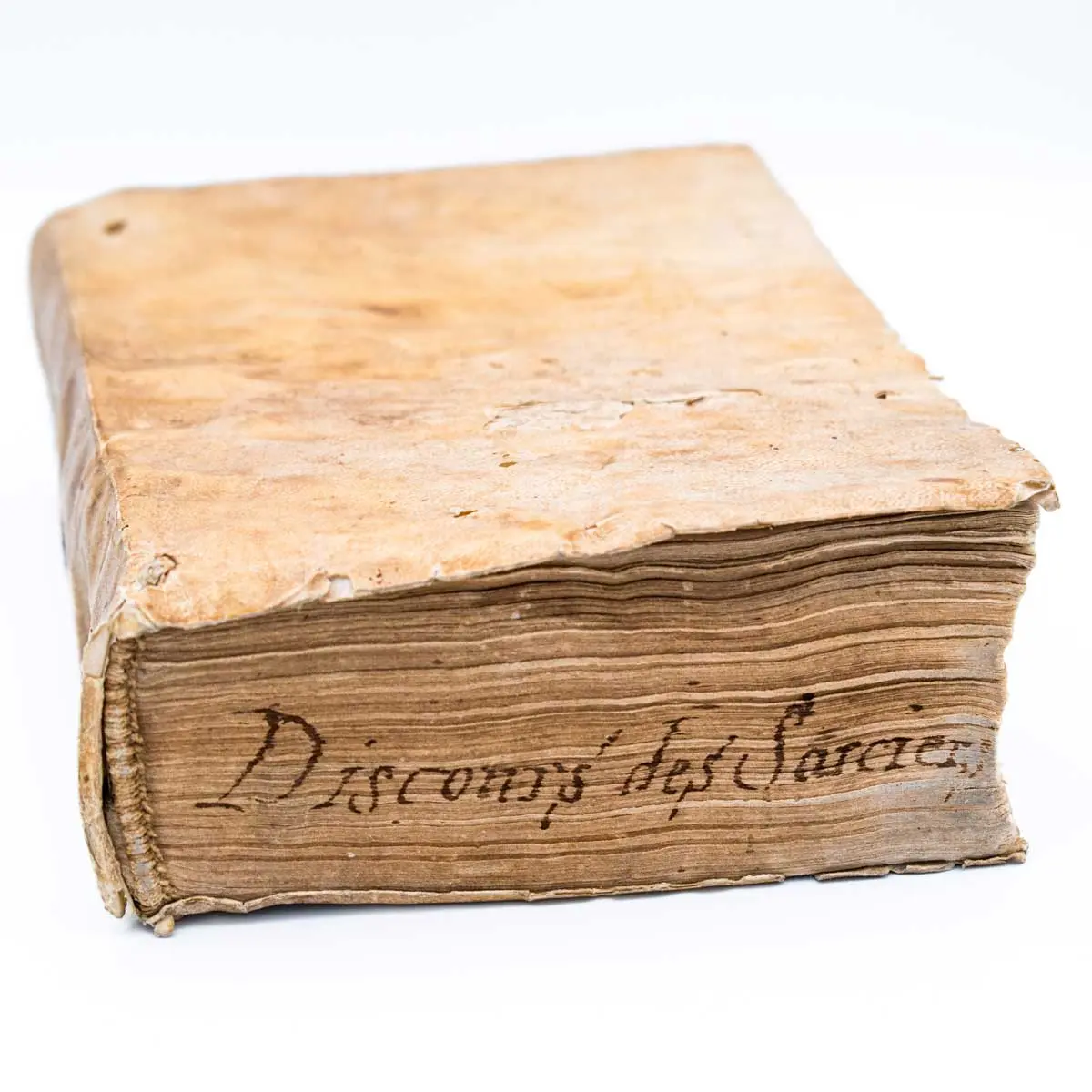
One of the Most Famous Works On Witchcraft in a Contemporary Vellum Binding
3 parts in one vol., [24], 550, [2]; [8], 93; [3], 32, [64]pp., woodcut printers device, woodcut initials, tear at the lower corner of p.211 with a few letters affected, slight water stains, contemporary limp vellum, flat spine with manuscript title, manuscript title on the lower edge, 8vo (172 x 117mm), Lyons, Pierre Rigaud, 1610.
“I have founded the following treatise upon certain trials which I myself conducted, during the last two years, of several members of this sect, whom I have seen and heard and probed as carefully as I possibly could in order to draw the truth from them.” – Henry Boguet.
This is the rare, enlarged, third edition of one of the most famous works on demonology. As the most complete, this edition is the most sought after.
Henry Boguet (about 1550-1619) was an eminent lawyer, and was appointed Chief Judge at St.Claude in Franche-Comté. He is also one of the most famous demonologists who waged an intensive campaign against witches. In the early 16th century Franche-Comté was under the domination of the Inquisition. Despite being a layman, Henry Boguet built himself a distinguished career trying witches by building upon the Inquisitorial procedure for prosecuting heresy; confession constituted compelling proof of guilt. The number of victims attributed to Boguet ranged greatly, from 28 to 1500 people burned at the stake. However it is unequivocal that as a result of Boguet’s fury, the witch trials continued in Franche-Comté far longer than elsewhere. A legend claims that, like so many of his victims, Boguet ended his life on the stake.
Discours des Sorciers is a legal textbook that was a standard work for over a century. With twelve editions in twenty years, it rapidly became an authoritative tract on demonology.
A compilation of the three treatises on demonology produced by Boguet, its wealth of carefully verified human interest stories sheds much light on the psychology of witchcraft in the early seventeenth century. The first work was first published in 1602 under the title Discours execrable des sorciers. The treatise is devoted to processing the confessions and testimony Boguet heard while presiding over a series of witchcraft trials between 1598 and 1600. In order to make sense of the ever-growing number of confessions generated by the trials, Boguet turned to the authoritative texts of his demonologist predecessors. These authorities appear in the text itself, but also in the form of abbreviated marginal annotations. The margins of Discours execrable des sorciers are peppered with references to Bodin’s Demonomanie, following scholarly contemporary conventions in printing. Discours exerable des sorciers was hugely successful, and was reprinted twelve times in twenty years.
In the second work, In Six advis (1608), Boguet urges for all the acts of witchcraft to be unified in order to completely eradicate it. He returns several times to the uniformity of witches’ confessions, for him this is evidence of the reality of witchcraft; witches tell the same story because they are all part of the same conspiracy. The success of Discours de Sorciers was helped by the lavish praise of many professors and church dignitaries, who seconded Boguet’s wish that all witches might “be united in one single body, so that they might all be burned at once in a single fire.”
Despite his strong theoretical interests, Henry Boguet was a very practical man concerned with meeting the legal criteria for proving guilt. This is illustrated in the final work, his concise manual for prosecuting witchcraft Instruction pour un juge en fait de sorcellerie appended at the end of the Discours. Intended to be used by prosecutors, it contains seventy articles which codified existing statutes and court methods, supplemented with anecdotal evidence. This work has had considerable influence, enabling Discours to surpass similar works by noted contemporaries like Bodin, Remy and De Lancre, and rivalling the Malleus Maleficarum in its repute.
It is believed by some that Boguet’s family tried to suppress Discours; possibly his relatives were secretly sympathetic to the victims of witchcraft.
A very scarce and important work on demonology.
Provenance:
The Ballemant Library with seventeenth century ex-libris.
[The Encyclopedia Of Witchcraft And Demonology, Robbins, 1959; Thinking with Demons: the idea of witchcraft in early modern Europe, Clark, 1999; Witchcraft, Demonology, and Confession in Early Modern France, Krauss, 2015]