
 Marshall Rare Books
Disquisitionum Magicarum Libri Sex, in Tres Tomos Parti…Tomos Primus
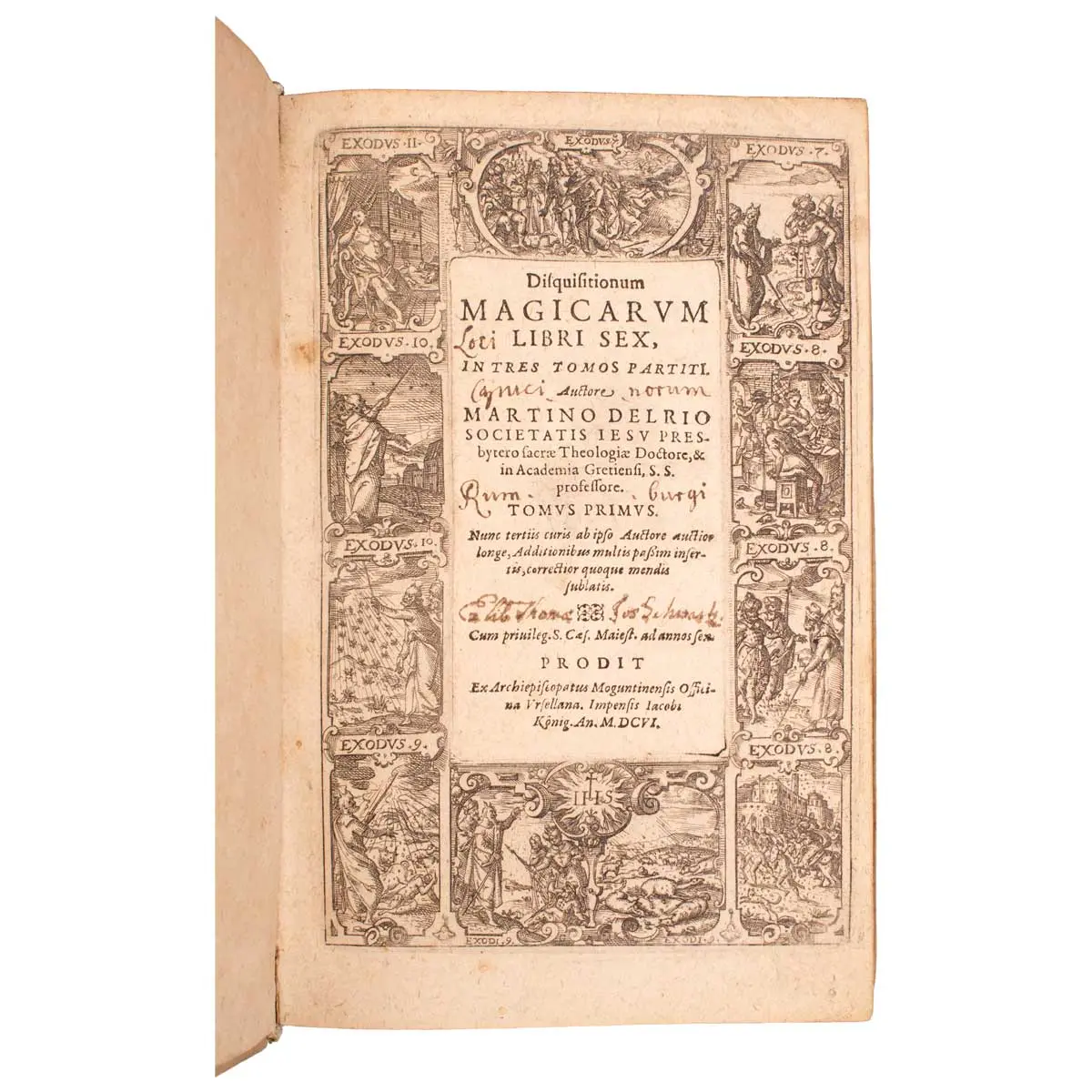
THE BEST-KNOWN COUNTER-REFORMATION WORK ON MAGIC, DEMONOLOGY AND WITCHCRAFT
1 vol only (of 3), pp. [xlix], 2-773, [xliii, index]; collation running )(8, (::)8, )()(8, A-Z8, Aa-Zz8,. Aaa-Eee8; a series of vignettes framing title depicting occult activities from the book of Exodus, text enclosed inside dual woodcut borders, woodcut initials, head-and-tail pieces, corners of p. 290 and 294 repaired, not touching text; some early ink annotations to title, occasional light spotting, later vellum, yapped edges, 8vo, ex Archiepiscopatus Moguntinensis Officina Vrsellana, impensis Iacobi König, 1606.
Volume one of this superb early 17th century edition of Del Rio’s manual on witchcraft, with a scrap of previous owner’s manuscript notes loosely tipped in.
Jesuit theologian Martin Del Rio was one of the chief advocates of the witch trials, credited with importing the beliefs of the Malleus Maleficarum into the Low Countries. As a Catholic, Del Rio was concerned by the issues that witchcraft raised about the nature of the magic that lay at the heart of religious identity.
Del Rio studied or taught at Jesuit colleges across Catholic Europe, including at the College of Clermont in Paris where he was taught by the Spanish demonologist Juan Maldonado. Maldonado’s passionate writings against witches deeply influenced Del Rio.
Based on Del Rio’s knowledge of the classics and familiarity with Church history, Disquisitionum magicarum libri six summed up a vast knowledge about demons and witches. Del Rio’s work sets out in considerable detail the range of contemporary practices of magical healing and diving as a compendious assault on popular superstitions. He questions the validity of entire sciences such as natural magic, astrology, mathematics and alchemy, as well as whether characters, sigils, words and charms have any intrinsic power. Yet he also maintained that the Church had an arsenal of sacred objects, blessings and pious practices which were effective against witchcraft. As a Catholic, Del Rio was forced to define central features of his faith and the nature of the divine. It was difficult to know where to draw the line. To Del Rio’s annoyance, sceptics seized on the work’s more moderate comments.
However the work was very successful, being cited as authoritative by demonologists well into the eighteenth century.
[USTC:2100266; Palau 268269; De Backer-Sommervogel, II, 1899; Robbins 283; Graesse, Magica, 47; Coumont, Demonology and Witchcraft, D45.3.; Witch Craze, Roper, 2004; The Oxford Handbook of Witchcraft in Early Modern Europe and Colonial America, 2013]