Marshall Rare Books
Dissertazioni sopra le apparizioni de' spirit e sopra i vampiri, o redivivi d'Ungheria, di Moravia ec…
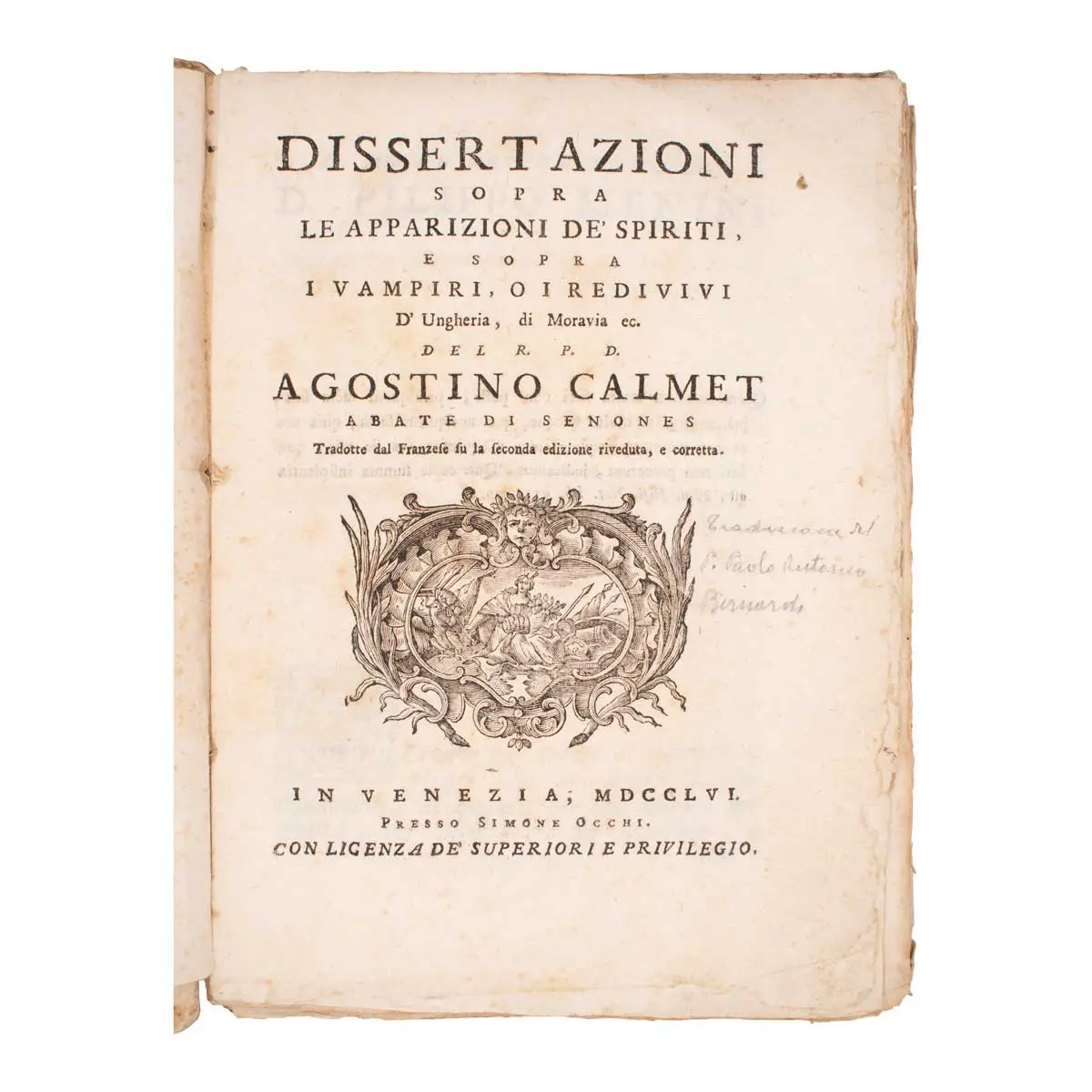
Scarce First Italian Edition of the Interesting Work on Demonology by French Monk Augustin Calmet.
First Italian Edition, XII,250, [2]pp., woodcut vignette to title, text in italics and roman with woodcut initials and tail-pieces, occasional light foxing, small hole in H1, original paper wrapper, lacking spine, 4to(252 x 188mm), In Venezia: presso Simone Occhi, 1756
Scarce First Italian Edition of the Interesting Work on Demonology by French Monk Augustin Calmet
Learned demonology continued much longer than the witch trials, and this work stands as a major source of information on Enlightenment views of witchcraft, demonology and supernatural phenomenon.
Augustin Calmet (1672-1757) was a French Benedictine monk and biblical scholar who is best known for his investigation into vampires. In 1746, Calmet published his extraordinary work Dissertations sur les Apparitions des Anges, de Demons et des Espirits, expanding on it in 1749 and 1751. This edition is translated from the French edition of 1751. The work is divided into two dissertations: “On the Apparitions of Angels, Demons, and the Souls of the Dead” and “On Those Who Return After Death with Their Bodies, the Excommunicated, the Oupir, or Vampires, Broucolachi, etc.”
Although the witchcraft section of his book takes up a modest part of the overall work, it does highlight some major differences between Enlightenment demonology and the demonologists of a century earlier. But the main difference can be summed up like this: earlier demonologists endorsed witch-hunting, while Calmet did not.
Calmet dismissed witches’ confessions, and cited mediaeval sources as often as early modern demonological works; he exposed falsehoods and declared that entire demonological topics could not be believed, such as the witches sabbath. But he did assert that demons were active in the physical world. He was sure that levitating saints were carried bodily by good angels, and cautiously concluded that witches could also be carried bodily by demons. He showed particular interest in cases from his own locality, Lorraine – though he distanced himself carefully from Lorraine’s previous demonologist, Niclas Remy.
Unlike Remy,Calmet showed no practical interest in the idea that witches should be executed. Yet the overall thrust of Calmet’s argument tended to revise and purify demonology, not to contradict it. He shows that demonology, now separated from witch-hunting, remained active and credible in the 1750s.
Calmet also writes about apparitions of good and bad angels, demonic possession, goblin spirits, ghosts, resurrections, vampires, spells, reincarnation, including examples sent to him from readers of his earlier editions.
The views of Calmet were attacked both by Voltaire and by the archivist abbe Lenglet-Dufesnoy. The abbe makes a point of denouncing not only the credulity of Calmet’s writing but especially the undeniably seductive aspect of these tales about witchcraft, and the influence it could have on readers.
A scarce edition of this important work.
[Demonology and Witch-Hunting in Early Modern Europe, 2020, Julian Goodare]
Books you may also like
Magica de spectris et apparitionibus spiritum de vaticiniis, divinationibus…
Letters on Demonology and Witchcraft, addressed to J. G. Lockhart, Esq.
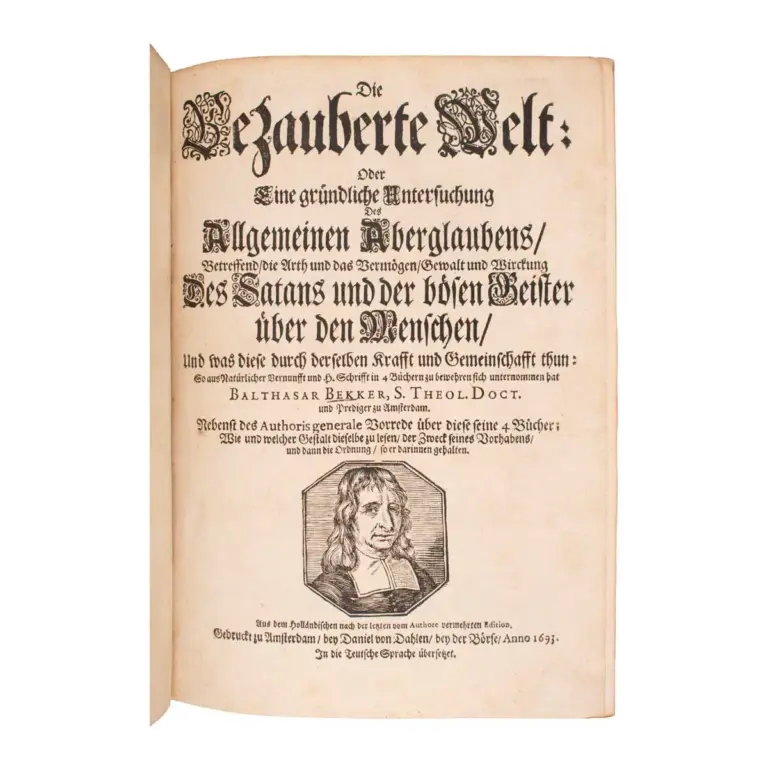
Die bezauberte Welt: Oder eine grundliche Untersuchung des allgemeinen Aberglaubens. Aus dem Hollandischen (ubers. von J. Lange)