
 Marshall Rare Books
Enchiridion Leonis Papae Serenissimo imperatori Carolo Magno
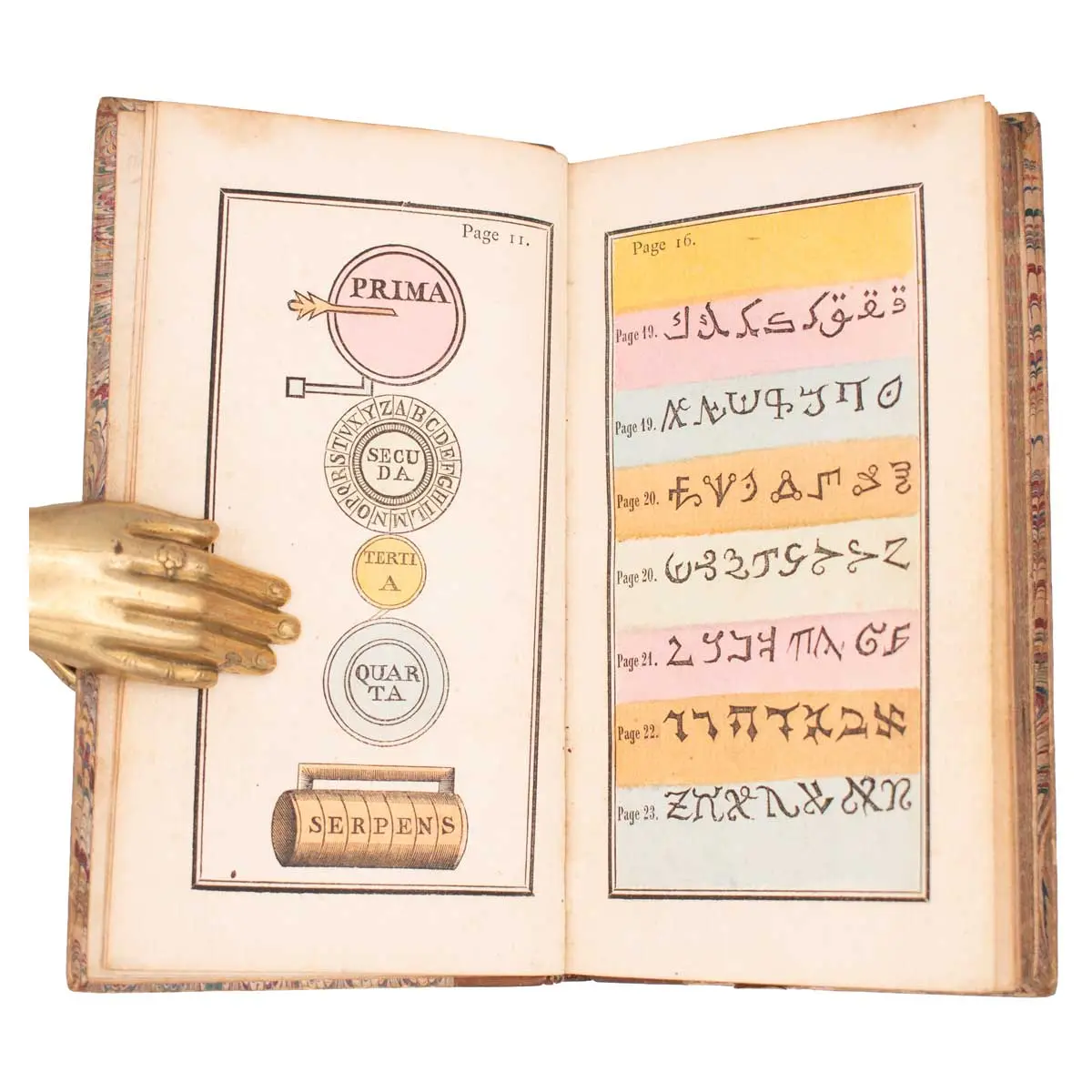
Enchiridion Leonis Papae is one of the most popular and influential grimoires.
Edition corrigee, 108pp., hand coloured figure of Pope Leo III to title, 7 hand coloured wood engraved plated, wood engraved floriated initials, occasional light marginal staining, contemporary quarter calf, black calf label to spine, slightly chipped, spine gilt, spine head chipped, marbled edges, 12mo, Paris, Jules Bonaventure, [c.1850s] (reprint with title showing Rome, 1740).
Enchiridion Leonis Papae is one of the most popular and influential grimoires. It contains simple healing charms, a version of the apocryphal Abgarus letter, and a set of rather handsome colour engravings of talismans and instructions on constructing pentacles. Its defining content though, is its series of protective prayers. The prayers had nothing to do with the Roman Catholic Church, as the Enchiridion is concerned more with worldly, rather than spiritual, empowerment. Instead, the prayers could protect against all the dangers that could do one harm – poison, fire, wild beasts and tempests.
It was not only purchased by magical practitioners, and those who were merely curious. The mere possession of non-diabolic grimoires was thought to have some protective function. A herbal healer was found with a copy of the Enchiridion when he was arrested for practising false medicine. He said he had bought it from a soldier who assured him that it would shield him from falling ill or being killed.
Despite the vigilance of the Paris police, France became the centre of grimoire production. The Bibliothèque bleue, similar to the English chapbook, started being produced at the beginning of the 17th century as a low cost and small form book that appealed to all levels of french society. As one of the Bibliotheque blue grimoires, its influence spread throughout the globe. Despite well known witch hunters, like Bodin and Boguet, denouncing the Enchiridion, it was often found alongside the works of demonologists. This work, as well as other Bibliotheque bleue grimoires, migrated to the French Caribbean colonies, becoming the foundation of that region’s literary magical tradition.
It has been pseudepigraphically attributed to Pope Leo III. Its magical virtue rests on a supposed letter from Charlemagne to Pope Leo, in which the former states that since receiving the Enchiridion he has never ceased to be fortunate. However, no such letter appears to be in the Vatican library, where it was supposedly consigned. It is improbable that this book is the work of Pope Leo and is more likely a compilation by a printer during the height of grimoire publication.
[Grimoires: a history of magic books, Davies, 1969]