
 Marshall Rare Books
Exemplification of the enrolment of a decree of the court of Chancery in a case between Richard Sawyer and many other tenants of the manor of Farnborough and Richard Norton, esq, establishing the customs of the manor, of 3 February 1599; exemplified at the request of the tenants, 16 February 1599.
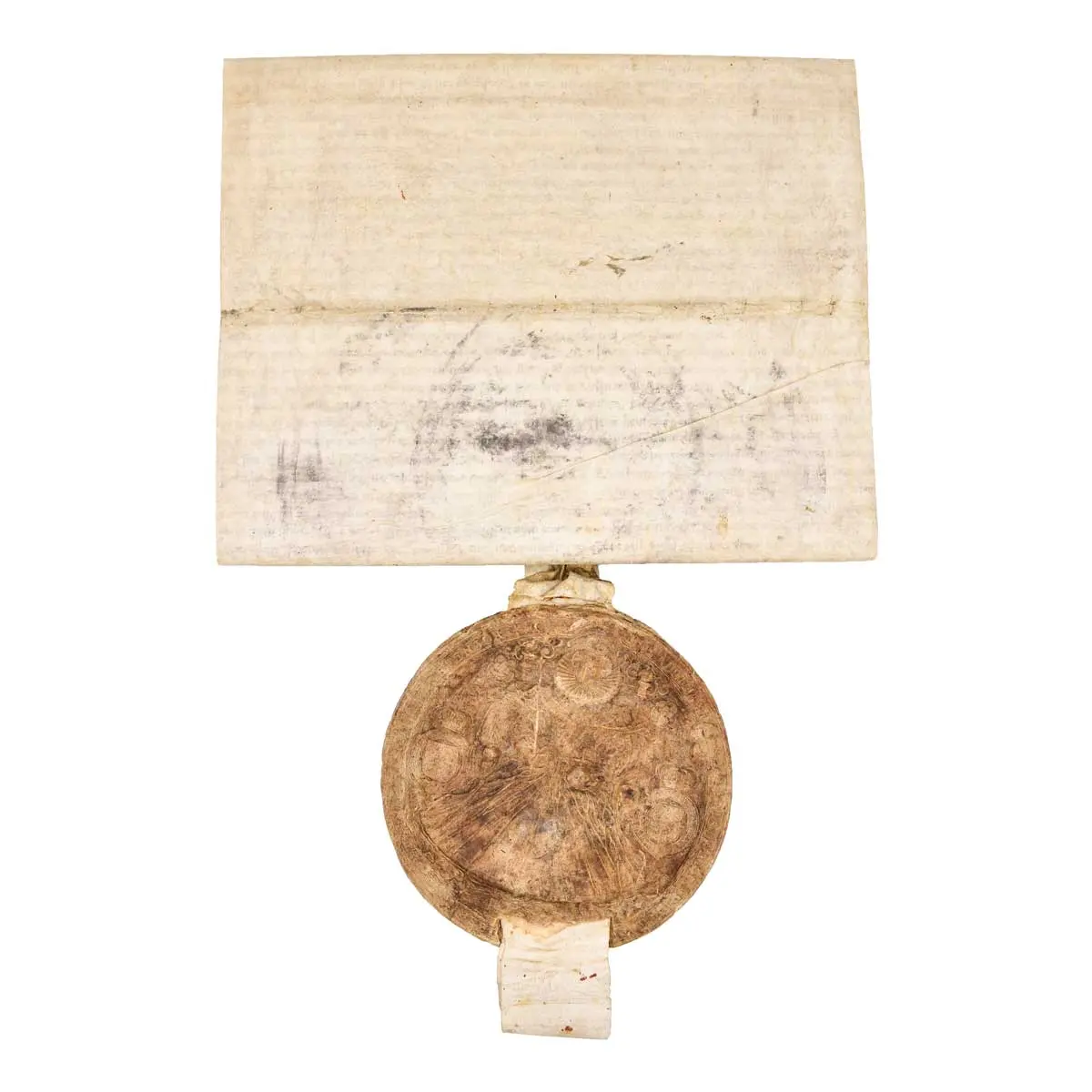
This is one of the finest examples of the Great Seal.
Lengthy and large vellum document in English, in a neat official hand on two sheets, three decorative initials to first line, text near foot of second membrane. 63.5 x 79cm.
With a Superb Example of the Great Seal in white wax appended by silk tags, 15cm diameter, slightly rubbed but generally in excellent state preservation, with clear impressions of the Queen on both sides and surrounding inscription, contained in 20th-century document box with inset tray to hold seal and gilt-titled morocco label to upper cover.
Richard Norton, who had married Elizabeth Rotherfield, daughter and heir of Sir William Rotherfield and Elizabeth Dawtrey, died seised of a fourth, and his son John evidently purchased the other three-fourths, for he was seised of the whole manor at his death in 1561. Victoria County Histories.
Sir Richard Norton, son of John, died in 1592, leaving the manor of Farnborough to his son Richard, afterwards Sir Richard Norton. The latter died in 1611, leaving as his heir his son Richard, who sold the manor in 1619 to John Godson of Odiham and Edward Dickenson of Odiham. In 1630 John Godson held courts baron as lord of the manor of Farnborough.’ The Chancery suit was probably collusive, brought in order to establish the customs and have them enrolled in a Court of Record.
This is one of the finest examples of the Great Seal.
Elizabeth I used this great seal during the second half of her reign – from 1586 to 1603. It is an impression from a seal matrix made of bronze and was engraved by Nicholas Hilliard, famous for his small paintings or miniatures, particularly of the Elizabethan Court.
The great seal of Elizabeth gives an insight into how the queen wanted to be seen. On one side, she is shown holding the sceptre and orb that are the traditional symbols of royal power. Heavenly rays above her head are a sign of her divine status. On the reverse side, Elizabeth is shown on horseback riding across a field of flowering plants. This symbolises hope and prosperity, as well as the queen’s femininity. Her image is one of strength, but unlike her predecessors she is not wearing military dress. She is flanked by the symbols of her lands : the Tudor Rose OF England, the Harp of Ireland, and the Fleur – de – Lys of France.The inscription around the edge reads : ‘Elizabetha dei gracia Anglie Francie et Hibernie Regina Fidei Defensor’ (Elizabeth, by grace of God, Queen of England, France and Ireland, Defender of the Faith. National Archives