
 Marshall Rare Books
Fabularum liber, ad omnium poetarum lectionem mire necessarius, & nunc denuo excusus. Eiusdem poeticon astronomicon libri IV. Quibus accesserunt similis argumenti, Palaephati.
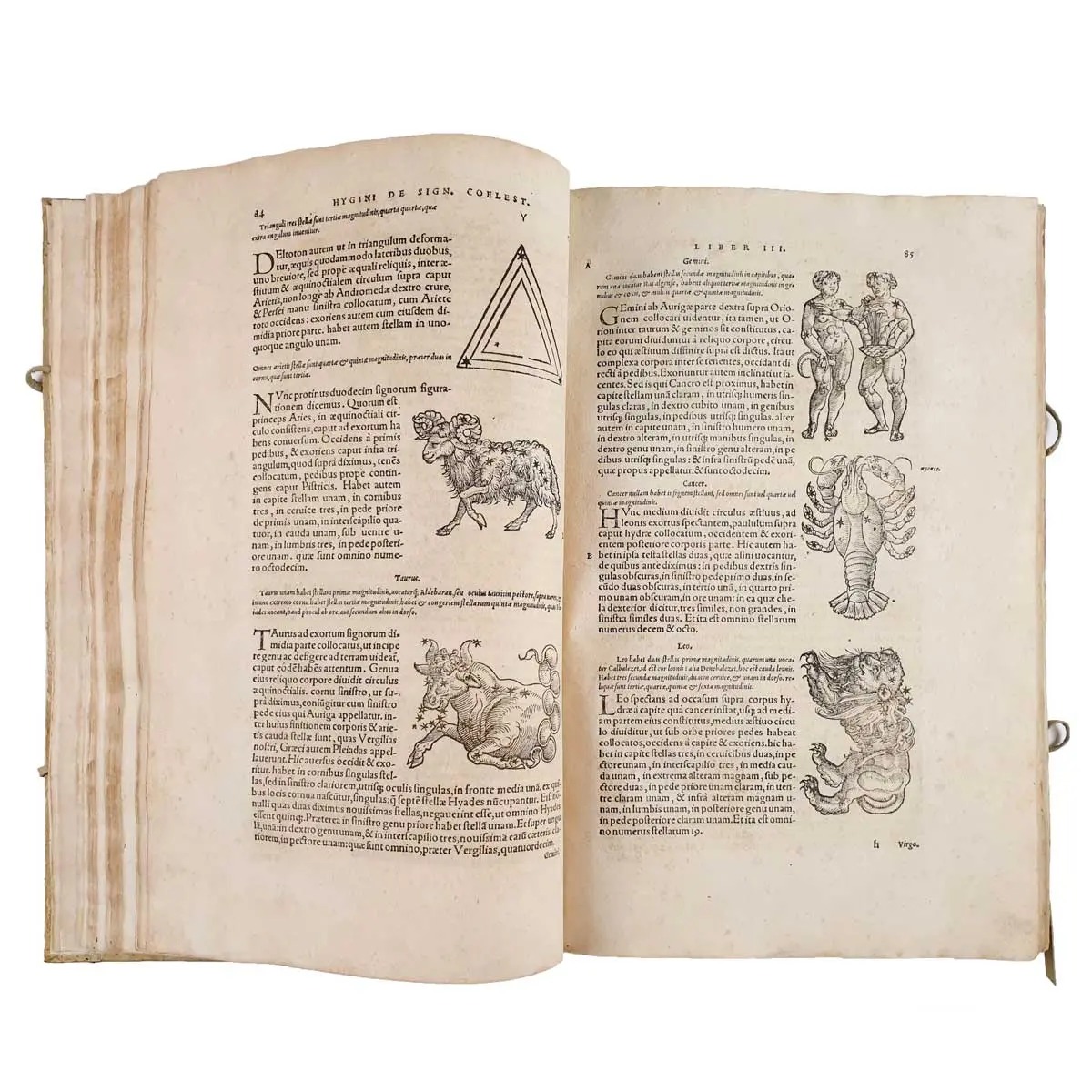
Basel: Hervagiana, 1570, third edition, Folio (330 x 220mm), edited by Jacob Micyllus (1503-1558), Contemporary vellum, original ties, manuscript title to spine,including works by other writers: Palaephatus, Fulgentius, Phurnutus, Albricus, Aratus, and Proclus, woodcut printer's device on title, with forty-nine fine wood engravings of the constellations. Small unobtrusive collectors stamp to title. A very attractive copy
Basel: Hervagiana, 1570, third edition, Folio (330 x 220mm), edited by Jacob Micyllus (1503-1558), Contemporary vellum, original ties, manuscript title to spine,including works by other writers: Palaephatus, Fulgentius, Phurnutus, Albricus, Aratus, and Proclus, woodcut printer’s device on title, with forty-nine fine wood engravings of the constellations. Small unobtrusive collectors stamp to title.
A very attractive copy
Fabulae consists of some three hundred very brief and plainly, even crudely told myths and celestial genealogies. Arthur L. Keith, reviewing H. J. Rose’s edition (1934) of Hygini Fabulae, wondered “at the caprices of Fortune who has allowed many of the plays of an Aeschylus, the larger portion of Livy’s histories, and other priceless treasures to perish. Hyginus’ compilation represents in primitive form what every educated Roman in the age of the Antonines was expected to know of Greek myth, at the simplest level. The Fabulae are a mine of information today, when so many more nuanced versions of the myths have been lost.
In fact the text of Fabulae was all but lost: a single surviving manuscript from the abbey of Freising, in a Beneventan script datable c. 900, formed the material for the first printed edition, negligently and uncritically transcribed by Jacob Micyllus, 1535, who may have supplied it with the title we know it by. In the course of printing, following the usual practice, by which the manuscripts printed in the 15th and 16th centuries have rarely survived their treatment at the printshop, the manuscript was pulled apart: only two small fragments of it have turned up, significantly as stiffening in book bindings. Another fragmentary text, dating from the 5th century is in the Vatican Library.