Marshall Rare Books
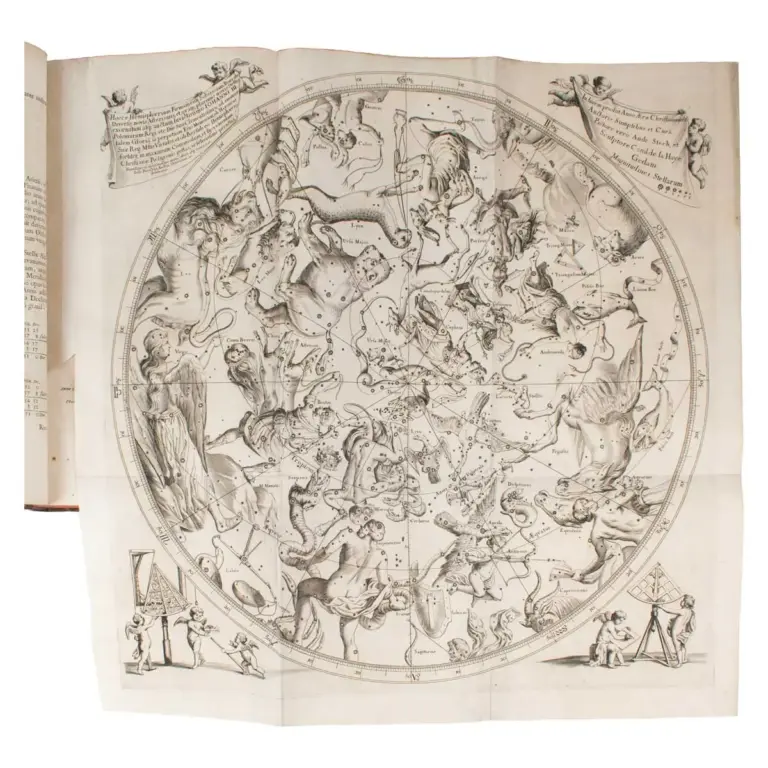
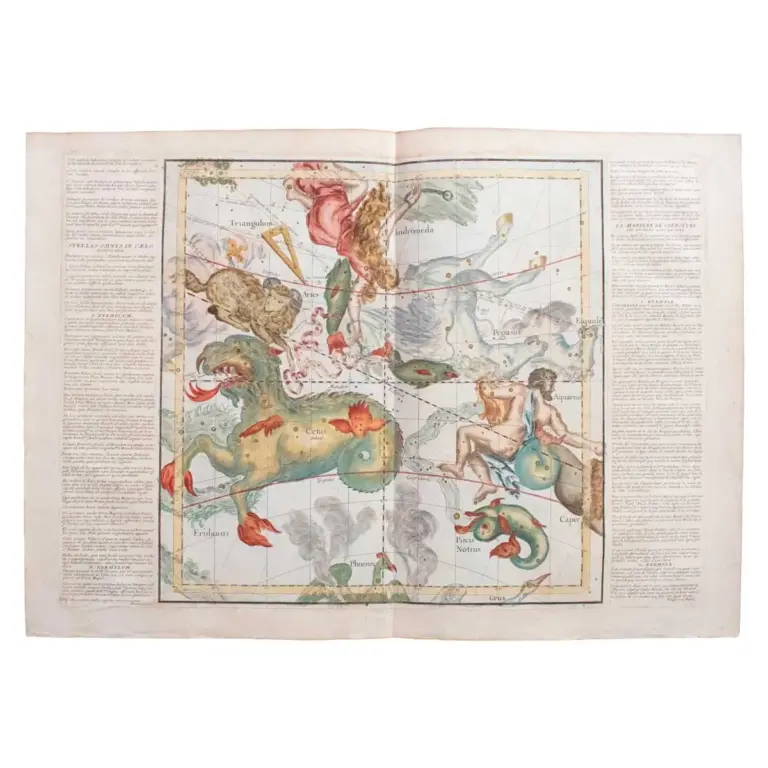
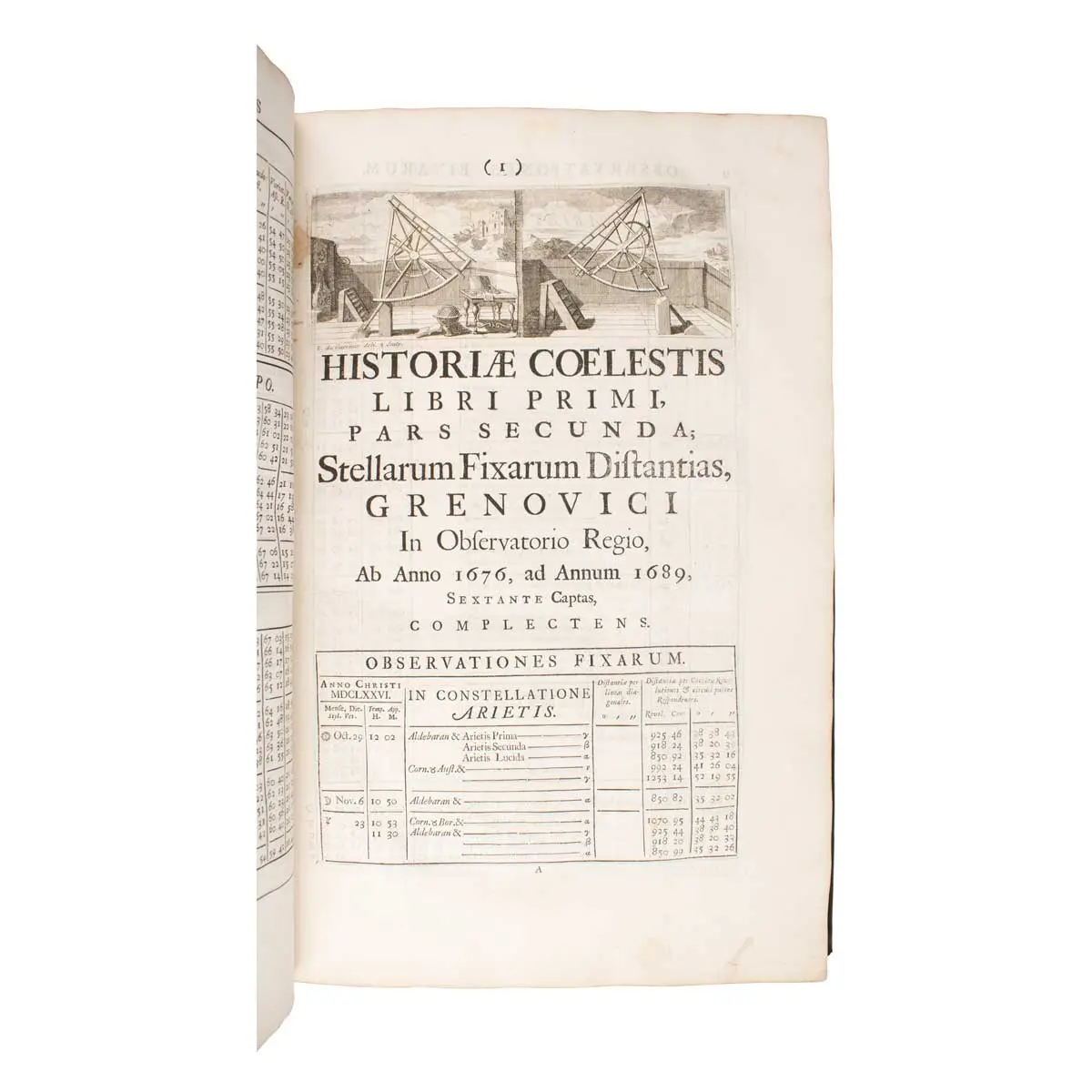
Historiae coelestis libri duo quorum prior exhibet catalogum stellarum fixarumBritannicum novum & locupletissimum una cum earundem planetarumqueomnium… observante J Flamsteedio in Observatorio Regio Grenovicensi continua serie ab anno 1676 ad annum 1705 completum.
EXTREMELY SCARCE FIRST EDITION OF THE MOST IMPORTANT WORK OF EIGHTEENTH CENTURY ASTRONOMY
First Edition (one of only a few known copies).
London, J.Mathews, 1712, engraved frontispiece by George Vertue after J.B. Catenaro, engraved dedication by Guernier after Catenaro, engraved headpieces and 4 engraved plates, errata leaf at end, bound in contemporary panelled calf, hinges repaired but an excellent copy of this rare work.
This is the most important work of eighteenth-century astronomy in the extremely rare first edition produced by Edmund Halley. The British Catalogue at the beginning of this work lists thousands of stars and was the most extensive and comprehensive list to date.
The latter part of Flamsteed’s life passed in controversy over the publication of his excellent stellar observations. He struggled to withhold them until completed, but they were urgently needed by Isaac Newton and Edmond Halley, among others. Newton, through the Royal Society, led the movement for their immediate publication. In 1704 Prince George of Denmark undertook the cost of publication with the approval of Queen Anne and despite the Prince’s death in 1708 and Flamsteed’s objections, the incomplete observations were edited by Halley, and 400 copies were printed in 1712.
After the death of Queen Anne in 1714, Flamsteed managed to burn 300 of them. “I made a sacrifice of them to heavenly truth” (Bailey p. 101). He subsequently disposed of any other copies he came across.
England appointed its first Astronomer Royal, John Flamsteed, born in Denby, Derbyshire (1646-1719) in 1675. He lived and worked at the Royal Observatory, Greenwich, built by King Charles II of England in the same year and catalogued over 3000 stars. Flamsteed accurately calculated the solar eclipses of 1666 and 1668. He was responsible for several of the earliest recorded sightings of the planet Uranus.
As Astronomer Royal, Flamsteed spent some forty years observing and making meticulous records for his star catalogue, which would eventually triple the number of entries in Tycho Brahe’s sky atlas. In 1725 Flamsteed’s, Historia CoelestisBritannica was published posthumously. It contained Flamsteed’s observations and included a catalogue of 2,935 stars to much greater accuracy than any prior work. It was considered the first significant contribution of the Greenwich Observatory, and the numerical Flamsteed designations for stars that were added subsequently to a French edition are still in use.
Provenance: Derby Grammar School; Signature of J.Merrill, 15th June, 1722.