
 Marshall Rare Books
Illustrations of the Book of Job.
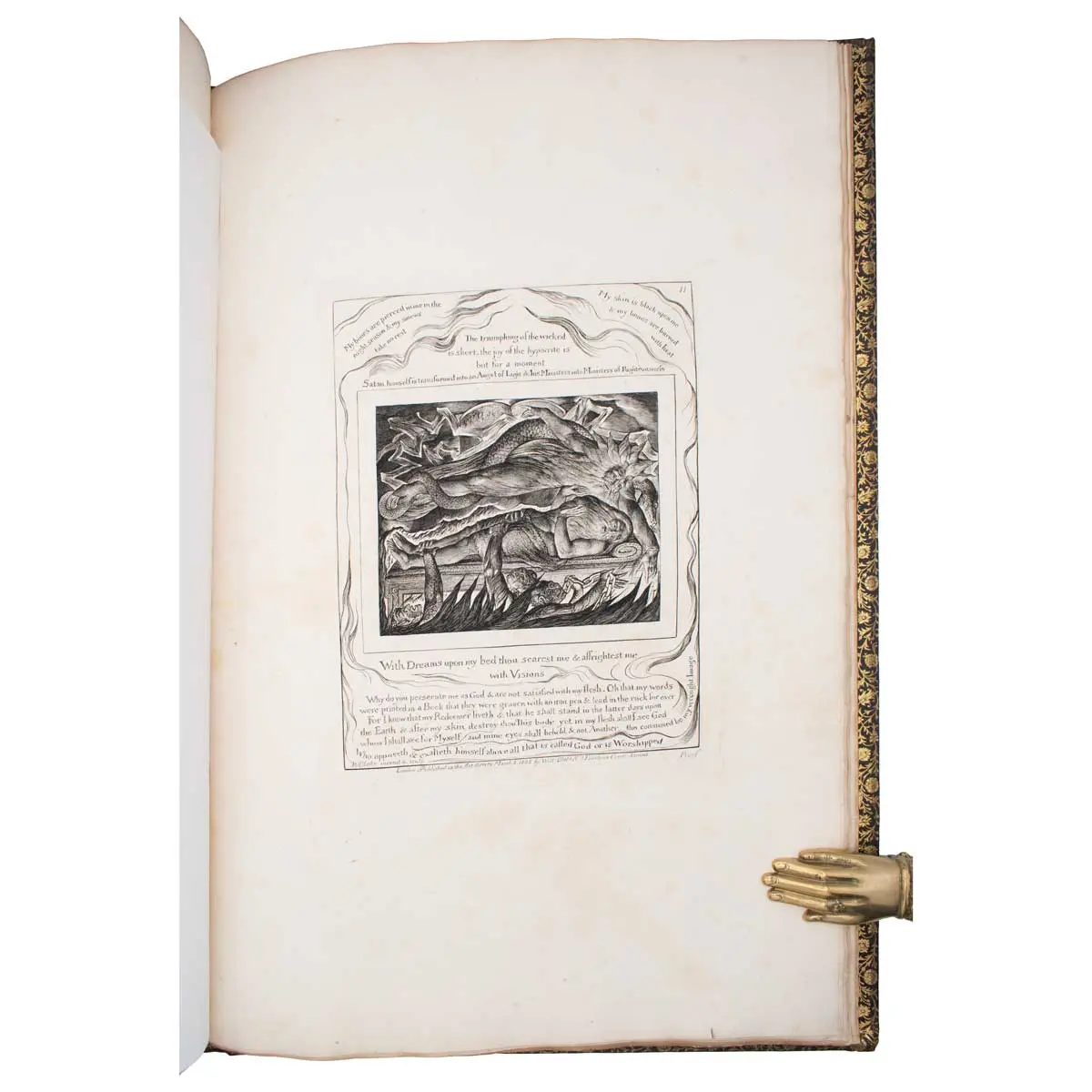
An Excellent Copy of this Scarce First Issue.
One of 215 FIRST-ISSUE “Proof” copies, one of 65 copies on “French” paper, unwatermarked, line-engraved pictorial title and 21 plates designed and engraved by Blake, each plate marked “Proof”, second plate (Job and his family praising God) misdated “1828”, original front wrapper with printed label preserved, some light marginal foxing, crushed brown morocco gilt by Riviere, green-coated endpapers, t.e.g., broadsheets (422x274mm), Invented & Engraved by William Blake. London: Printed as the Act Directs March 8: 1825 by William Blake (March 1826).
An Excellent Copy of this Scarce First Issue.
Blake’s twenty-two engraved Illustrations of the Book of Job are the culmination of his long pictorial engagement with that biblical subject. Blake had completed the designs for what would become his Illustrations for the Book of Job around 1805–1806 for Thomas Butts, a clerk to the commissary general of musters who had by then become Blake’s major patron. In 1821, Blake and his new patron John Linnell borrowed the watercolours from Butts, which Linnel traced and Blake coloured. Blake also added two more compositions to both sets, bringing them up to twenty-one designs.
This led to Linnell commissioning the engravings. Blake first executed a series of twenty-one reduced pencil sketches of the central designs, before beginning the arduous task of transferring these onto copper plates. According to John Linnell, the border designs were a last-minute addition to the copper plates. Although the title page is dated 1825, publication was delayed until 1826, and the date amended on a label pasted to the boards in which the plates were issued. The Job engravings are generally considered to be Blake’s masterpiece as an intaglio printmaker.
Blake follows the general outline of the story of Job in the Bible, but also incorporates into his designs many motifs representing his personal interpretation. At the beginning, Job and his family attend only to the letter, rather than the spirit, of God’s laws. Job thereby falls under a false conception of God and into the hands of Satan. Job’s sufferings are recorded in the first half of the series, culminating in his horrific vision of a devil-god in the eleventh design. Job’s spiritual education and material restoration are pictured in the second half of the series. In the penultimate design, Job tells his story to his daughters; the entire family is restored to life in the final design. Some critics and biographers have interpreted the Job series as personal statements about Blake’s own tribulations and the spiritual peace he found late in life. However appealing this approach may be, it is made questionable by the early dating of the Butts series, the basis for all the later series.
There has been some confusion over the states of the earliest issues of the Job plates. Most bibliographical sources, including Bentley in his Blake Books, list 150 “proof” sets on India paper watermarked “J Whatman Turkey Mill 1825” and 65 “proof” sets on French paper watermarked “J Whatman 1825.” These were followed by 100 sets printed on drawing paper with the word “proof” removed. However, in the essay “Blake’s Engravings to the Book of Job: An Essay of their Graphic Form with a Catalogue of their States and Printings,” Robert Essick states that he has “not been able to identify any set as definitely printed on a French paper but this description probably refers to impressions with the ‘Proof’ inscription (State A) printed directly on an ivory-coloured wove paper without watermark”. As in this copy, “some leaves have a rather mottled appearance when viewed through a backing light”.
Although Bentley states that the French paper shows a Whatman watermark, Essick believes that it is unlikely that such a clearly English paper used for the Drawing paper impressions of state B, would be referred to as “French” in John Linnell’s account books. As such, it seems most probable that this copy is one of the 65 sets on French paper. These sets are considerably scarcer than those printed on India paper.
Provenance: Bishop Nathaniel D. Pendleton (gift inscription, 21 February 1922, on front blank)