
 Marshall Rare Books
Important Collection of Original Nature Printed Drawings of Indian Butterflies & Moths.
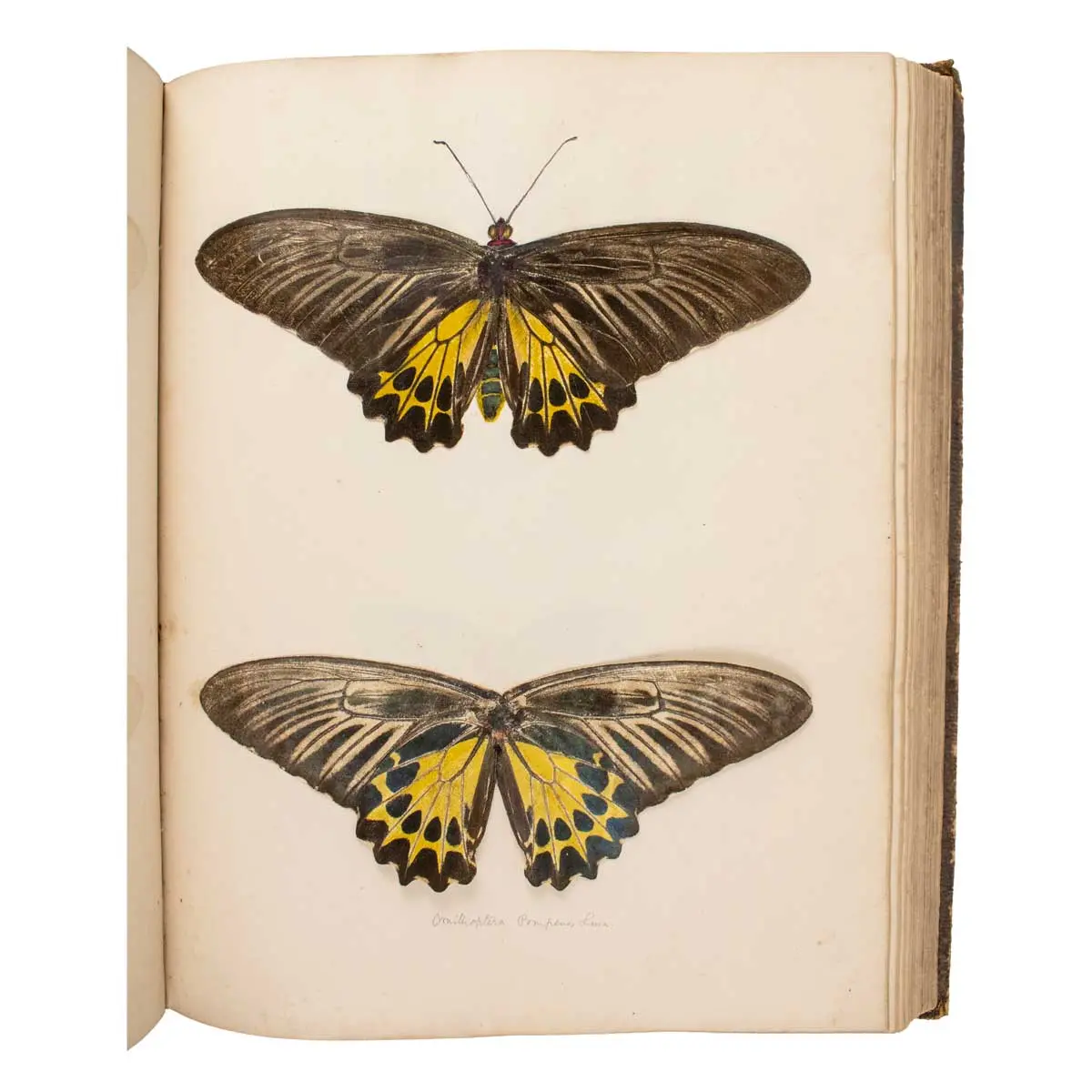
Many of These Examples are Now Extinct.
Assam, India. 1873-74, 4to, Contemporary Calf. Manuscript Title Page.
A large Album containing approx. 360 original nature printed drawings of Moths & Butterflies, collected during 1873, 1874. They vary in size and are mounted mostly two to a page. The Collection was made by Chas. E.O. Wagentreiser, Kacharrie Pookree Factory, Assam Company.
Together with this lot, are 5 wooden cases of mounted Lepidoptera, and larvae almost 600 examples in all.
This Scarce and Splendid Collection of Indian Butterflies and Moths was compiled by a serious collector with scientific interest and a very able artist. Many of these examples are now extinct.
It has not been possible to find any information about the compiler of this collection other than he is likely to have been a Director in the Assam Company.
A solution to the problem of illustration for the Nineteenth Century Natural Historian was the development of Nature Printing, especially for producing images of butterflies and moths. These insects were collected enthusiastically by explorers, missionaries and colonisers, resulting in pinned collections of dead insects in drawer after drawer of cabinets, or mounted into an artistic display. We are all familiar with herbarium collections of dried plants and the use of pressed flowers in illustration but they are not permanent, whereas Nature Prints are. They provided descriptions of butterflies and moths for those who could not visit museums and other collections to see preserved specimens, and adherents of the technique believed it was superior to any painting or drawing.
A handbook for those interested in Nature Printing butterflies and moths was published by “A.M.C.” in 1879.1 He details five separate methods, the best known of which is the Gum Process, which had its origins in the preparations made by French missionaries in India. Firstly, a piece of high quality paper is folded and the inner surface coated with Gum Arabic (“the very best and clearest which can be had”) using a finger. The wings are then cut from butterflies (or moths) and laid on the paper which is then re-folded to ensure that each side of the wing is attached to the glue. Then begins a lengthy rubbing process to ensure adhesion of the scales and this ends with a rapid pulling apart of the folded paper. The wing membrane should now remain, with the scales of the upper and lower surface stuck into the gum. After drying, the paper is cut around the outline of the wings and each preparation is then ready for mounting.
The state of Assam in northeastern India, harbouring some of the world’s riches in biodiversity, is home to more than 500 species of butterflies. Large-scale habitat deforestation and fragmentation has led to the decline of several butterfly populations in the state, and many species believed to be common during the late 19th and early part of the 20th Centuries have now declined rapidly through much of their range
The 19th century saw vast progress in every field of science, and the study of butterflies was no exception. The East India Company’s Museum at London contained a number of Indian butterflies, which were described by Thomas Horsfield and Frederick Moore between 1828 and 1859. Butterflies were collected even in the remotest parts of India by army men and civilians alike. Particularly in the late 19th century. More importantly, the art of preserving butterflies was also refined until it was possible to keep the two great enemies, mould and insects, away, thereby preserving specimens in good condition for extended periods of time.
Whether from the torrid jungles of Assam, or the slopes of the high Himalaya, insect specimens were safely brought down to the seaports and transported to Europe or less often donated to the Calcutta Museum. Large numbers of scientific papers and books describing Indian insects were also published during this period, some of them privately. Although of importance, this information was fragmentary in nature and scattered. The result was that the same butterfly species was often described several times under different names by different authors.