
 Marshall Rare Books
Insectorum sive minimorum animalium theatrum.
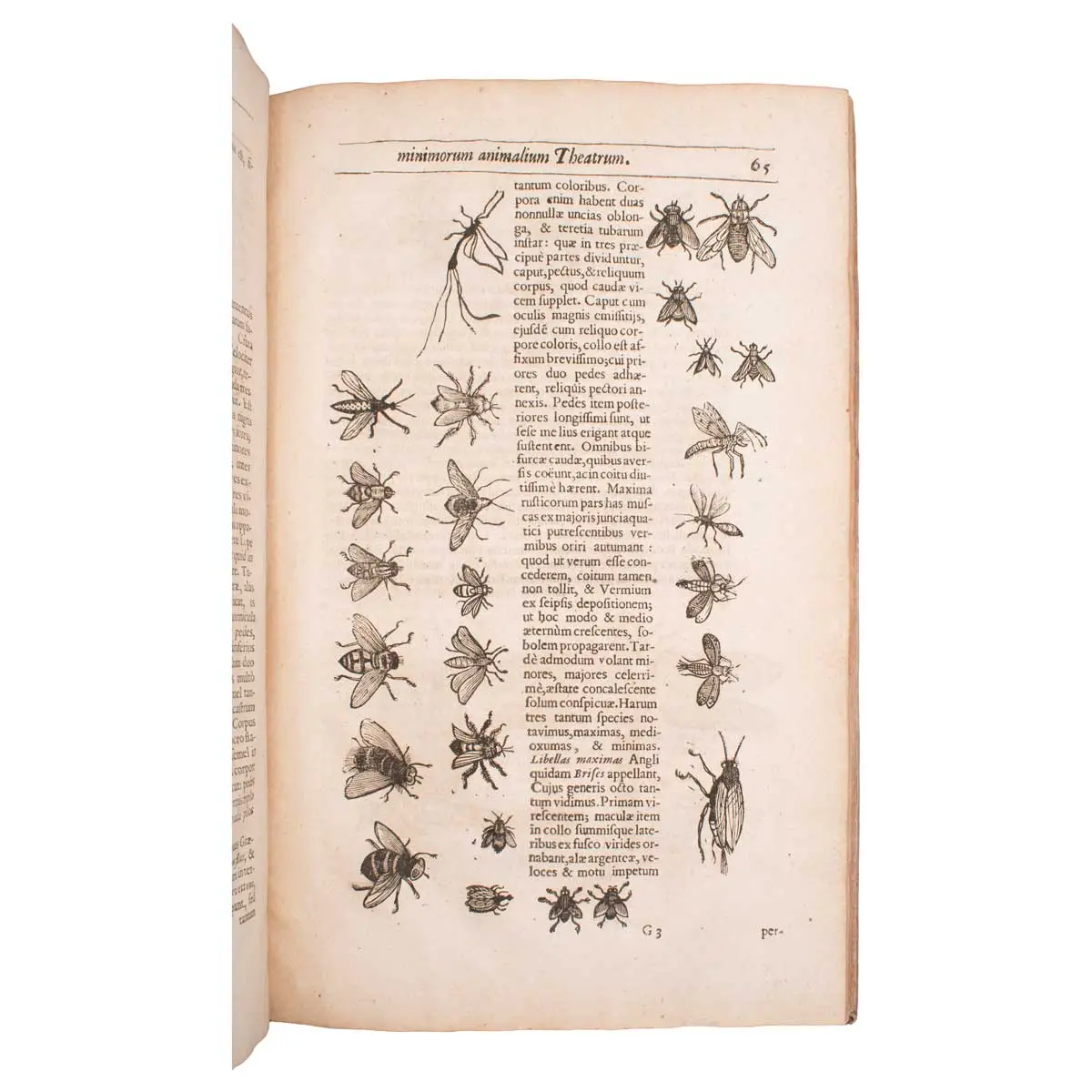
EARLIEST ENTOMOLOGICAL WORK PUBLISHED IN ENGLAND
London: Officina typographica Thom. Cotes. 1634, Folio (300 x 190mm), pp. (xx), 1-285, 296-326, (4), (p.48 numbered 52),Contemporary vellum, central device of a wreath on both covers, rebacked at an early date, remains of old label on spine, Large woodcut on title surrounded on three sides by various insects, 4 pages of woodcuts of insects at end, numerous woodcuts in text of hundreds of varieties of insects and small creatures
First edition of the earliest entomological book published in England with the first representation of an American Butterfly
When it appeared in 1634, the Insectorum was the most accurate study on invertebrates and set a new standard, by systematically analysing their habits, habitat, breeding and economic importance.
Apart from Wotton’s own work, which derived from his direct observation during his European travels, the book relied on the research of three other naturalists: Conrad Gesner (1516-1565) of Zurich, Thomas Penny (c.1532-1588) of Gressingham, Lancashire, and Edward Wotton (1492-1555) of Oxford. When Gesner died, he left among his papers an unfinished book on insects, which was eventually sold to his assistant Penny. Penny also acquired the entomological notes of Wotton and had made some progress in combining Gesner’s and Wotton’s information before his death in 1589. Penny’s manuscript passed to his friend and neighbour Thomas Moffet, who completed it, had an engraved title (dated 1589) made for it by the engraver William Rogers (fl.1584-1604), and began negotiating for its publication at The Hague. Moffet’s negotiations apparently fell through, however, and the book was still in manuscript at his death.
The Insectorum was published 30 years after Moffet’s death by Sir Theodore Mayerne (1573-1655), who having purchased the manuscript(preserved in the British Library) from Moffet’s apothecary Darrell, added a dedication to the royal physician Sir William Paddy (1554-1634), but did not alter the text. To reduce costs, the book appeared with woodcuts rather than engraved illustrations, and without Rogers’s engraved title. Species were not given names but only differentiated by short descriptive paragraphs; numerous woodcuts, ‘crude’ but ‘perfect intelligible to anyone tolerably skilled in the science of entomology’, facilitate the determination (Lisney p.7).
Moffet is often mistakenly said to have used a microscope in his observations, but in fact made the highly accurate woodcuts with the naked eye. The illustration of the American Swallowtail on p 98 is the first printed representation of an American butterfly.
There are three variant imprints, but these variants do not indicate a chronology, simply that the edition was shared among booksellers.
Garrison-Morton 288; Lisney pp.4-9; Nissen ZBI 2852; Norman 1528.