
 Marshall Rare Books
Introductionis In Universam Geographiam, Tamueterem Quam Novam,
The First Comprehensive Modern Geography
[8],142, [2], 31, [1], 46 engraved maps, all folding, title in red and black, woodcut printers device on title page, three ownership notes on title (the latest dated 1794), floriated initials, lacking front flyleaf, expertly repaired tear to map titled ‘Vinelicie et Norici”, contemporary vellum over boards, top board blind stamped P.C.D. 1661, two cloth ties, manuscript title to spine, 4to, Amsterdam, Joannem Janssonium, 1661
Published posthumously, this is Philipp Cluver’s most important work.
During his time as a soldier, Cluver travelled extensively throughout Europe, spending time in Germany, England, Scotland, Holland and Italy. A year after he returned to Leiden he was appointed geographus academicus (“academic geographer”), with an annual stipend.
This is when he began what would emerge as his life’s work. Cluver approached geography through history and classical authors. This was a popular Enlightenment era field of study, antiquarian geography attempted to resolve place names known from classical literature, but, by the time of the Renaissance, geographically confused. However Cluver supplemented the classical literary sources with knowledge gained during his vast travels and local observations. The short descriptions he gives of the countries consolidate the human and historical foundations. With this approach, Cluver became the founder of historical geography.
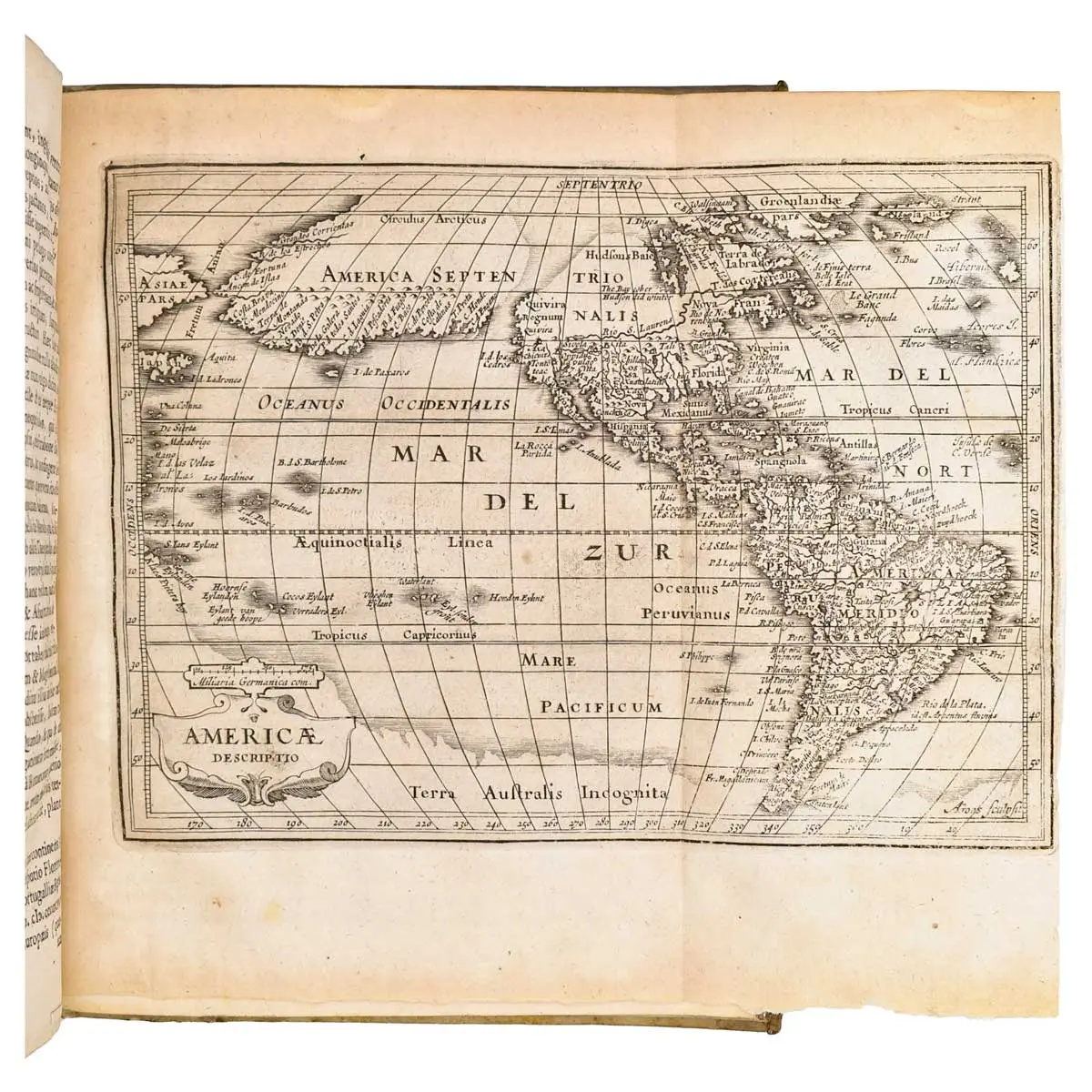
The main text describes all the countries of the world, including a section on the Americas. This work first appeared in 1624 without maps but in this edition there are some great engraved maps including those of Italy, Africa, Russia, China, India and America. Interestingly the map of America shows California attached to the continent, whereas it is shown as an island in later editions. Many of the maps were etched by Petrus Bertius.
A very popular work among contemporaries, 20 editions were published in several languages between 1624 and 1729, including two others in 1661. The Introductionis remained a standard work through the mid-17th century.
[Sabin 13805]