
 Marshall Rare Books
Kreuterbuch. Jetzo auffs fleissigst zum letzten mal von neuwem ersehen, und durchaus an vielen Orthen gebessert, auch weit uber vorige.
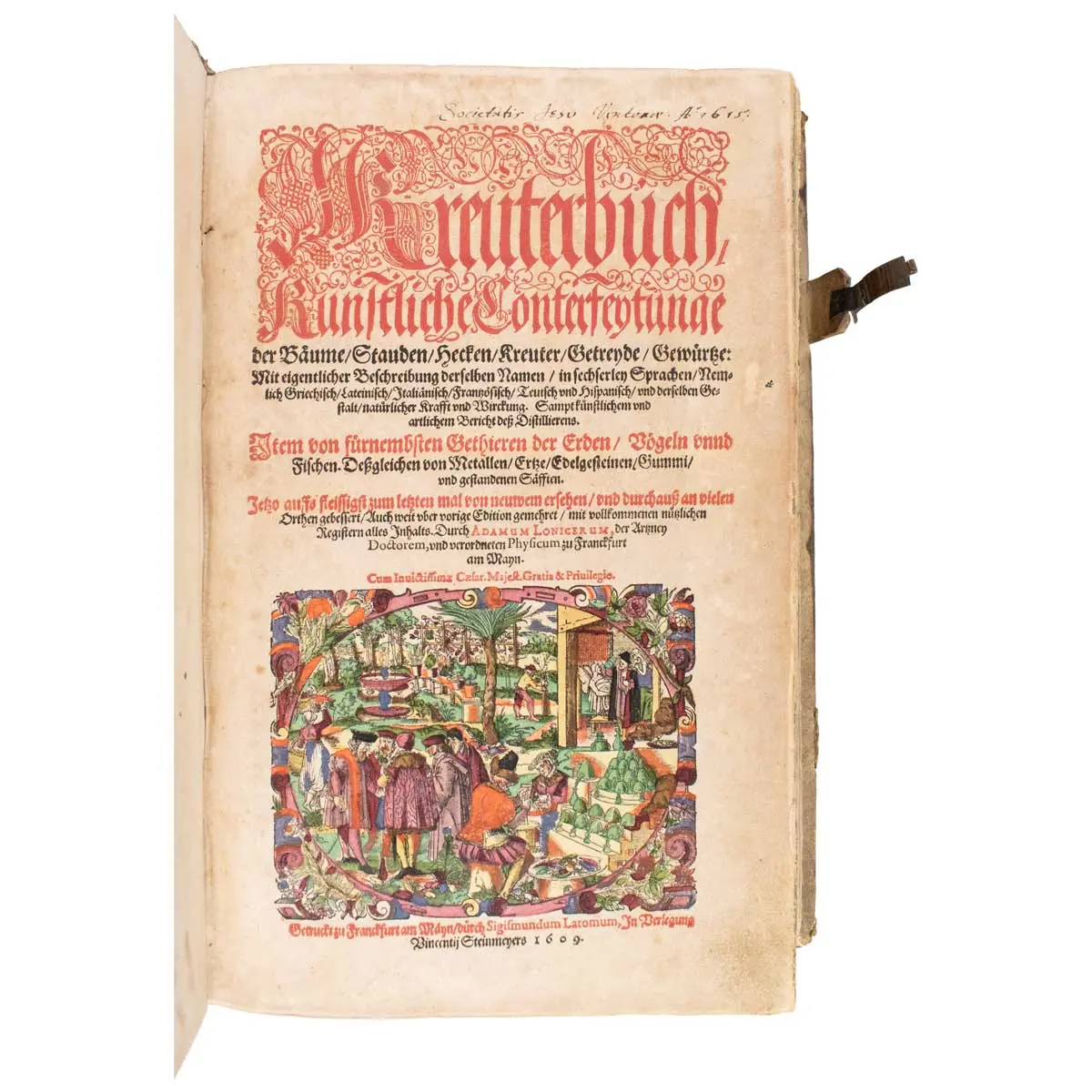
A beautifully contemporary hand-coloured example of Lonicer's popular herbal.
Frankfurt, Latomus for Steinmeyer, 1609. Folio (335 x 210 mm). pp (14), 382, 3. with engraved title, engraved portrait. in the text, with over 800 beautifully hand-coloured woodcuts in a contemporary hand, woodcut printer’s mark at the end, Contemporary blind tooled pigskin over wooden boards, some wear to the binding as usual but intact and a very attractive copy, one clasp missing.
A beautifully contemporary hand-coloured example of Lonicer’s popular herbal. This edition deals not only with trees, shrubs and herbs and the creation of gardens, but also the art of distillation, animals, ores, precious stones and metals. The woodcuts are for the most part copied from designs by Rößlin and Hieronymus Bock, and include mythical creatures such as unicorns, griffins and dragons.
Lonicer brought in his widely distributed herbal books with a rare, clear treatise on the distillation methods of his time. It is clear and very well illustrated in its woodcuts.” – this edition with new engravings by Weiditz including the gardener, the herb kitchen.
Herbals which contained the names and descriptions of herbs and plants, together with information on their medicinal, culinary, and occasionally even magical, properties were extremely popular amongst the ancient and medieval civilisations of East and West, the advent of movable type, together with the growing appreciation of the utility of the technical woodcut illustration as a pedagogic tool, ensured the production of herbals boomed in the fifteenth and sixteenth centuries. Whilst still retaining the more traditional emphasis upon the pharmaceutical properties of the plant world, the herbals of the Renaissance, with their detailed illustrations, also marked an important step in the science of botany, and the description and classification of the natural world.
Renaissance Germany proved to be an epicentre for the production of these herbals.Formerly professor of mathematics at Marburg, in 1554 Lonicer became the town physician at Frankfurt, and married the daughter of the celebrated Frankfurt printer, Christian Egenolff. Renowned for his crafting of lavishly-illustrated texts, Egenolff had early realised the mass-market potential for attractive herbals, bringing out a well-received volume in the early 1530s. Following his death in 1555, Lonicer assumed control of his father-in-law’s firm, and immediately set about producing his own Herb Book.
First printed in 1557, Lonicer’s Kreuterbuch made generous use of text from various earlier printed German herbals, and actually pirated many of the 800 woodcut images from other volumes. Nevertheless, if somewhat lacking in originality, as a work it proved enduringly popular, with at least 11 revised editions being brought out before the close of the sixteenth century and a new edition being issued in Augsburg as late as 1783.
Title with ownership entry “Societas Jesu Victoriae Ao 1615”.
VD 17 1:680473M. Nissen 1228. Pritzel 5599. – Cf. Heilmann 220