Marshall Rare Books
L'ART DE JUGER DE L'ESPIRIT ET DU CARACTERE DES HOMMES DE DES FEMMES
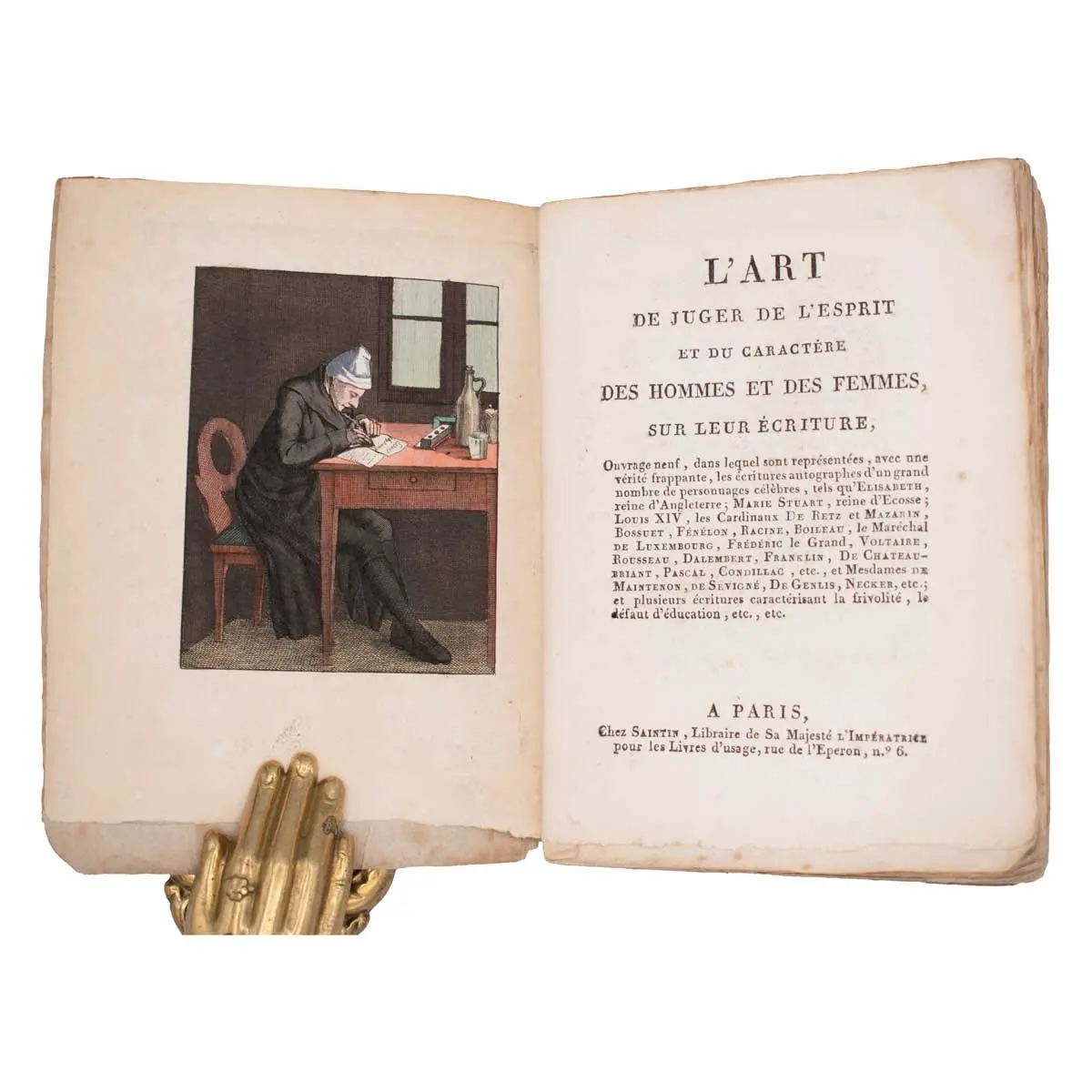
Rare First Edition of this early popular manual on graphology by the printer and bookseller Edouard Hocquart (1789-1870).
FIRST EDITION, [ii], 52pp., 10 bookseller’s catalogue; coloured engraved frontis piece, 24 engraved plates showing 45 facsimiles of handwriting samples, occasional light foxing, pages uncut, near contemporary wrappers, printed paper label to spine, ownership note to inner cover “acheté au havre le vendredi 15 7.bre 1815”, spine cracked, 12mo, Paris, Chez Saintin, c.1812
Rare First Edition of this early popular manual on graphology by the printer and bookseller Edouard Hocquart (1789-1870).
Graphology is the analysis of handwriting in an attempt to determine the writer’s personality traits. Although graphology had some support in the scientific community before the mid-twentieth century, more recent research rejects the validity of graphology as a tool to assess personality and today it is considered a pseudoscience.
However, in the early nineteenth century Hocquart uses it as evidence to support his own prejudices. The author, in his introduction, confines himself only to the observation that the handwriting of the Italians ‘est remarquable par une délicatesse et une souplesse particulières; ne sont-ce pas les traits les plus prononcés du génie de la nation?’; but it is clear that he might consider the less delicate hands of other nations as signifiers of less delicate morals. He also discusses the innate differences between men’s and women’s hands, the latter being allegedly marked by a lack of strength, delicacy, etc.
Among the 43 specimens, many of which are not attributed with any named character, there are examples of someone who shows the traits of lack of education, frivolity, a love of order, and a desire to please without being coquettish. There are also samples taken from manuscripts by Mazarin, Racine, Frederick the Great, Rousseau and Ben Franklin. Nobody’s hand exhibits more the grandeur and noblesse of the age of Louis XIV than that of the King himself; Voltaire’s hand, as with all else he did, indicates firmness but also a lightness of touch, while d’Alembert’s is clearly that of a mathematician, and Lavater’s (a clear influence) that of a phlegmatic melancholic. Also juxtaposed are two contemporaries: Elizabeth I: the hand of this Protestant queen is deemed stiff and ostentatious, in contrast with the supposedly gentle and noble script of Mary Stuart, a Catholic.
The work went through several editions in the following few years, but this first is especially uncommon.
Although undated, we can say with certainty that it was not published before October 1812, when Saintin received his brevet de libraire.
Outside Continental Europe, OCLC records copies at Yale, NYPL, Columbia, the Morgan, Chicago, Birmingham and the National Library of Australia.
[Barbier, Anonymes I: 289.]
Books you may also like

A Defensative Against the Poyson of Supposed Prophecies
A Musician with a Music Box Leading a Noble Couple Perhaps Just Wed with an Ladies Attendant and Following of Nobles. Grand House in Background.
![An Astrologicall Judgement upon His Majesties Present March [with Postscript by William Lilly]](https://marshallrarebooks.com/wp-content/uploads/2025/11/Wharton-3-768x768.webp)
An Astrologicall Judgement upon His Majesties Present March [with Postscript by William Lilly]