
 Marshall Rare Books
Malleus maleficarum ex variis auctoribus concinnatus, & in tres Tomos distinctus: Quorum Postremus, qui Fustis Dæmonum Inscribitur, nunc primum reliquis adiectus est. Tomus Primus - Mallei Maleficarum Ex Plurimis Auctoribus Coadunati; Quorum nomina sequens pagella exhibit, Tomus Secundus: Eadem ura, diligentia & studio, quo primus, locupletatus, auctus & castigatus: et Indice Locupletissimo Donatus. - Fustis Daemonum Adiurationes Formidabiles, et Potentissimas ad Malignos Spiritus Effugandos de oppressis corporibus humanis: Ex sacre Apocalypsis fonte, variisque santorum Patrum auctoritatibus haustas, complectens…
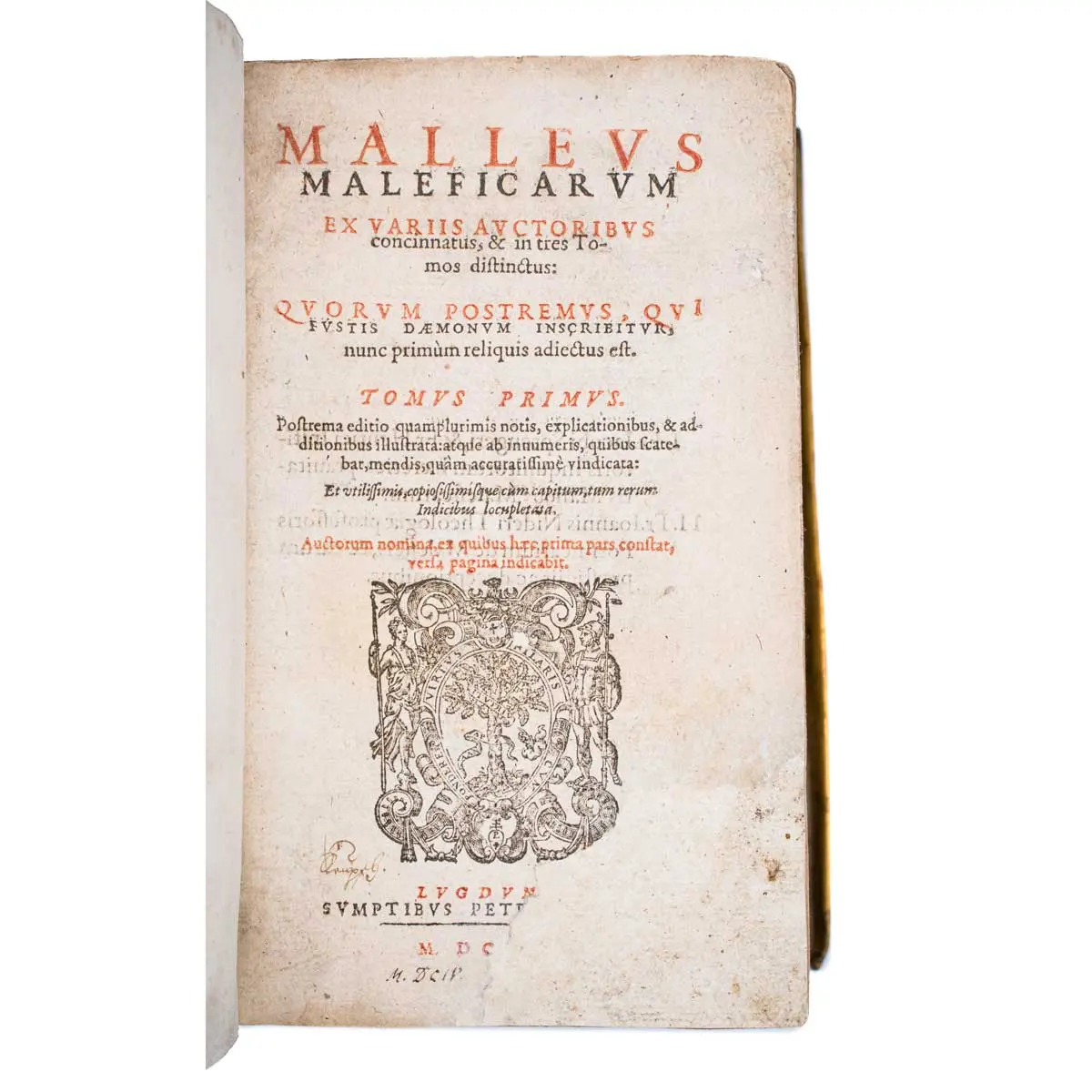
THE MOST INFAMOUS TREATISE ON WITCHCRAFT.
3 parts in one vol., [44], 544; [24], 9-496; [16], 208, part 2 gathering bb repeated, titles in red and black, identical woodcut printers devices, vol 1. title lower corner to title torn with loss, excellently repaired, floriated initials and head pieces, marginal annotations in an old hand, contemporary limp vellum, yapped edges, later endpapers, later leather ties, 8vo, Lyon, Petri Landry, 1604
Malleus Maleficarum, the comprehensive disquisition called “Hammer of the Witches” is regarded as one of the most salient and authoritative works on witchcraft. “It crystallized into a fiercely stringent code previous folklore about black magic with church dogma on heresy, and if any work could have opened the floodgates of the inquisitorial hysteria” this is the most infamous. The Malleus Maleficarum came at a peak point in European witchcraft accusations and executions. It was a foundation for treating witchcraft not as a superstition, but as a dangerous and heretical practice of associating with the Devil — and therefore, a great danger to society and to the church.
The oldest edition is probably the one published in Lyon by Giunta in 1484. No less than 14 editions were published between 1487 and 1520 and at least 16 editions between 1574 and 1669. The text is made up of three parts; the first explaining how to identify witches and where they might dwell; the second how to identify and rectify acts of witchcraft; and the third part covers how to trial and sentence a witch. The influence of this work throughout time is indisputable and is corroborated by the countless quotes of its methods and examples in many other works. The text is often blamed for the worst aspects of the hunts.
The problem of the authorship remains an interesting issue as the current literature is not conclusive and most of the bibliographies refer to Jacob Sprenger (1435-1495) as the main author (Adams, Caillet, Machiels, Wellcome). Nevertheless, recent research indicates that Institoris or Heinrich Krämer (1430-1507) not only wrote this work alone but also used Sprenger’s name to promote it. In spite of the fact both were important theologians, their relationship was characterised by animosity and acrimony and the more powerful Sprenger used every opportunity to thwart Krämer. It is more than likely that beyond lending the work the prestige, Sprenger’s contribution was minimal (Broedel).
Likely written only by Krämer, it is based on his experiences at failed trials in Innsbruck. Helena Scheuberin was an Austrian woman who stood trial accused of witchcraft in 1485. She appears to have disagreed with the doctrine that was being espoused by Dominican inquisitors like Heinrich Krämer. She avoided his sermons and spoke out against him. Despite being quashed by the local bishop, Krämer used some of his experiences to write the Malleus Maleficarum as an attempt to justify this significant loss of reputation.
Although it was not popular where it was originally published, Malleus Maleficarum began to travel. As the work became more removed from the context it began to be taken more seriously. This is partly due to another work it was often bound with. The famous bull of Innocent VIII Summis desiderantes affectibus (1484) authorised a formal inquisition against all witches in German church provinces. The two texts are separate but they travelled together and thus eventually became linked. After time passed it became thought that the Pope commissioned the Malleus Maleficarum. The Summis gave eminence to everything Krämer had written. The veneer of time lent the Malleus Maleficarum a form of respectability that it never had when it was first published. The result was the witch trials were expediated.
The scarce fourth Lyon edition also features Fustis Daemonum Adiurationes Formidabiles added as the third part for the first time, one of the most important and influential works on exorcism by the most authoritative exorcist of Renaissance Italy; the Franciscan, Girolamo Menghi. A theologian and exorcist, he practised in Bologna, and was known as ‘the father of the exorcists’ art’. First published in 1584, Fustis Daemonum (The Daemon’s Bludgeon) followed the widely popular Flagellum Daemonum published eight years earlier.
“The texts consist of both a theoretical treatise and a hands on guide describing actual exorcisms. Fustis Daemonum lists exorcisms that follow a strict formula: after an initial prayer, signs of the cross are made, followed by incantations, a reading from the Gospels, and repeated orations” Joseph P. Laycock, Spirit Possession around the World: Possession, Communion, and Demon.
Menghi was well acquainted with demoniacal literature; the authors he quotes range from Avicenna to Michael Psellus, from Lull to Sprenger. Despite his contemporary fame, his works were placed on the index of forbidden books by the Sant’Uffizio in the eighteenth century. “Girolamo Menghi articulated a philosophy of evil that reflected the social and religious culture of his time.[…] He tried to arrange devils according to their function, spheres of action and bad habits – just as Pseudo-Dionysius the Areopagite had arranged angels in his ‘Celestial Hierarchy’”. Gaetano Paxia.
[Soltész S-766; Introduction to the Malleus Maleficarum, Summers (http://www.sacred-texts.com/pag/mm/mmintro.htm); The Malleus Maleficarum and the Construction of Witchcraft, Broedel, 2003; The Encyclopedia of Witchcraft and Demonology, Robbins, 1964; Caillet Dorbon/Bibliotheca Esoterica; USTC: 6900502]