
 Marshall Rare Books
Mariners workbook and log book
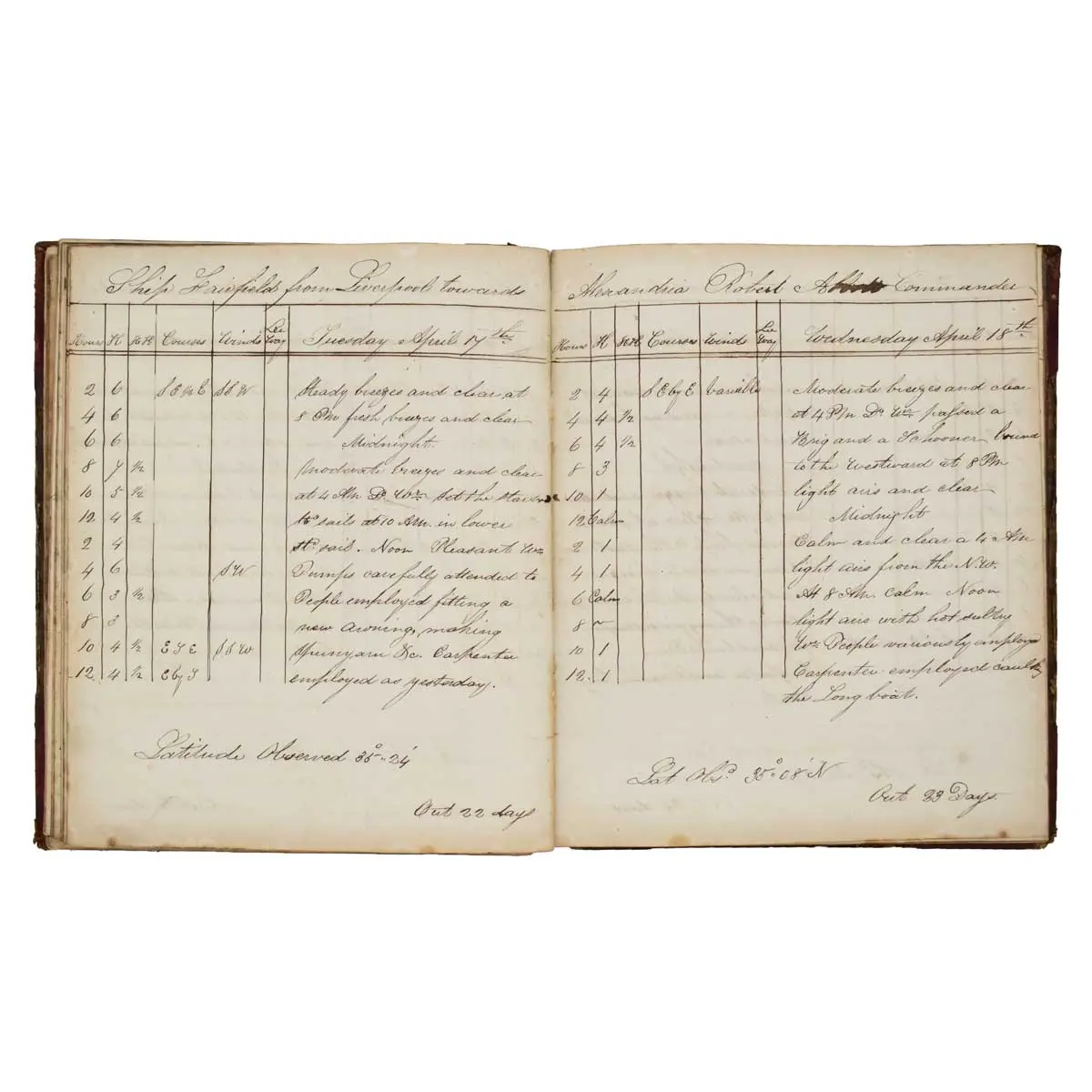
2 vols, manuscript, [156pp.]-[164pp.], square 8vo [170 x 200mm], contemporary half red morocco, marbles boards, rubbed, corners worn, one spine perished, text block firm, 1847-1850 These two log books belonged to a young merchant mariner, Benjamin Phillips. The first logbook contains accounts of four separate voyages of the ship Fairfield, the first voyage Philips joined at Liverpool on the 22nd February 1847. These interesting logbooks act as a diary with personal and sometimes naive comments, along with recording the weather, direction and days of employment.
2 vols, manuscript, [156pp.]-[164pp.], square 8vo [170 x 200mm], contemporary half red morocco, marbles boards, rubbed, corners worn, one spine perished, text block firm, 1847-1850
These two log books belonged to a young merchant mariner, Benjamin Phillips. The first logbook contains accounts of four separate voyages of the ship Fairfield, the first voyage Philips joined at Liverpool on the 22nd February 1847. These interesting logbooks act as a diary with personal and sometimes naive comments, along with recording the weather, direction and days of employment.
The first voyage was from Liverpool to Jamaica to sell fuel and building materials and to buy sugarcane and logwood. They set off on the 22nd of February, after removing a stow away boy in the hold, going via Antigua (29th February) and Cuba (April 5th) arriving in Jamaica on April 8th.
“…we can see fields of sugarcane and coconut trees, along the shore a beautiful sight.”
Phillips had a rough start to this first voyage, writing: “I fell sick about 6 o’clock. (Not much pity) ill for more than a week.”
He also notes the various wildlife he sees on the journey, including porpoises, dolphins and sharks. After nearly two months, the company sails from Jamaica on June 13th, arriving in Brunswick dock on August 7th.
The second voyage of the Fairfeild leaves Liverpool on the 25th of August for Russia. The company stopped off at Norway and Copenhagen to pick up pilots before arriving in Russia on the 14th of September. On the return journey they passed Finland and Norway, stopping at Copenhagen to return the pilot and sail around Ireland before returning to England on the 15th of January, 1848.
The third voyage begins on Saturday 18th of March, leaving from Liverpool to Montego Bay, Jamaica, to trade in sugar and rum. Although Phillips’ writing has become more observation based, he still makes diary-like entries. May 6th”I took some medicine. Went to Chapel this evening.”
Phillips takes particular issue with the actions of the boatswain, mentioning him in several entries, including comments such as “the boatswain went ashore without leave”, “the boatswain went ashore without liberty”.
The Fairfield left Jamaica on the 16th of July, passing St Vincent, the gulf of Mexico and Newfoundland, returning to Brunswick Dock on September 4th.
The fourth and final voyage is from Corburg Pier to Alexandria, leaving on the 1st of February 1849. This logbook is written more professionally within a standard table layout. Three days after leaving Coburg the Fairfield arrives in London, where coal is discharged and over a month is spent refurbishing the ship, including replacing the deck. The refitted ship leaves London on March 24th, 1849, arriving in Alexandria on April 26th. On the 28th of June the Fairfield departed Alexandria to return to Liverpool, the log ending on September 7th 1849.
The second is a workbook full of notes and exercises important for a sailor to know. These include mathematical equations to figure out price conversions and wages, find latitude, navigational tools such as Mercator’s equation as well as knowledge of astronomy. The latter half is a logbook of the Barque Nafian Belle on its return voyage from Liverpool to Alexandria, starting on 1st February 1850 and reaching Alexandria on the 17th March. After two days in Alexandria, the barque made its way back to Liverpool, arriving home on the 5th of July.
A good overview of the life of a merchant sailor, the hardships and the excitement of voyaging across the world.