
 Marshall Rare Books
Museum Richterianum continens fossilis animalia vegeabilia mar. Accedit de gemmis scalptis antiquis.
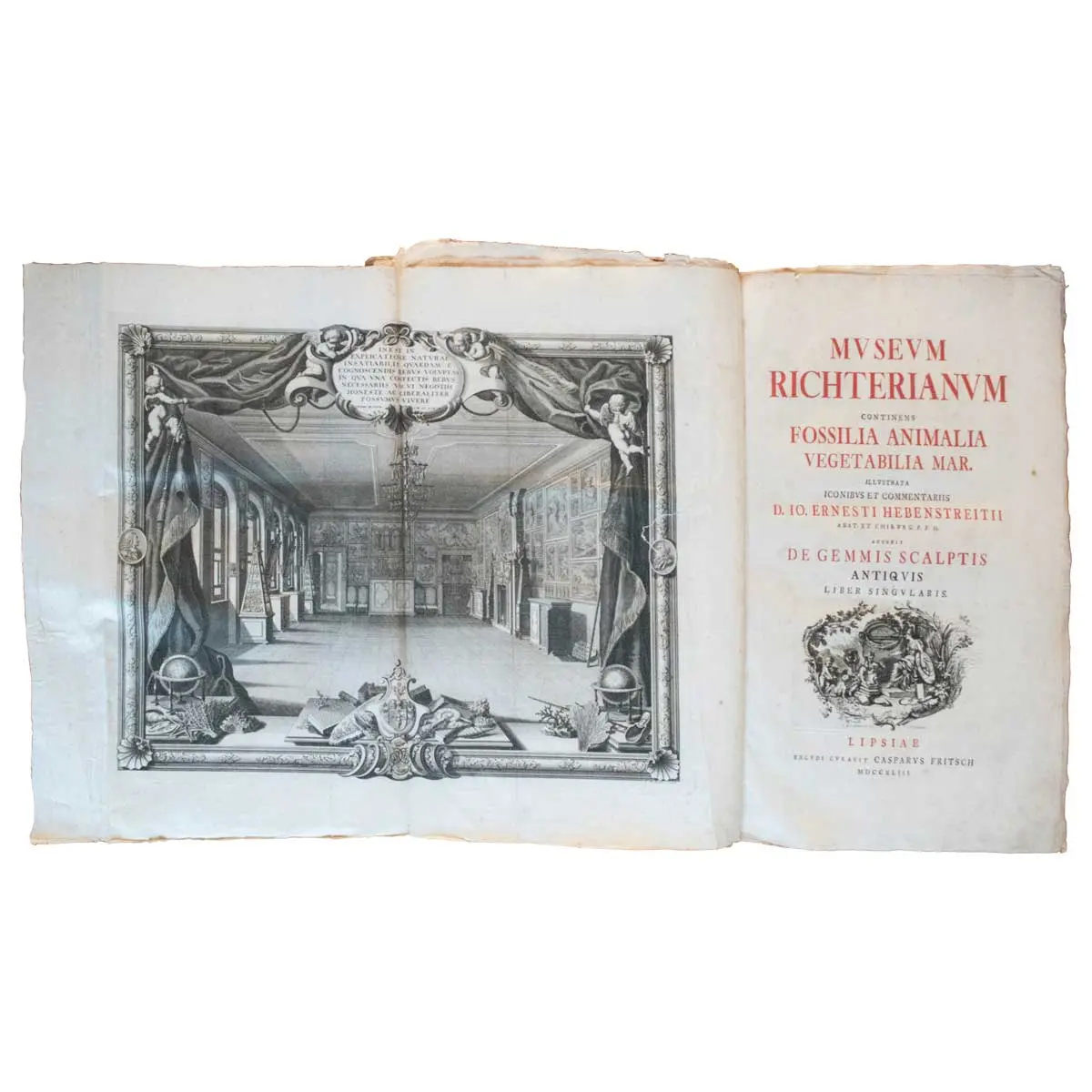
EXTENSIVE CATALOGUE OF RICHTER’S ‘CABINET OF CURIOSITIES’
[56],384pp. ([18], 34), half title, folding engraved frontispiece of view of the interior of the museum, title in red and black, copper engraved printers device, copper engraved portrait of Richter by M.Bernigeroth after A. de Manjocxy, 17 copper engraved plates, wood cut initials and head and tail-pieces, copper engraved text illustrations, pages uncut and somewhat unopened, contemporary marbled boards, spine repaired with later marbled paper, folio, Leipzig, Casper Fritsch, 1743.
This work is a comprehensive catalogue of Johann Christoph Richter’s Wunderkammer, containing fossils, plants and marine animals. There is a final chapter on antique cameos and carved gemstones by J.F. Christio.
Johann Ernst Hebenstreit was born into a poor family in Neustadt, Germany in 1702. As a youth he developed an interest in natural science and mineralogy. He studied at the university in Jena, Germany, then entered the University of Leipzig in 1723, eventually becoming a Professor of Medicine there in 1730. Hebenstreit published a treatise on minerals of pharmacological value that same year, and also published on such natural history subjects as fish, insects, plants and anatomy. On the strength of these publications he was invited by Johann Christoph Richter (1689-1751), a wealthy banker and member of the legislature in Leipzig, to help curate Richter’s mineral collection and prepare a book describing it. Thus in 1742, Hebenstreit’s Museum Richterianum appeared, with a thorough and well-organised text illustrated by hand-coloured engravings of 114 mineral specimens from Richter’s collection.
The museum, established in the early nineteenth century by the German naturalist Karl Richter, held one of the largest and most diverse collections of its kind in Europe.
[Wellcome III 230, Nissen ZBI, 1869, Eales, Cole Library. 1473. ]